Reading & Literacy

Reading Books Is Found To Ward Off ‘Summer Slump’

By Debra Viadero — May 05, 2004 2 min read
  • Save to favorites
  • Print

Having elementary school pupils read four or five books during the summer can prevent the reading-achievement losses that normally occur over those months, a study suggests.

Published last month in the Journal of Education for Students Placed at Risk, the findings are based on surveys and test data on 1,600 students in 18 elementary schools in an unnamed suburban district in the Middle Atlantic region.

Regardless of race, socioeconomic level, or previous achievement, researcher Jimmy S. Kim found, children who read more books fared better on reading-comprehension tests in the fall than their peers who had read one or no books over the summer.

Though the differences between the heaviest readers—those who had read at least four or five books—and those who had barely read at all were small, he said, they were about the same size as the average summer reading loss documented in other studies on the “summer slump.”

“From a policy perspective, this study shows that maybe we need to spend more money to get books into kids’ hands,” said Mr. Kim, who was a research associate for the American Academy of Arts and Sciences, in Cambridge, Mass., when he undertook the study. He is now a K-12 research associate for the Civil Rights Project at Harvard University.

“From a school perspective,” he added, “maybe we need to think about having all kids read and do a simple writing activity based on their books over the summer.”

Encouraging Reading

Studies since the 1970s have pointed to reading as one way to stem summer learning losses and bridge the achievement gaps that widen over that time between many poor and minority students and their better-off, white, and Asian-American counterparts.

Less research exists on how best to encourage students to read over the summer. Some districts have started incentive programs. Others publish required reading lists, and some educators even mail packets of books to students.

The district Mr. Kim studied required rising 6th graders to read at least one book over the summer and write a story or report about it. Several schools within the district asked parents to verify that their children had read a book.

Mr. Kim found both strategies increased the likelihood that students would read more. Only about half the children in every racial and ethnic group, however, said they had met those requirements.

Any strategy to promote summer reading is unlikely to close achievement gaps by itself, said Barbara Heyns, a New York University sociologist who has studied the summer slump. “If you have a diverse group of kids, and only the middle-class kids read, then it’s going to help the middle-class kids even more,” she said.

Both she and Mr. Kim cautioned that the new findings showed only that reading was associated with better achievement, not that it caused the differences in reading scores.

Related Tags:

Events

This content is provided by our sponsor. It is not written by and does not necessarily reflect the views of Education Week's editorial staff.
Sponsor
Assessment Webinar
Measuring What Matters: How District Leaders Are Redefining Student Assessment
In this panel discussion, district leaders and systems experts will examine the gap between the outcomes we want and the systems in place.
Content provided by Otus
Early Childhood Webinar Selling Into Early Learning: New Survey Data and Strategies for Marketers
Selling into PreK? Get fresh EdWeek Research Center data and strategies to position your products and reach the right early learning buyers.
Artificial Intelligence Webinar AI and 'Techlash' Are on a Collision Course. How Should Schools Respond?
Learn what strategies and tactics schools can develop to encourage smart and responsible AI use, while also enforcing tech guardrails.

EdWeek Top School Jobs

Teacher Jobs
Search over ten thousand teaching jobs nationwide — elementary, middle, high school and more.
View Jobs
Principal Jobs
Find hundreds of jobs for principals, assistant principals, and other school leadership roles.
View Jobs
Administrator Jobs
Over a thousand district-level jobs: superintendents, directors, more.
View Jobs
Support Staff Jobs
Search thousands of jobs, from paraprofessionals to counselors and more.
View Jobs

Read Next

Reading & Literacy Q&A Why This Under-the-Radar Piece of Literacy Reform Is One of the Most Important
Parent notification is a central piece of reading reform, this advocate says.
5 min read
Collage of a Black female reading a book with her young daughter on her lap. Other pieces of the collage show an open book with non-legible text, speech bubbles, the letter "A" and a butterfly.
Collage by Gina Tomko/Education Week + Canva
Reading & Literacy 'Long Form' vs. 'Short' Reading: What's Going on Inside A Student's Brain?
Reading a novel and reading short text messages work the brain differently. Here's what that means.
3 min read
Pieces of a book page and a cellphone.
Collage by Laura Baker/Education Week + Getty
Reading & Literacy Creating a Culture of Reading for Pleasure Amid a Focus on Basics
School librarians at Missouri's Clayton school district bring a culture of reading to all students.
9 min read
Tom Bober
Students read books in the library at Captain Elementary School in Clayton, Mo., on Tuesday, Sept. 29, 2026. School Librarian Tom Bober works with teachers at the school to help instill a culture of reading early in students' lives.
Neeta Satam for Education Week
Reading & Literacy Getting Middle Schoolers to Do the Reading Is Hard. Can Communal Reading Help?
New classroom methods aim to help kids internalize the message that engaging in print is worth it.
11 min read
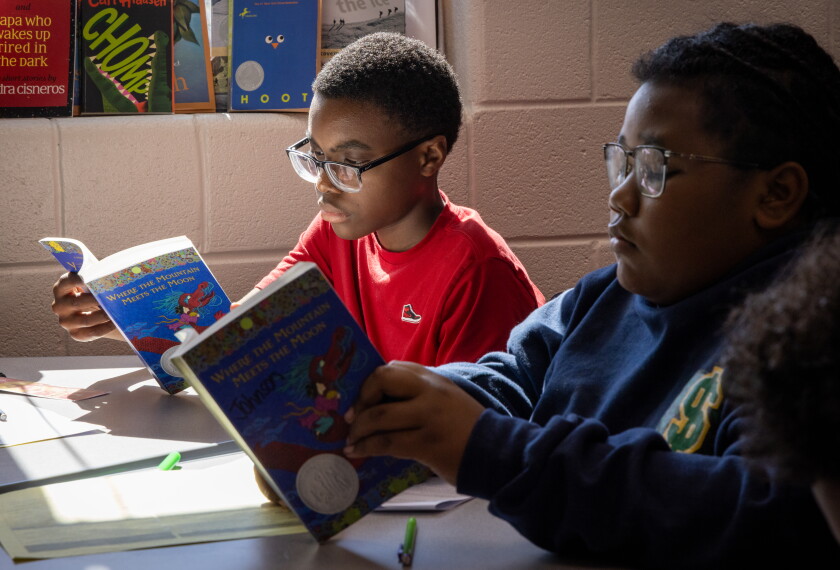
Students read Where the Mountain Meets the Moon in Jaime Johnson’s 6th grade language arts class at Murphy Middle School in Dacula, Georgia on September 22, 2026.
Students read <i>Where the Mountain Meets the Moon</i> in teacher Jaime Johnson’s 6th grade language arts class at Murphy Middle School in Dacula, Georgia on September 22, 2026. Johnson has students do most of the reading in class—to improve fluency, created a shared culture of engagement in books, and above all make sure every student completes the text.
Dustin Chambers for Education Week