If scholars want policymakers to take their scholarship seriously, they should be concerned with the academy’s lack of political diversity. Both research and political support for higher education are undermined when an overwhelming majority of the social sciences and humanities professors are on one side of the political aisle. That makes the cost for the academy and society too high.
Political homogeneity undermines scholarship both by limiting the questions that we ask and restricting our ability to eliminate error. Political biases inevitably shape what we find important. When vast swaths of researchers share the same biases, important questions go unasked. And even when researchers in the political minority find them important, they often refrain from asking them, fearing political reprisals by their colleagues. When interviewed for my book on conservative professors, one sociologist reported, “To say a strong conservative political opinion with conviction in an academic gathering is analogous to uttering an obscenity.”
Explore the geographic distribution of 2017 RHSU Edu-Scholars concentrations and the political composition of their universities’ faculty.
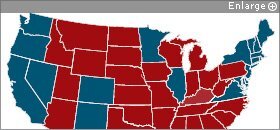
Source: Mitchell Langbert, Anthony J. Quain, and Daniel B. Klein (Econ Journal Watch, 2016); Associated Press
Researchers also don’t want to appear out of step with disciplinary norms: Rather than fear political discrimination, they simply want to check the right boxes necessary for professional advancement in their field.
All of us are also affected by the unrelenting force of confirmation bias—our tendency to uncritically accept findings that fit our assumptions. When political minorities are scarce, weaknesses in arguments supporting favored orthodoxies are less likely to be challenged. And supporters of those orthodoxies can promote an atmosphere of intolerance toward those with heterodox opinions. When that happens, beliefs ossify into dead, academic dogma. Indeed, the constitutional justification for affirmative action announced by U.S. Supreme Court Justice Lewis F. Powell Jr. in Regents of the University of California v. Bakke addressed this concern in 1978: The search for truth requires a “multitude of tongues,” he wrote. If universities truly believe in diversity, they should support a range of political opinions on campus.
For more in this package, please visit:
For publicly engaged scholars, the political narrowness of the academy compounds these problems. When asked to weigh in on political and policy debates, it is tempting to abuse our authority by speaking with certainty on questions that are, in fact, much in dispute. Just think of all the political scientists, including me, who thought Donald Trump would never win the Republican presidential nomination, much less the presidential election. When scholars primarily advocate for progressive positions, they risk being seen as ideologues masquerading as scholars.
This table lists the top 10 junior scholars who have not yet received tenure, according to the 2017 RHSU Edu-Scholar Public Influence Rankings.

This points to the political danger that a monoculture creates for the university. Publicly accountable policymakers are less likely to support the university when it is perceived as implacably hostile to roughly half the electorate. State institutions are particularly vulnerable to political backlash—just ask the faculty at the University of Wisconsin.
Politicians don’t even have to level divisive charges of liberal bias against the hardest and farthest of the left-leaning scholars—those in the social sciences and humanities. They just have to charge these fields with being “impractical” or a “poor investment.”
While homogeneity risks political attacks on the academy, it also imposes costs on policymakers and, therefore, the public. Not only do scholars ignore research questions that could inform and improve public policy out of political fear, but policymakers also sometimes dismiss academic research because they view the academy as completely politically compromised.
Linda Darling-Hammond, Diane Ravitch, and Gloria Ladson-Billings took the top three spots in the 2017 RHSU Edu-Scholar Public Influence Rankings. Click on the chart below to learn who took the other two spots. (The affiliations cited are drawn from the scholars’ CVs.)

Unfortunately, there is no straightforward or single solution. The most obvious one—instituting affirmative action for conservative scholars—would not work, since conservatives themselves find the idea offensive.
But at a minimum, universities should stop censoring and disinviting conservative speakers. What could indicate epistemic closure more than excluding conservative opinions from your campus?
Faculty members should consider supporting organizations like the Heterodox Academy, to which I belong. We are a group of professors from across the political spectrum who came together in 2015 to enhance viewpoint diversity on campus. The hope is that a willingness to create a politically tolerant and inclusive academic environment should help attract a more diverse faculty. If that happens, the university can better achieve one of its most important functions: showing that sharp but civil disagreement is possible—and necessary—even in an increasingly polarized society.


