
Federal

Data: Which Ed. Dept. Offices Lost the Most Workers?

By Brooke Schultz — March 13, 2025 3 min read
Chloe Kienzle of Arlington, Va., holds a sign as she stands outside the headquarters of the U.S. Department of Education, which were ordered closed for the day for what officials described as security reasons amid large-scale layoffs, Wednesday, March 12, 2025, in Washington.
  • Save to favorites
  • Print

The mass layoffs that touched virtually every division of the U.S. Department of Education cut deeper into some offices than others, particularly affecting the agency’s civil rights investigation and research arms, according to an Education Week analysis of documents detailing the cuts.

The firings, which the department announced on Tuesday, will shrink the already diminished federal agency’s footprint by nearly half as a “first step” toward abolishing it, should Congress approve such an effort, Education Secretary Linda McMahon said in a Fox News interview Tuesday night. President Donald Trump is also considering an executive order that would direct McMahon to prepare for the agency’s closure.

Already, the layoffs have drawn a lawsuit filed Thursday by 21 Democratic attorneys general arguing that the reductions imperil the agency’s ability to fulfill its congressional mandates.
See Also

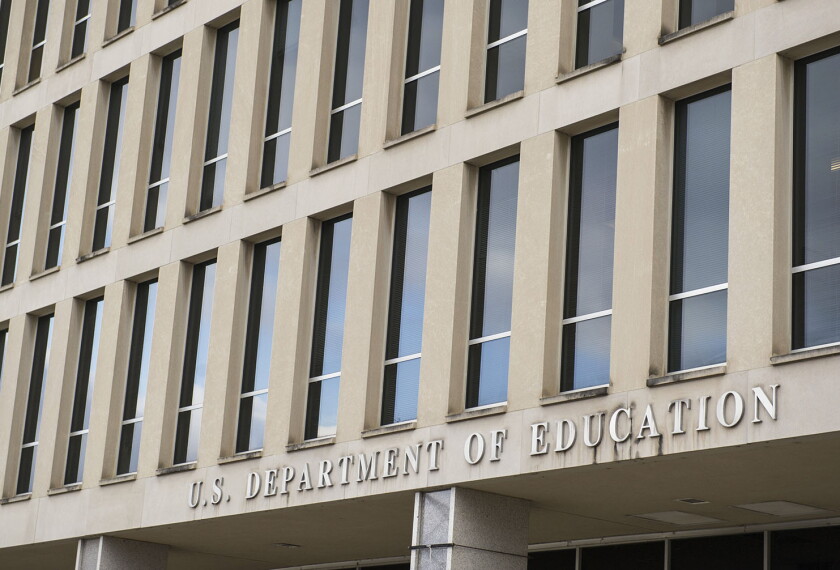
The exterior of the Department of Education Building in Washington, DC on Thursday, December 14, 2017.
The exterior of the Department of Education building in Washington on Thursday, December 14, 2017. The department's Washington office and regional offices will be closed on Wednesday for "security reasons," according to an email sent to staff members.
Swikar Patel/Education Week

A department spokesperson said the layoffs “are strategic, internal-facing cuts that will not directly impact students and families.”

The Education Department had 4,133 employees on Jan. 20, when Trump was inaugurated, according to the agency. After the reductions in force—a combination of layoffs and the loss of employees who accepted buyout offers—the department will have 2,183 staff members, a 47 percent reduction.

The chart below shows the number of union-represented positions cut from each office in Tuesday’s announced reduction in force and the 2023 full-time equivalent headcount for each office.

The cuts shown in the chart don’t represent all the positions the Education Department has lost. The numbers don’t include non-union-represented employees who were let go. They don’t include probationary employees dismissed weeks ago or employees who accepted deferred resignation, early retirement, or buyouts, either.

The 2023 headcount is the most recent available data from budget documents. These numbers could vary from the employee headcount as it existed immediately before the reduction in force.

Two of the department’s larger divisions that saw some of the most significant cuts were the office for civil rights, which investigates discrimination claims at the nation’s schools and colleges, and the Institute of Education Sciences, which oversees the National Assessment of Educational Progress (NAEP) and statistics-gathering and dissemination through the National Center for Education Statistics.

The office for civil rights, the second-largest division in the department, will lose more than 40 percent of its staff by the end of this month.

The office, which investigates discrimination claims at the nation’s schools and colleges, had 562 staffers doing that work in 2023. At least 243 of its employees will no longer have jobs.

The department also shuttered regional offices in cities that include Boston, Chicago, Cleveland, New York City, Philadelphia, and San Francisco. Regional offices allow attorneys to do on-site investigations, rather than parachuting in from Washington, an OCR staffer said.

Those cuts come as the department ramps up its enforcement efforts to follow a barrage of Trump directives, which have threatened to pull funding from schools that allow transgender athletes to play on girls’ and women’s teams, have race-based programming, or require COVID-19 vaccinations.

Meanwhile, the Institute of Education Sciences will lose at least 62 percent of its staff, going from 167 employees in 2023 to 62 at most. A source familiar with IES cuts said the dismissals essentially hollow out the National Center for Education Statistics, one of four centers within IES and the one that handles key data collections and the number-crunching behind the NAEP.

The department’s largest division, the Federal Student Aid office, will see at least 23 percent of its staff cut. It had 1,371 full-time equivalent employees in 2023.

The office of elementary and secondary education—the primary office supporting K-12 districts—is losing at least 17 percent of its staff, which numbered 282 in 2023.

The career, technical, and adult education office will see at least nine employees lose their jobs from a staff of 67 in 2023.

The office that oversees state compliance with the Individuals with Disabilities Education Act, the office of special education and rehabilitative services, will lose a smaller portion of its staff—at least 16 from a staff of 185 in 2023.

And the office of English language acquisition, which helps states and schools better serve English learners, will see at least 75 percent of its staff depart: 12 employees were laid off. The office’s 2023 headcount was 16.

“As much as we were all expecting it, it still hurts,” a department employee said by text the night agency employees were told they were losing their jobs.

See Also

Chloe Kienzle of Arlington, Va., holds a sign as she stands outside the headquarters of the U.S. Department of Eduction, which were ordered closed for the day for what officials described as security reasons amid large-scale layoffs, Wednesday, March 12, 2025, in Washington.
Chloe Kienzle of Arlington, Va., holds a sign as she stands outside the headquarters of the U.S. Department of Education on Wednesday, March 12, 2025, in Washington. The department this week said it was cutting nearly half its staff.
Mark Schiefelbein/AP

Events

This content is provided by our sponsor. It is not written by and does not necessarily reflect the views of Education Week's editorial staff.
Sponsor
Recruitment & Retention Webinar
Hiring, Retention, and Fill Rates: A Data-Driven Sub Strategy
Explore what keeps substitutes coming back and hear how one district rebuilt its substitute hiring process and improved its fill rate.
Content provided by Frontline Education
Early Childhood K-12 Essentials Forum Early Childhood Education: Building Essential Skills for Success
Join this free virtual event to examine the biggest challenges in supporting young children, from preschool through elementary school. 
This content is provided by our sponsor. It is not written by and does not necessarily reflect the views of Education Week's editorial staff.
Sponsor
Student Absenteeism Webinar
Attendance Isn't an Attendance Problem
Boost attendance by strengthening relationships, belonging, and support with practical strategies from Doug Fisher & Nancy Frey.
Content provided by Corwin

EdWeek Top School Jobs

Teacher Jobs
Search over ten thousand teaching jobs nationwide — elementary, middle, high school and more.
View Jobs
Principal Jobs
Find hundreds of jobs for principals, assistant principals, and other school leadership roles.
View Jobs
Administrator Jobs
Over a thousand district-level jobs: superintendents, directors, more.
View Jobs
Support Staff Jobs
Search thousands of jobs, from paraprofessionals to counselors and more.
View Jobs

Read Next

Federal Ed. Dept. Would Have More Power to Cut Off Grants Under New Rules
The agency last year ended in-progress grants worth more than $2 billion, with courts often objecting.
5 min read
Jeanette Vyhanek, a counselor at Wellstone Elementary, teaches a class of kindergarten students at the St. Paul school on Oct. 31, 2025 in Minnesota.
Jeanette Vyhanek, a counselor at Wellstone Elementary in St. Paul, Minn., teaches a class of kindergarten students on Oct. 31, 2025. Federal grants to expand the ranks of school counselors and other school mental health services were among hundreds terminated by the Trump administration in 2025. New rules from the U.S. Department of Education would give the federal agency greater latitude to end in-progress grants.
Alex Kormann/The Minnesota Star Tribune via TNS
Federal Q&A Education Data Collection Has Cratered Under Trump. Can It Be Rebuilt?
Ed. Dept.'s data-gathering agency is too unstable to adapt to changing needs, a new report claims.
6 min read
A student raises her hand to ask a question in her third grade classroom at Highland Elementary School in Columbus, Kan., on Oct. 17, 2022. The arm of the government that oversees education data which tracks educational outcomes for students, faces major challenges ahead due to financial cuts.
A student raises her hand to ask a question in her 3rd grade classroom at Highland Elementary School in Columbus, Kan., on Oct. 17, 2022. Federal education data-gathering, like the Condition of Education report, includes baseline information on students and schools. But cuts to the Education Department's statistics wings and mounting criticism of how it operates raise questions about how it can best fulfill its mission.
Charlie Riedel/AP
Federal Education Department Tells Schools Race Can’t Factor Into Student Discipline
A letter to educators follows up on last month's rescission of longstanding discrimination rules.
5 min read
Assistant Secretary for Civil Rights for the Department of Education nominee Kimberly Richey testifies before the Health, Education, Labor and Pensions committee about her nomination in Washington, D.C., on June 5, 2025.
Assistant Secretary for Civil Rights Kimberley Richey testifies before the Senate's Health, Education, Labor and Pensions committee at her nomination hearing in Washington on June 5, 2025. A new letter to educators from Richey instructs schools not to consider race at all in school discipline policies, following the Trump administration's rescission of longtime anti-discrimination rules.
Jason Andrew for Education Week
Federal Q&A What Head Start's English-Only Rule Could Mean for English Learners
Research shows it's not necessary to lose a home language to learn English.
3 min read
Long Beach, CA - March 20 : Teacher Monica Alvarado, left, leads activities with staff in the infant class at Educare Los Angeles at Long Beach , a very high-quality child care center in Long Beach on Wednesday, March 20, 2024 in Long Beach, CA.
Teacher Monica Alvarado, left, leads activities with staff in the infant class at Educare Los Angeles at Long Beach, a very high-quality child care center in Long Beach on Wednesday, March 20, 2024 in Long Beach, Calif. Head Start programs for early childhood education will no longer promote bilingualism under a proposed rule change.
Brian van der Brug / Los Angeles Times via TNS
