
The key House subcommittee studying the reauthorization of the No Child Left Behind Act held its first field hearing here last week in what is normally a federal courtroom.
The setting was perhaps fitting for a federal education law that, in the minds of many Americans, is still on trial. But while there is no shortage of critics of the Bush administration’s signature K-12 education achievement, they were apparently not invited to this particular hearing on Aug. 28.
Read the related story,
“The No Child Left Behind Act is a critical piece of education legislation that is helping to close the achievement gap between disadvantaged students and their more affluent peers,” Rep. Judy Biggert, R-Ill., a former school board member in suburban DuPage County, said in opening the hearing.
She was joined by two Democrats on the House Education and the Workforce Committee and its subcommittee that deals with education reform: Rep. Danny K. Davis, whose Illinois district covers parts of Chicago and its close-in suburbs, and Rep. Robert C. Scott of Virginia.
No Hurry
“We’re not in a rush to try to slap something together,” Rep. Scott said at the hearing, referring to the looming renewal of the No Child Left Behind law. “Hearings such as this one mean that when we do it, we’ll do it in a thoughtful fashion.”
Rep. Davis expressed concerns about how the law is playing out in his congressional district, and after the hearing said, “It is too punitive.”
The 4½-year-old law requires, among other mandates, testing of all public school students in grades 3-8 in reading and mathematics, with an array of sanctions against schools and districts that do not meet annual achievement targets.
The House Education Reform Subcommittee this year began a series of hearings focused on the reauthorization, which is scheduled for next year but is not guaranteed of receiving timely action in Congress.
Looming over the process, meanwhile, is the question of whether Republicans will lose control of either or both chambers of Congress in the November midterm elections. The No Child Left Behind law passed with strong bipartisan support in 2001, but Democrats have since accused Republicans of providing inadequate funding to carry out its mandates.
Maximum Flexibility
The hearing last week was held at the Everett McKinley Dirksen Federal Building, a 30-story structure designed by Ludwig Mies van der Rohe that broke the mold for how a federal courthouse should look when it was completed in 1964.
In the ceremonial courtroom of the city’s federal district court, where the hearing was held, portraits of some 65 federal judges hung on the walls, including that of the late Judge Julius J. Hoffman, who presided over the turbulent trial of the Chicago Seven defendants, including the activist Abbie Hoffman, charged with inciting riots at the Democratic National Convention here in 1968.
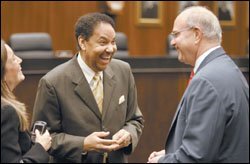
The most-anticipated witness at last week’s very civil hearing was Arne Duncan, the chief executive officer of the 426,000-student Chicago school system, who has been widely credited with boosting student test scores in the five years he has been at the helm of the district as Mayor Richard M. Daley’s handpicked leader.
Last year, Mr. Duncan had been at sharp odds with the U.S. Department of Education over whether the Chicago district could provide tutoring to eligible students under the federal law, even though the district had failed to meet state academic goals. The conflict was defused a year ago, when Secretary of Education Margaret Spellings traveled to the Windy City to grant the school system a waiver that would allow it to provide the supplemental education services on its own.
Mr. Duncan said at the hearing that the federal decision was an example of the flexibility that was allowing the No Child Left Behind law to work successfully.
“We are often trying to challenge the status quo and do things a little differently,” he said. “Our tutoring program is competitive with those in the private sector.”
In his lengthier written testimony, Mr. Duncan called on Congress to “maintain NCLB’s framework of high expectations and accountability,” but to amend the law “to give schools, districts, and states the maximum amount of flexibility possible.”
He also called for more funding for the law and for Congress to find a way to aid schools’ capital-construction needs.
Darlene Ruscitti, the superintendent of the DuPage County regional office of education, which helps oversee numerous school districts in the suburban county serving 164,000 students, told the subcommittee that while some in her area wish the No Child Left Behind law would go away, the federal statute has motivated educators to rise “to the next level.”
“NCLB has required us to look at all schools,” Ms. Ruscitti said. “That has been extremely powerful.”
The law requires states and districts to track and achieve adequate yearly progress not just for schools’ overall student populations, but also for subgroups of students based on race and ethnicity and for those in special education and still learning English.
Rep. Scott, the Virginia congressman, asked at one point whether “anyone wants to suggest that we want to stop gathering disaggregated data? That is, data on subgroups.”
No one appeared to want to suggest that, at least not a witness panel that also included Henry L. Johnson, the Education Department’s assistant secretary for elementary and secondary education; Paul Kimmelman, a senior adviser at Learning Point Associates, a Naperville, Ill.-based nonprofit education organization; and Dianne M. Piche, the executive director of the Citizens’ Commission on Civil Rights, a Washington-based group that is supportive of the No Child Left Behind law but has called for stronger enforcement of its provisions.
National Standards?
Rep. Scott also ventured into the delicate question of whether the federal government should play any part in establishing more-rigorous academic-content standards, a role that has been left primarily to the states and to subject-area organizations.
Read the related story,
State standards generally have tended to be “home baked,” Rep. Scott said.
Assistant Secretary Johnson said that, speaking as a federal official, “Congress has been pretty clear it does not want the Department of Education to establish national standards.”
But Mr. Johnson added that in his previous job as Mississippi’s state schools superintendent, he would probably have welcomed the help “if someone had come to me and said, ‘We can help establish more-rigorous standards.’ ”
With more hearings and discussions about the reauthorization of the No Child Left Behind Act to come in the year ahead, Rep. Biggert expressed a concern that the mere debate over changing the law might lead educators to think it was temporary.
Mr. Kimmelman, whose organization has a federal contract to run the National Comprehensive Center for Teacher Quality, said: “I don’t think it would be in the best interest of Congress to decimate the overall law.”
Any such radical overhaul, he added, “would demonstrate the ‘this too shall pass’ syndrome in schools.”


