Special Report
Federal

Losing Global Ground

By Lynn Olson — December 29, 2006 1 min read
  • Save to favorites
  • Print

For decades, a highly qualified workforce has helped fuel economic prosperity in the United States. But now other countries are catching up with and even surpassing America’s performance.

On a variety of measures, “the U.S. has been joined by a number of other countries,” says Alan P. Wagner, a professor of educational administration at the State University of New York at Albany, “and particularly in the younger age groups, there is evidence of higher levels of performance elsewhere.”

For example:

  • Although the achievement gap opens before children even reach school, U.S. support for early-childhood education lags well behind that of other developed nations.
  • While U.S. children in elementary school perform relatively well on international tests of achievement, particularly in reading, American 15-year-olds perform in the middle of the pack on tests of science and mathematics, with one-quarter performing at the lowest achievement levels.
  • At a time when a high school diploma is typically the minimum requirement for a decent job, the United States has slipped to 11th among 30 Organization for Economic Cooperation and Development countries in the proportion of 25- to 34-year-olds with that credential.

Data Download
International Perspective IndicatorsPDFExcel

  • Long a leader in higher education, the United States has dropped to seventh in the proportion of 25- to 34-year-olds with a college degree.

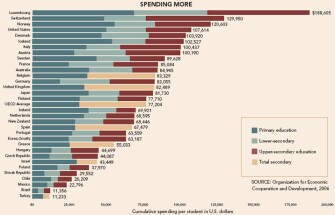
“These results cannot simply be tied to money,” says Barbara Ischinger, who heads the education directorate for the OECD. “ Only Luxembourg, Switzerland, and Norway spend more per student in the primary through secondary grades than the United States does, according to OECD data.

Accompanying Charts

  • Mathematically Lagging On international tests of performance, 15-year-olds in the United States, on average, trail behind their peers in many other developed nations. Out of the 30 countries taking part in the 2003 Program for International Student Assessment, or PISA, the average mathematics achievement of U.S. students was higher than that of students in only five countries.
BRIC ARCHIVE

  • Spending More Spending levels in the United States are some of the highest among those countries belonging to the Organization for Economic Cooperation and Development. Only Luxembourg, Switzerland, and Norway spend more per student in the primary through secondary grades than the United States does.
BRIC ARCHIVE


The United States, however, devotes only half of its expenditures to teacher compensation, a share that is below those of all but five OECD countries.

Perhaps most troubling, America’s older adults, ages 35 to 64, have higher rates of college completion than its younger generation—a trend opposite the direction in other industrialized nations.

“Are we going to react in a way that’s too little, too late?” asks Thomas J. Tierney, the president of the Bridgespan Group, a nonprofit management-consulting organization based in Boston. “I think the choice is ours.”

In March 2024, Education Week announced the end of the Quality Counts report after 25 years of serving as a comprehensive K-12 education scorecard. In response to new challenges and a shifting landscape, we are refocusing our efforts on research and analysis to better serve the K-12 community. For more information, please go here for the full context or learn more about the EdWeek Research Center.

Events

This content is provided by our sponsor. It is not written by and does not necessarily reflect the views of Education Week's editorial staff.
Sponsor
Recruitment & Retention Webinar
Hiring, Retention, and Fill Rates: A Data-Driven Sub Strategy
Explore what keeps substitutes coming back and hear how one district rebuilt its substitute hiring process and improved its fill rate.
Content provided by Frontline Education
Early Childhood K-12 Essentials Forum Early Childhood Education: Building Essential Skills for Success
Join this free virtual event to examine the biggest challenges in supporting young children, from preschool through elementary school. 
This content is provided by our sponsor. It is not written by and does not necessarily reflect the views of Education Week's editorial staff.
Sponsor
Student Absenteeism Webinar
Attendance Isn't an Attendance Problem
Boost attendance by strengthening relationships, belonging, and support with practical strategies from Doug Fisher & Nancy Frey.
Content provided by Corwin

EdWeek Top School Jobs

Teacher Jobs
Search over ten thousand teaching jobs nationwide — elementary, middle, high school and more.
View Jobs
Principal Jobs
Find hundreds of jobs for principals, assistant principals, and other school leadership roles.
View Jobs
Administrator Jobs
Over a thousand district-level jobs: superintendents, directors, more.
View Jobs
Support Staff Jobs
Search thousands of jobs, from paraprofessionals to counselors and more.
View Jobs

Read Next

Federal Opinion What’s Behind the Trump Administration's Push to Reform Head Start?
Assistant Secretary Alex Adams explains the Trump administration’s approach to the early-ed program.
7 min read
The United States Capitol building as a bookcase filled with red, white, and blue policy books in a Washington DC landscape.
Luca D'Urbino for Education Week
Federal Ed. Dept. Would Have More Power to Cut Off Grants Under New Rules
The agency last year ended in-progress grants worth more than $2 billion, with courts often objecting.
5 min read
Jeanette Vyhanek, a counselor at Wellstone Elementary, teaches a class of kindergarten students at the St. Paul school on Oct. 31, 2025 in Minnesota.
Jeanette Vyhanek, a counselor at Wellstone Elementary in St. Paul, Minn., teaches a class of kindergarten students on Oct. 31, 2025. Federal grants to expand the ranks of school counselors and other school mental health services were among hundreds terminated by the Trump administration in 2025. New rules from the U.S. Department of Education would give the federal agency greater latitude to end in-progress grants.
Alex Kormann/The Minnesota Star Tribune via TNS
Federal Q&A Education Data Collection Has Cratered Under Trump. Can It Be Rebuilt?
Ed. Dept.'s data-gathering agency is too unstable to adapt to changing needs, a new report claims.
6 min read
A student raises her hand to ask a question in her third grade classroom at Highland Elementary School in Columbus, Kan., on Oct. 17, 2022. The arm of the government that oversees education data which tracks educational outcomes for students, faces major challenges ahead due to financial cuts.
A student raises her hand to ask a question in her 3rd grade classroom at Highland Elementary School in Columbus, Kan., on Oct. 17, 2022. Federal education data-gathering, like the Condition of Education report, includes baseline information on students and schools. But cuts to the Education Department's statistics wings and mounting criticism of how it operates raise questions about how it can best fulfill its mission.
Charlie Riedel/AP
Federal Education Department Tells Schools Race Can’t Factor Into Student Discipline
A letter to educators follows up on last month's rescission of longstanding discrimination rules.
5 min read
Assistant Secretary for Civil Rights for the Department of Education nominee Kimberly Richey testifies before the Health, Education, Labor and Pensions committee about her nomination in Washington, D.C., on June 5, 2025.
Assistant Secretary for Civil Rights Kimberley Richey testifies before the Senate's Health, Education, Labor and Pensions committee at her nomination hearing in Washington on June 5, 2025. A new letter to educators from Richey instructs schools not to consider race at all in school discipline policies, following the Trump administration's rescission of longtime anti-discrimination rules.
Jason Andrew for Education Week
