
Federal

Senate Confirms Longtime North Dakota Schools Chief for Top Ed. Dept. Role

The Senate also confirmed a new leader of the department’s office for civil rights
By Brooke Schultz — October 07, 2025 3 min read
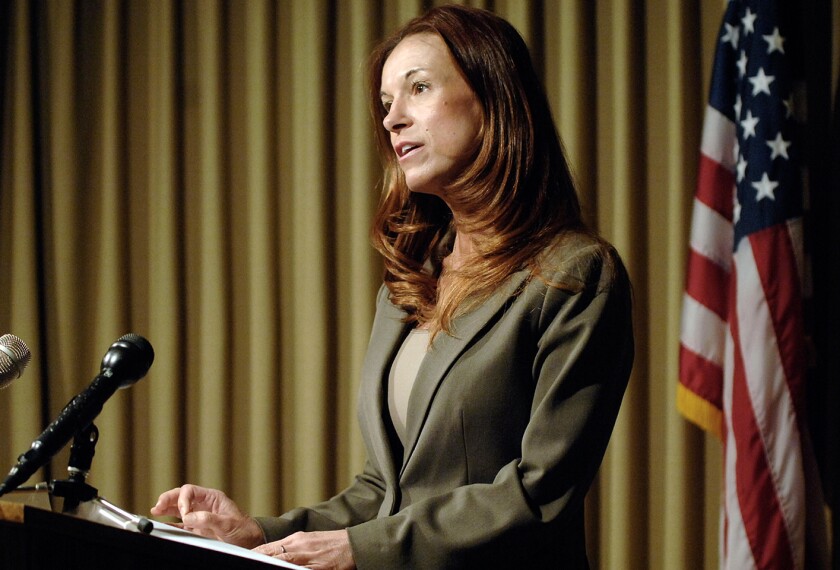
North Dakota Superintendent of Public Instruction Kirsten Baesler announces the gathering of a task force to look into future options the state has for the assessment of students during a press conference May 8, 2015, at the state Capitol in Bismarck, N.D.
  • Save to favorites
  • Print

Kirsten Baesler, the longtime North Dakota state education chief, cleared a U.S. Senate vote Tuesday to serve in a top leadership role at the U.S. Department of Education.

Baesler will join the department as assistant secretary of elementary and secondary education under Education Secretary Linda McMahon, amid turbulent changes to the federal agency that has seen rapid downsizing during the Trump administration. President Donald Trump tapped Baesler for the post in February.

The division Baesler will lead, the office of elementary and secondary education, oversees some of the federal government’s core K-12 functions, including distribution of Title I funds to states and enforcement of the Every Student Succeeds Act, the primary federal school accountability law.

See Also

North Dakota Superintendent of Public Instruction Kirsten Baesler announces the gathering of a task force to look into future options the state has for the assessment of students during a press conference May 8, 2015, at the state Capitol in Bismarck, N.D.
North Dakota Superintendent of Public Instruction Kirsten Baesler announces the gathering of a task force to look into future options the state has for the assessment of students during a press conference May 8, 2015, at the state Capitol in Bismarck, N.D. President Donald Trump has tapped Baesler to serve as assistant secretary of elementary and secondary education.
Mike McCleary/The Bismarck Tribune via AP

With a history of working across the political aisle, Baesler is the longest-serving current state education chief. She was first elected to her nonpartisan post in 2012, where she helped her state achieve national status in competency-based instruction and computer science, and she was last reelected in 2024. She also has served as president of the bipartisan Council of Chief State School Officers during her time as North Dakota’s state chief.

Her nomination had cruised through the Senate Health, Education, Labor and Pensions committee without a hearing, and was sent on to the full Senate in May. Since then, it had been among the executive branch nominations that the Senate didn’t approve until it changed its rules to allow the confirmation of several nominees at once with a simple majority vote.

Baesler was one of more than 100 nominees approved Tuesday in a 51-47, party-line vote.

“I am honored, humbled, and incredibly excited to have received this final vote of confidence from the U.S. Senate,” she said in a statement after the vote.

Baesler’s confirmation coincides with the first government shutdown in seven years, during which most of the Education Department’s workforce is furloughed and newly confirmed nominees can’t be sworn in. That workforce has also shrunk considerably since President Donald Trump took office in January, as he has aggressively worked toward his campaign promise to abolish the 45-year-old federal agency and disseminate its vast portfolio to other agencies.

It’s a vision Baesler herself has carried out at the state level. Last year, Beasler authored an opinion piece about cutting staff at North Dakota’s department of public instruction, and moving mental health services to another agency, outlining how it could serve as a model for the federal government.

She also suggested moving some of the federal Education Department’s functions, like civil rights enforcement and student loans, to other Cabinet-level agencies, mirroring suggestions made in the conservative policy agenda Project 2025. The Trump administration has already begun implementing several Project 2025 proposals, particularly in K-12 education.

Baesler’s appointment comes after the department’s presumptive No. 2, former state education chief and educator Penny Schwinn, dropped her bid to serve in the agency after some conservative lawmakers chafed at her past comments on gender and race in classrooms. The administration hasn’t yet announced a new appointee. Schwinn is serving as a senior adviser and chief strategist in the department—a post that doesn’t require Senate confirmation.

Alongside Baesler, Kimberly Richey, who will oversee the agency’s office for civil rights, was also confirmed Tuesday. The office has, in recent months, become a strict enforcer of the president’s public policy agenda in K-12 schools and colleges and universities.

See Also

President Donald Trump speaks before signing an executive order barring transgender female athletes from competing in women's or girls' sporting events, in the East Room of the White House, Wednesday, Feb. 5, 2025, in Washington.
President Donald Trump speaks at the White House on Feb. 5, 2025, before signing an executive order barring transgender females from competing in women's or girls' sports. Transgender athlete policies have been a common subject of investigations into schools, colleges, state education departments, and athletic associations by the U.S. Department of Education since Trump took office.
Alex Brandon/AP

Craig Trainor—who has been leading the office for civil rights since the start of the Trump administration in an interim capacity and has been a main actor in enforcing the administration’s efforts to eradicate diversity, equity, and inclusion programs—was confirmed to be an assistant secretary at the U.S. Department of Housing and Urban Development in Tuesday’s vote.

Events

School & District Management Webinar EdMarketer Quick Hit: Build Campaigns That Engage K-12 Leaders
We’ll share what’s resonating with Education Week’s K-12 audience based on user behavior across platforms and other proprietary data.
This content is provided by our sponsor. It is not written by and does not necessarily reflect the views of Education Week's editorial staff.
Sponsor
Assessment Webinar
Measuring What Matters: How District Leaders Are Redefining Student Assessment
In this panel discussion, district leaders and systems experts will examine the gap between the outcomes we want and the systems in place.
Content provided by Otus
Early Childhood Webinar Selling Into Early Learning: New Survey Data and Strategies for Marketers
Selling into PreK? Get fresh EdWeek Research Center data and strategies to position your products and reach the right early learning buyers.

EdWeek Top School Jobs

Teacher Jobs
Search over ten thousand teaching jobs nationwide — elementary, middle, high school and more.
View Jobs
Principal Jobs
Find hundreds of jobs for principals, assistant principals, and other school leadership roles.
View Jobs
Administrator Jobs
Over a thousand district-level jobs: superintendents, directors, more.
View Jobs
Support Staff Jobs
Search thousands of jobs, from paraprofessionals to counselors and more.
View Jobs

Read Next

Federal Q&A A Top Democrat Breaks Down His Party's Plans for K-12 in a House Majority
If Democrats retake the House, Rep. Bobby Scott may be in a position to set his chamber’s K-12 agenda.
5 min read
Rep. Bobby Scott, D-Va., speaks during a prayer vigil held by the Chesapeake Coalition of Black Pastors at The Mount (Mount Lebanon Baptist Church) in Chesapeake, Va., Sunday, Nov. 27, 2022, for the six people killed at a Walmart in Chesapeake, Va., when a manager opened fire with a handgun before an employee meeting Tuesday night.
Rep. Bobby Scott, D-Va., speaks during a prayer vigil in Chesapeake, Va., on Nov. 27, 2022. Scott is the ranking Democrat on the U.S. House of Representatives' education committee and will seek the panel's chairmanship if Democrats win a House majority in next month's elections.
Carolyn Kaster/AP
Federal What a Democratic Congress Could Mean for Trump's K-12 Agenda
They may try to reverse—or at least investigate—the Trump admin.'s efforts to dismantle the Ed. Dept.
9 min read
House Minority Leader Hakeem Jeffries, D-N.Y., the top Democrat in the Republican-majority House, is joined by Rep. Pete Aguilar, D-Calif., chair of the House Democratic Caucus, as they criticize President Donald Trump and his policies while talking to reporters about the approaching midterm election, at the Capitol in Washington, Thursday, Sept. 17, 2026.
House Democratic Leader Hakeem Jeffries speaks at the U.S. Capitol on Sept. 17, 2026. He's joined by Rep. Pete Aguilar, D-Calif., who chairs the House Democratic Caucus. If Democrats gain a majority of either chamber of Congress after next month's elections, they'll be able to hold oversight hearings on and launch investigations into the dismantling of the U.S. Department of Education.
J. Scott Applewhite/AP
Federal The Future of Education Research: More Partisan and Largely Left to States?
As Trump administration works to change federal grants, outside researchers try to regroup.
6 min read
Image of file folders with tabs called "funding" "grants" "projects" and a blank note paper paperclipped to the outside.
Collage by Laura Baker/Education Week + Getty
Federal Bipartisan Bill in Congress Would Help Schools Put Cellphone Bans or Restrictions in Place
The bill would establish a federal grant program to support state efforts to restrict cellphones.
5 min read
Sen. Tom Cotton, R-Ark., the chairman of the Senate Intelligence Committee, center, is joined from left by Sen. John Barrasso, R-Wyo., the GOP whip, and Senate Majority Leader John Thune, R-S.D., as he speaks to reporters ahead of a Wednesday meeting with President Donald Trump, at the Capitol in Washington, Tuesday, June 23, 2026. (AP Photo/J. Scott Applewhite) Senate Minority Leader Chuck Schumer, D-N.Y., speaks to reporters at the Capitol in Washington, Tuesday, June 23, 2026.
Sen. Tom Cotton, R-Ark., speaks to reporters ahead of a meeting with President Donald Trump at the Capitol in Washington on June 23, 2026. Cotton is one of the sponsors of a bipartisan bill that would create a grant program for states to implement school cellphone bans or restrictions.
J. Scott Applewhite/AP
