Federal

Teachers Defiant After Educator Loses Bid for Arizona Governor

By Daarel Burnette II — November 07, 2018 3 min read
Democratic gubernatorial candidate David Garcia is interviewed after his concession speech during the Arizona Democrats election watch party in Phoenix, Ariz.
  • Save to favorites
  • Print

Phoenix

David Garcia, a Democratic college of education professor who galvanized teachers, school administrators, and parents behind an ambitious bid to pump more than $1 billion back into Arizona’s public school system, lost Tuesday to incumbent Republican Gov. Doug Ducey in the race for Arizona governor.

It was a significant blow for public school advocates across the country who drew inspiration from the #redfored movement sparked here after thousands of teachers staged a week-long strike last spring over stagnant wages and stringent work conditions.

In the ballroom of the Renaissance Downtown Hotel in Phoenix on Tuesday night, shortly after hundreds of supporters decked in red chanted “Red for Ed,” Garcia told teachers, “You will not go back to your classrooms with your heads down. You will keep up this fight.”

Teacher Kate Walliser, 33, of Phoenix, Ariz., reacts during gubernatorial candidate David Garcia's concession speech at the Arizona Democrats election watch party in Phoenix, Ariz.

Garcia, who lost his 2014 bid to become the state’s superintendent by just a few hundred votes, shocked pollsters when he beat state Sen. Steve Farley, a more moderate Democrat committed to not raising the state’s taxes, in the Democratic gubernatorial primary.

But Ducey significantly outspent Garcia, bragged about the state’s surging economy, and told voters Garcia would only raise the state’s taxes to spend on failing schools, anathema in this Libertarian state.

Arizona’s large coalition of public school advocates must now find a way to repair its relationship with Ducey and the state’s legislature. During the campaign, Ducey described teachers as money-hungry activists who only want to raise the average citizen’s taxes.

After the strike last spring, Ducey provided teachers with a 10 percent pay raise and said teachers would get a 20 percent pay raise by 2020. But teachers were largely skeptical.

“Ducey is full of lies,” Porche Allah, a 7th grade science teacher at Greenfield Elementary in Phoenix said at Tuesday night’s watch party for Garcia.“There’s so much dishonesty in the state capitol. I don’t trust any of them.”

Arizona teachers Nicholas Martin, 25, from left, Noah Karvelis, 24, and Jay Barbuto, 29, all from Phoenix, look at election results during the Arizona Democrats election watch party on Nov. 6 in Phoenix, Ariz.

Ducey promised on the campaign trail to devote “more money, over and above inflation, every year I am governor,” but avoided specifying a certain amount. Notably, in his first bid for governor in 2014, Ducey promised to cut taxes every year he was in office. Those tax cuts are now being blamed for the overcrowded classrooms and low teacher pay.

While the state’s economy is surging, Arizona’s property values, which plummeted during the Great Recession and which schools are dependent on for tax revenue, have been slow to rebound. Meanwhile, the state’s student enrollment has signficantly grown in the last decade, resulting in overcrowded classes and a statewide teacher shortage.
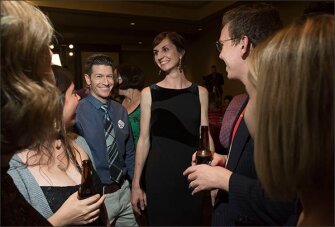
Candidate for Superintendent of Public Instruction, Kathy Hoffman (center) greets supporters during the Arizona Democrats election watch party on Nov. 6 in Phoenix, Ariz.

At an especially rowdy protest at the state capitol in April, teachers worried out loud if their movement would still resonate with voters come Election Day. But their energy remained high throughout this state’s scorching summer as hundreds of teachers canvassed, sent postcards and made personal phone calls to their neighbors to vote for Garcia.

When in August, the state supreme court knocked off the ballot a question that would’ve asked voters to raise taxes on the state’s wealthy in order to provide $690 million for public schools, teachers were furious.

“It was a slap in the face for us,” said Joseph Fuentes, a 3rd grade teacher at Garfield Elementary School, said Tuesday night. His message for state Republican leaders: “We did everything you asked us to do and you pulled that from right underneath us.”

The surge in support among parents across political lines surprised many teachers.

“We will take this fight to the next election,” said Courtney Kemp, an AP teacher at Chandler High School. “This taught us that we have a voice. We can make a change.”

Events

This content is provided by our sponsor. It is not written by and does not necessarily reflect the views of Education Week's editorial staff.
Sponsor
Personalized Learning Webinar
Differentiation That Delivers: Proven Practices From High-Growth Districts
Make every minute count. Proven strategies from educators and leaders driving real student growth. Save your seat!
Content provided by i-Ready, Curriculum Associates
This content is provided by our sponsor. It is not written by and does not necessarily reflect the views of Education Week's editorial staff.
Sponsor
College & Workforce Readiness Webinar
From Exposure to Experience: Designing Accessible Work-Based Learning
Learn how schools can create meaningful experiences that help every student build skills, connections, and a clearer path to their future.
Content provided by Project Lead The Way
This content is provided by our sponsor. It is not written by and does not necessarily reflect the views of Education Week's editorial staff.
Sponsor
School & District Management Webinar
A Tale of Two School Districts: Forecasting Enrollment
Forecasting enrollment is hard. Here’s how two different districts are navigating times of change with data that considers the whole picture.
Content provided by Zonda Education

EdWeek Top School Jobs

Teacher Jobs
Search over ten thousand teaching jobs nationwide — elementary, middle, high school and more.
View Jobs
Principal Jobs
Find hundreds of jobs for principals, assistant principals, and other school leadership roles.
View Jobs
Administrator Jobs
Over a thousand district-level jobs: superintendents, directors, more.
View Jobs
Support Staff Jobs
Search thousands of jobs, from paraprofessionals to counselors and more.
View Jobs

Read Next

Federal Q&A A Top Democrat Breaks Down His Party's Plans for K-12 in a House Majority
If Democrats retake the House, Rep. Bobby Scott may be in a position to set his chamber’s K-12 agenda.
5 min read
Rep. Bobby Scott, D-Va., speaks during a prayer vigil held by the Chesapeake Coalition of Black Pastors at The Mount (Mount Lebanon Baptist Church) in Chesapeake, Va., Sunday, Nov. 27, 2022, for the six people killed at a Walmart in Chesapeake, Va., when a manager opened fire with a handgun before an employee meeting Tuesday night.
Rep. Bobby Scott, D-Va., speaks during a prayer vigil in Chesapeake, Va., on Nov. 27, 2022. Scott is the ranking Democrat on the U.S. House of Representatives' education committee and will seek the panel's chairmanship if Democrats win a House majority in next month's elections.
Carolyn Kaster/AP
Federal What a Democratic Congress Could Mean for Trump's K-12 Agenda
They may try to reverse—or at least investigate—the Trump admin.'s efforts to dismantle the Ed. Dept.
9 min read
House Minority Leader Hakeem Jeffries, D-N.Y., the top Democrat in the Republican-majority House, is joined by Rep. Pete Aguilar, D-Calif., chair of the House Democratic Caucus, as they criticize President Donald Trump and his policies while talking to reporters about the approaching midterm election, at the Capitol in Washington, Thursday, Sept. 17, 2026.
House Democratic Leader Hakeem Jeffries speaks at the U.S. Capitol on Sept. 17, 2026. He's joined by Rep. Pete Aguilar, D-Calif., who chairs the House Democratic Caucus. If Democrats gain a majority of either chamber of Congress after next month's elections, they'll be able to hold oversight hearings on and launch investigations into the dismantling of the U.S. Department of Education.
J. Scott Applewhite/AP
Federal The Future of Education Research: More Partisan and Largely Left to States?
As Trump administration works to change federal grants, outside researchers try to regroup.
6 min read
Image of file folders with tabs called "funding" "grants" "projects" and a blank note paper paperclipped to the outside.
Collage by Laura Baker/Education Week + Getty
Federal Bipartisan Bill in Congress Would Help Schools Put Cellphone Bans or Restrictions in Place
The bill would establish a federal grant program to support state efforts to restrict cellphones.
5 min read
Sen. Tom Cotton, R-Ark., the chairman of the Senate Intelligence Committee, center, is joined from left by Sen. John Barrasso, R-Wyo., the GOP whip, and Senate Majority Leader John Thune, R-S.D., as he speaks to reporters ahead of a Wednesday meeting with President Donald Trump, at the Capitol in Washington, Tuesday, June 23, 2026. (AP Photo/J. Scott Applewhite) Senate Minority Leader Chuck Schumer, D-N.Y., speaks to reporters at the Capitol in Washington, Tuesday, June 23, 2026.
Sen. Tom Cotton, R-Ark., speaks to reporters ahead of a meeting with President Donald Trump at the Capitol in Washington on June 23, 2026. Cotton is one of the sponsors of a bipartisan bill that would create a grant program for states to implement school cellphone bans or restrictions.
J. Scott Applewhite/AP
