Federal

U.S. Urban Students Middling vs. Foreign Peers

By Sean Cavanagh — October 22, 2008 3 min read
  • Save to favorites
  • Print

Students in U.S. urban school districts are the latest to have their academic skills measured on a global scale in a study that shows them achieving mixed results when judged in math against their counterparts in foreign nations.

Children in American cities generally fared better at the 4th grade level in the global comparison, and performed more unevenly in 8th grade, according to the analysis, published last week by the Washington-based American Institutes for Research.

Six of the 11 U.S. city school systems evaluated performed at or above the average for developed nations in 4th grade mathematics, according to the study. Yet only two of the 11 districts—Charlotte-Mecklenburg, N.C., and Austin, Texas—reached the 8th grade international average for developed nations.

The study statistically links urban districts’ 2003 scores on the National Assessment of Educational Progress with country-by-country results from the same year on the Trends in International Mathematics and Science Study. After linking those test results, the authors compared the TIMSS scores against the 2007 NAEP Trial Urban District Assessment, as well as overall state NAEP results, which provide national U.S. averages.

In addition to Charlotte-Mecklenburg and Austin, other districts in the study are Atlanta, Boston, Chicago, Cleveland, the District of Columbia, Houston, Los Angeles, New York City, and San Diego.

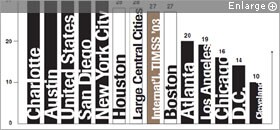
Comparing 2007 NAEP and 2003 TIMSS Math

Four big-city districts performed signiicantly better than the overall international average of 24 countries at the 4th grade level. Five performed below the international average.
BRIC ARCHIVE

SOURCE: American Institutes for Research

The study compares the percentage of U.S. and international students reaching the NAEP “proficient” level in math in grades 4 and 8.

Holding American students to a high bar is crucial, the authors argue.

The international workplace demands that an American student perform at a mathematically “proficient level, at the minimum,” they write, or he or she will face a “quantitative headwind in his or her adult life.”

The report was written by Gary W. Phillips, a chief scientist at the AIR, a nonprofit, independent research group, and John A. Dorsey, a professor of mathematics at Illinois State University in Normal. It is a follow-up to a 2007 analysis Mr. Phillips conducted, which compared individual U.S. states with foreign nations, using the same methodology but different data.

8th Grade Drop-Off?

U.S. urban students fared relatively well when compared against both industrialized and developing nations that took part in TIMSS, Mr. Phillips noted in an interview. But when compared with students just in industrialized countries—those with economic conditions similar to those of the United States—American students’ showing was not as strong, a finding that should trouble policymakers, Mr. Phillips said.

In a separate measure of the entire U.S. student population, 4th graders were more successful against developed nations in math, topping the international average, the study found. But U.S. 8th graders did not do as well, performing at roughly the same level as the average for industrialized nations.

In explaining 8th graders’ relatively poor performance, Mr. Phillips said it was possible that they simply didn’t match up as well academically as 4th graders in the international comparison. But it also could be that the 8th grade proficiency standard on NAEP was higher for 8th grade than for 4th grade. Federal officials score those students on different scales, Mr. Phillips pointed out.

Michael D. Casserly, the executive director of the Council of the Great City Schools, said he wished the study had documented the strong gains made by city districts on the trial urban NAEP, which his Washington organization was instrumental in creating. The value of the urban NAEP is that it provides school officials with data to gauge improvement, rather than pitting them in a “horse race” against nonurban or foreign students, he said.

While calling the international study “interesting,” he said he wasn’t sure it would shape policy in big-city districts in the way that other analyses might.

It’s difficult “to know what to do with these results,” Mr. Casserly said. “If you’re [a district] above Latvia, and you’re below Hungary, what do you do?”

A version of this article appeared in the October 29, 2008 edition of Education Week as U.S. Urban Students Middling vs. Foreign Peers

Events

This content is provided by our sponsor. It is not written by and does not necessarily reflect the views of Education Week's editorial staff.
Sponsor
Recruitment & Retention Webinar
Hiring, Retention, and Fill Rates: A Data-Driven Sub Strategy
Explore what keeps substitutes coming back and hear how one district rebuilt its substitute hiring process and improved its fill rate.
Content provided by Frontline Education
Early Childhood K-12 Essentials Forum Early Childhood Education: Building Essential Skills for Success
Join this free virtual event to examine the biggest challenges in supporting young children, from preschool through elementary school. 
This content is provided by our sponsor. It is not written by and does not necessarily reflect the views of Education Week's editorial staff.
Sponsor
Student Absenteeism Webinar
Attendance Isn't an Attendance Problem
Boost attendance by strengthening relationships, belonging, and support with practical strategies from Doug Fisher & Nancy Frey.
Content provided by Corwin

EdWeek Top School Jobs

Teacher Jobs
Search over ten thousand teaching jobs nationwide — elementary, middle, high school and more.
View Jobs
Principal Jobs
Find hundreds of jobs for principals, assistant principals, and other school leadership roles.
View Jobs
Administrator Jobs
Over a thousand district-level jobs: superintendents, directors, more.
View Jobs
Support Staff Jobs
Search thousands of jobs, from paraprofessionals to counselors and more.
View Jobs

Read Next

Federal Opinion What’s Behind the Trump Administration's Push to Reform Head Start?
Assistant Secretary Alex Adams explains the Trump administration’s approach to the early-ed program.
7 min read
The United States Capitol building as a bookcase filled with red, white, and blue policy books in a Washington DC landscape.
Luca D'Urbino for Education Week
Federal Ed. Dept. Would Have More Power to Cut Off Grants Under New Rules
The agency last year ended in-progress grants worth more than $2 billion, with courts often objecting.
5 min read
Jeanette Vyhanek, a counselor at Wellstone Elementary, teaches a class of kindergarten students at the St. Paul school on Oct. 31, 2025 in Minnesota.
Jeanette Vyhanek, a counselor at Wellstone Elementary in St. Paul, Minn., teaches a class of kindergarten students on Oct. 31, 2025. Federal grants to expand the ranks of school counselors and other school mental health services were among hundreds terminated by the Trump administration in 2025. New rules from the U.S. Department of Education would give the federal agency greater latitude to end in-progress grants.
Alex Kormann/The Minnesota Star Tribune via TNS
Federal Q&A Education Data Collection Has Cratered Under Trump. Can It Be Rebuilt?
Ed. Dept.'s data-gathering agency is too unstable to adapt to changing needs, a new report claims.
6 min read
A student raises her hand to ask a question in her third grade classroom at Highland Elementary School in Columbus, Kan., on Oct. 17, 2022. The arm of the government that oversees education data which tracks educational outcomes for students, faces major challenges ahead due to financial cuts.
A student raises her hand to ask a question in her 3rd grade classroom at Highland Elementary School in Columbus, Kan., on Oct. 17, 2022. Federal education data-gathering, like the Condition of Education report, includes baseline information on students and schools. But cuts to the Education Department's statistics wings and mounting criticism of how it operates raise questions about how it can best fulfill its mission.
Charlie Riedel/AP
Federal Education Department Tells Schools Race Can’t Factor Into Student Discipline
A letter to educators follows up on last month's rescission of longstanding discrimination rules.
5 min read
Assistant Secretary for Civil Rights for the Department of Education nominee Kimberly Richey testifies before the Health, Education, Labor and Pensions committee about her nomination in Washington, D.C., on June 5, 2025.
Assistant Secretary for Civil Rights Kimberley Richey testifies before the Senate's Health, Education, Labor and Pensions committee at her nomination hearing in Washington on June 5, 2025. A new letter to educators from Richey instructs schools not to consider race at all in school discipline policies, following the Trump administration's rescission of longtime anti-discrimination rules.
Jason Andrew for Education Week
