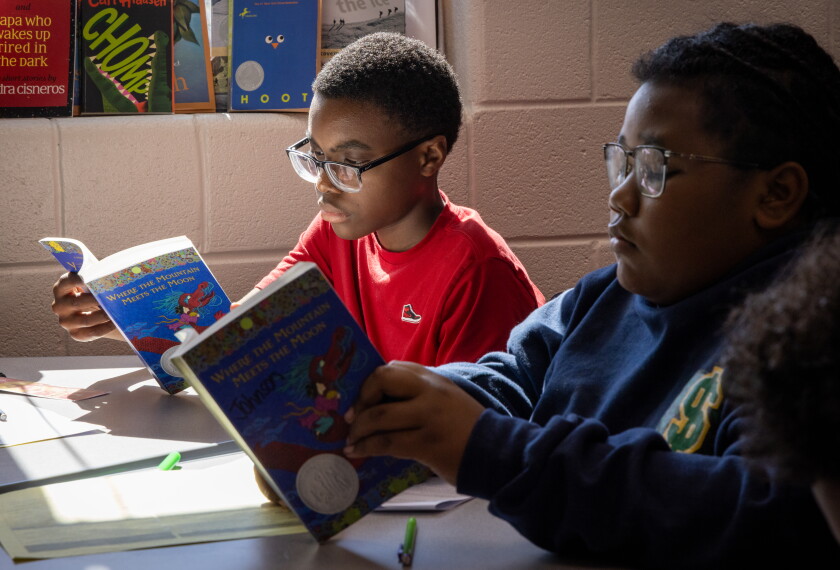

Since 2021, the number of books challenged in and banned by school districts has escalated sharply.
During the 2021-22 school year, 138 school districts in 32 states banned more than 2,500 books, an updated report by PEN America earlier this month revealed. These districts include 5,049 schools and in total enroll almost 4 million students.
The increase is largely due to a national effort by conservative groups and Republican lawmakers. They’ve objected to books about LGBTQ characters as well as books dealing with race and racism, according to the report from PEN America, a free speech advocacy organization.
The current wave of parent challenges to books began with the start of the school year in 2021. In 2022, the book bans are getting worse and are already on track to exceed 2021’s numbers, according to the American Library Association.
Proponents of the book bans have argued that many of the most commonly banned books are inappropriate for children because they contain references to sex and sexuality, which those groups have labeled “pornography.”
“I think it’s clear that it’s an ongoing campaign, that we’ll see it continue for the indefinite future,” said Deborah Caldwell-Stone, director of the American Library Association’s Office for Intellectual Freedom. “What we’re seeing now is organized efforts at the local level, at the national level, to challenge 10, 20, 50 books at a time, and books that generally represent the voices and experiences of traditionally marginalized and underrepresented communities.”
Experts and book authors have pushed back on those claims, saying that most books dealing with sexual themes that are about straight or white characters have not been challenged.
In 2021, a member of Moms for Liberty, a right-wing parent group, got national attention for challenging books about Ruby Bridges in Williamson County, Tenn. The group now has grown into a nationwide organization with about 200 branches. Along with a few other conservative groups, Moms for Liberty is behind at least 50 percent of book bans, PEN America found.
“Teachers’ unions continue to talk more about ‘banning books’ than reading books and our children’s literacy rate is now at an all-time low, due in no small part to the lockdowns, shutdowns and mandates that they pushed,” in some communities, said Moms for Liberty co-founders Tina Descovich and Tiffany Justice in an emailed statement.
Descovitch and Justice also said their organization is launching an “election-year ‘parent pledge’ this week to help our parents know which elected officials to vote for in November.”
But the group did not directly respond to requests for comment specifically about book bans and its alleged involvement in pushing for them.
Here are three takeaways and numbers from the recent debates and reports on book bans:
2022 book bans are set to exceed 2021’s numbers
From January to August 2022, the ALA found 681 attempts to ban or restrict library resources which targeted 1,651 unique titles. Based on these numbers for the first eight months of 2022, book bans have increased since last year, when they reached an all-time high.
In 2021, the ALA reported 729 attempts to ban library books and resources, impacting 1,597 unique titles. This was the highest number of attempted book bans since the library association began tracking book banning efforts more than 20 years ago, according to a report in early 2022.
While the library association kept track of book bans based on the calendar year, PEN America counted bans based on the school year and found 2,532 instances of individual books being banned, affecting 1,648 unique book titles.
The book bans will most likely not lose steam in the 2022-23 school year, said Jonathan Friedman, the director of free expression and education programs at PEN America and author of his organization’s report. PEN America tracked at least 139 additional bans imposed since July 2022.
Books about LGBTQ characters and people of color were disproportionately challenged or banned
Forty-one percent of all books banned from July 2021 to June 2022 were about LGBTQ characters, PEN America found. That includes 671 titles that explicitly address LGBTQ themes or feature protagonists or prominent secondary characters who are part of the LGBTQ community. About 9 percent of these bans—or 145 titles—targeted transgender characters and their stories.
Titles that contain protagonists or important secondary characters of color were a close second, accounting for 40 percent of all book bans, or 659 unique banned titles. Finally, 338 titles directly address issues of race and racism, making up 21 percent of all book bans.
“Teachers and librarians have worked very hard to assure that there are books for everyone that reflect everyone’s lives in classrooms and libraries, and have done so according to policy and in light of professional expertise,” Caldwell-Stone said. “And we’re seeing an effort to replace that expertise with conservative talking points. And eliminating and silencing voices that they disapprove of, because of [those voices’] viewpoint, and sometimes because of their very identity.”
The most frequently banned books have been removed from multiple districts across the country
The five most banned book titles all deal with characters’ experiences of race, racism, gender, and sexual identity.
They include Gender Queer: A Memoir by Maia Kobabe, which has become the single most frequently banned title in the country, with 41 districts restricting students’ access to it or completely removing it from shelves. The second-most banned book is All Boys Aren’t Blue by George M. Johnson, banned in 29 districts, followed by Out of Darkness by Ashley Hope Pérez, which 24 districts have removed or restricted.
Nobel Laureate Toni Morrison’s The Bluest Eye is fourth on the list with bans in 22 districts, and finally, The Hate U Give by Angie Thomas, which was made into a movie in 2018, was banned in 17 districts.
“The students are telling us that when a book that reflects their life and experience is removed from the shelf, it’s an act of erasure,” Caldwell-Stone said. “And particularly gay, queer, and transgender teens, black teens, teens of color are stepping up at board meetings to say that having these books is important, that to take them away is a real message to them that they are not part of the school community, that they don’t belong.”