Special Report
Reading & Literacy

Do ‘Digital Natives’ Prefer Paper Books to E-Books?

By Kate Stoltzfus — November 09, 2016 2 min read
  • Save to favorites
  • Print

As digital devices and access to e-books proliferated in schools and homes over the past several years, some ed-tech experts expected that print books would soon become relics—or at least fall out of favor with a generation growing up in an electronic world.

But, in a wrinkle in the digital revolution, that hasn’t transpired—at least not yet.

More children now know what it’s like to read an e-book—61 percent in 2014 compared with 25 percent in 2010, according to Scholastic’s 2015 Kids and Family Reading report.

But most students still opt to turn actual pages. In the Scholastic survey, 65 percent of children ages 6 to 17 agreed they would always want to read in print, up from 60 percent in 2012. And 77 percent who had tried e-reading said that the majority of the books they read were in print. That was especially true for younger readers when reading for pleasure: 84 percent of 6- to 8-year-olds read mostly on paper, compared with 62 percent of 15- to 17-year-olds.

Meanwhile, e-books haven’t markedly altered the collections of school libraries. According to a 2015 School Library Journal survey, some 56 percent of school librarians responded that they now make e-books available to students—but that number was down from the previous year. And the librarians surveyed observed that while students use e-books for school projects and research, many still prefer print books, especially for pleasure reading. Only 6 percent of librarians reported a high interest in e-books from students, while 37 percent called it “moderate,” and 50 percent said it was “low.”

‘Tactile Experience’

Those responses appear to be reflected in e-book sales in children’s and young-adult categories. E-book sales for publishers have steadily dropped since 2012, according to the Association of American Publishers’ annual survey of 1,800 publishers in the United States, including the five largest traditional ones. Digital books made up 6.4 percent of annual children’s and young-adult revenue sales for book publishers in 2015 (around $271.8 million), compared with 13.1 percent in 2012.

However, it is worth noting that Amazon.com, the maker of the Kindle and the leading seller in the e-bookindustry, reported overall growth in e-book sales in 2015, according to The Wall Street Journal.

E-books by the Numbers

BRIC ARCHIVE

Source: School Library Journal

Studies point to a number of reasons why young people may prefer print to e-books, including early familiarity with print books, the “tactile experience” of reading on paper, and possible advantages in comprehension, particularly for longer texts.

Indeed, the ability to “toggle” between print and digital for different types of information consumption might be a key aspect of effective literacy today.

“Our teachers are using digital books more than ever before,” said Susie Harkey, the media coordinator at Park View Elementary School in Mooresville, N.C. “Students are very familiar with digital content, but I don’t think they equate reading with their iPads. They like to have something in hand.”

But, as the School Library Journal points out, the next generation of students may add a whole new dimension to reading trends. “The first ‘smartphone natives’ (born since 2007 when the iPhone was introduced) are now just entering elementary school,” the group says in its survey. “Will they have a greater affinity for e-books?”

A version of this article appeared in the November 09, 2016 edition of Education Week as Digital Generation Eschews E-Books for Pleasure Reading

Events

School & District Management Webinar EdMarketer Quick Hit: Build Campaigns That Engage K-12 Leaders
We’ll share what’s resonating with Education Week’s K-12 audience based on user behavior across platforms and other proprietary data.
This content is provided by our sponsor. It is not written by and does not necessarily reflect the views of Education Week's editorial staff.
Sponsor
Assessment Webinar
Measuring What Matters: How District Leaders Are Redefining Student Assessment
In this panel discussion, district leaders and systems experts will examine the gap between the outcomes we want and the systems in place.
Content provided by Otus
Early Childhood Webinar Selling Into Early Learning: New Survey Data and Strategies for Marketers
Selling into PreK? Get fresh EdWeek Research Center data and strategies to position your products and reach the right early learning buyers.

EdWeek Top School Jobs

Teacher Jobs
Search over ten thousand teaching jobs nationwide — elementary, middle, high school and more.
View Jobs
Principal Jobs
Find hundreds of jobs for principals, assistant principals, and other school leadership roles.
View Jobs
Administrator Jobs
Over a thousand district-level jobs: superintendents, directors, more.
View Jobs
Support Staff Jobs
Search thousands of jobs, from paraprofessionals to counselors and more.
View Jobs

Read Next

Reading & Literacy Q&A Why This Under-the-Radar Piece of Literacy Reform Is One of the Most Important
Parent notification is a central piece of reading reform, this advocate says.
5 min read
Collage of a Black female reading a book with her young daughter on her lap. Other pieces of the collage show an open book with non-legible text, speech bubbles, the letter "A" and a butterfly.
Collage by Gina Tomko/Education Week + Canva
Reading & Literacy 'Long Form' vs. 'Short' Reading: What's Going on Inside A Student's Brain?
Reading a novel and reading short text messages work the brain differently. Here's what that means.
3 min read
Pieces of a book page and a cellphone.
Collage by Laura Baker/Education Week + Getty
Reading & Literacy Creating a Culture of Reading for Pleasure Amid a Focus on Basics
School librarians at Missouri's Clayton school district bring a culture of reading to all students.
9 min read
Tom Bober
Students read books in the library at Captain Elementary School in Clayton, Mo., on Tuesday, Sept. 29, 2026. School Librarian Tom Bober works with teachers at the school to help instill a culture of reading early in students' lives.
Neeta Satam for Education Week
Reading & Literacy Getting Middle Schoolers to Do the Reading Is Hard. Can Communal Reading Help?
New classroom methods aim to help kids internalize the message that engaging in print is worth it.
11 min read
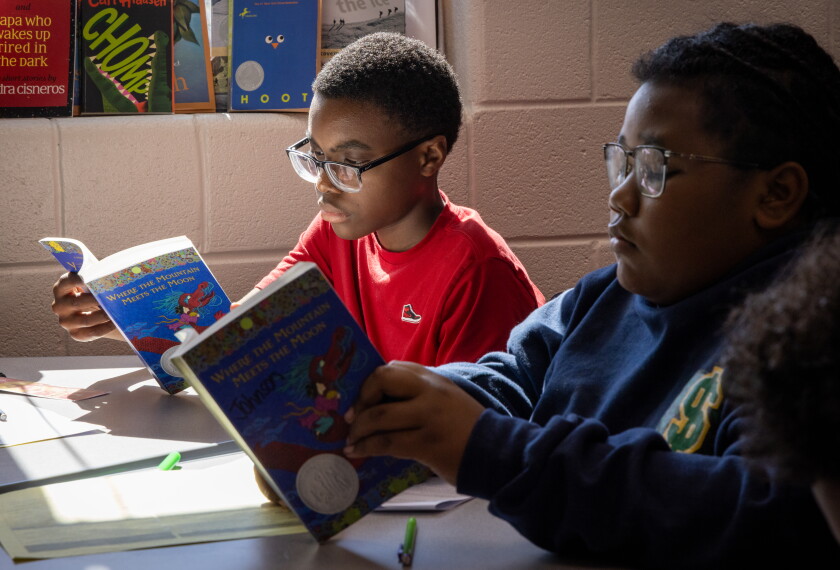
Students read Where the Mountain Meets the Moon in Jaime Johnson’s 6th grade language arts class at Murphy Middle School in Dacula, Georgia on September 22, 2026.
Students read <i>Where the Mountain Meets the Moon</i> in teacher Jaime Johnson’s 6th grade language arts class at Murphy Middle School in Dacula, Georgia on September 22, 2026. Johnson has students do most of the reading in class—to improve fluency, created a shared culture of engagement in books, and above all make sure every student completes the text.
Dustin Chambers for Education Week