Special Report
Reading & Literacy

Editors Note: Building Literacy Skills

By The Editors — May 11, 2015 1 min read
  • Save to favorites
  • Print

Early-grades reading instruction has long been a central point of emphasis—and concern—for educators and policymakers.

That’s in large part owing to a provocative body of research showing that students who don’t read with proficiency by the end of 3rd grade are far more likely to experience poor academic outcomes, including leaving school without a diploma. Early-grades reading skills, in other words, are often seen as a key indicator of educational achievement.

By that standard, many U.S. schools have struggled to give students adequate pathways. On the 2013 National Assessment of Educational Progress, or NAEP, only 35 percent of 4th graders scored at or above “proficient” in reading. The rate was considerably lower for minority students—18 percent for blacks and 20 percent for Hispanics. Meanwhile, the average NAEP reading score for 4th graders has increased only minimally over the past decade.

This Education Week special report takes a wide-ranging look at new efforts to address the challenges of early-grades reading instruction, particularly in light of the waning influence of the federal Reading First program. While that initiative, launched in 2002, drew praise for providing some $1 billion annually to expand reading instruction and professional development and support for teachers, it was criticized by many teachers and reading experts for focusing too narrowly on basic skills. A number of the stories highlight the growing impact of the Common Core State Standards, whose early-grades reading expectations often diverge from previous instructional systems.

Scanning the changing landscape of literacy instruction, the report explores new thinking on time-honored practices such as read-alouds, teaching vocabulary, and developing reading fluency; details school-community efforts to boost early-reading skills; dives into recent research on the potentially negative effects of focusing too rigidly on 3rd graders’ reading proficiency; and looks at an Alabama professional-development program that has shown promise in boosting achievement across racial categories, in part through a combination of consistency and responsiveness to change.

Related Tags:

A version of this article appeared in the May 13, 2015 edition of Education Week as A Note From the Editors

Events

This content is provided by our sponsor. It is not written by and does not necessarily reflect the views of Education Week's editorial staff.
Sponsor
Assessment Webinar
Measuring What Matters: How District Leaders Are Redefining Student Assessment
In this panel discussion, district leaders and systems experts will examine the gap between the outcomes we want and the systems in place.
Content provided by Otus
Early Childhood Webinar Selling Into Early Learning: New Survey Data and Strategies for Marketers
Selling into PreK? Get fresh EdWeek Research Center data and strategies to position your products and reach the right early learning buyers.
Artificial Intelligence Webinar AI and 'Techlash' Are on a Collision Course. How Should Schools Respond?
Learn what strategies and tactics schools can develop to encourage smart and responsible AI use, while also enforcing tech guardrails.

EdWeek Top School Jobs

Teacher Jobs
Search over ten thousand teaching jobs nationwide — elementary, middle, high school and more.
View Jobs
Principal Jobs
Find hundreds of jobs for principals, assistant principals, and other school leadership roles.
View Jobs
Administrator Jobs
Over a thousand district-level jobs: superintendents, directors, more.
View Jobs
Support Staff Jobs
Search thousands of jobs, from paraprofessionals to counselors and more.
View Jobs

Read Next

Reading & Literacy Q&A Why This Under-the-Radar Piece of Literacy Reform Is One of the Most Important
Parent notification is a central piece of reading reform, this advocate says.
5 min read
Collage of a Black female reading a book with her young daughter on her lap. Other pieces of the collage show an open book with non-legible text, speech bubbles, the letter "A" and a butterfly.
Collage by Gina Tomko/Education Week + Canva
Reading & Literacy 'Long Form' vs. 'Short' Reading: What's Going on Inside A Student's Brain?
Reading a novel and reading short text messages work the brain differently. Here's what that means.
3 min read
Pieces of a book page and a cellphone.
Collage by Laura Baker/Education Week + Getty
Reading & Literacy Creating a Culture of Reading for Pleasure Amid a Focus on Basics
School librarians at Missouri's Clayton school district bring a culture of reading to all students.
9 min read
Tom Bober
Students read books in the library at Captain Elementary School in Clayton, Mo., on Tuesday, Sept. 29, 2026. School Librarian Tom Bober works with teachers at the school to help instill a culture of reading early in students' lives.
Neeta Satam for Education Week
Reading & Literacy Getting Middle Schoolers to Do the Reading Is Hard. Can Communal Reading Help?
New classroom methods aim to help kids internalize the message that engaging in print is worth it.
11 min read
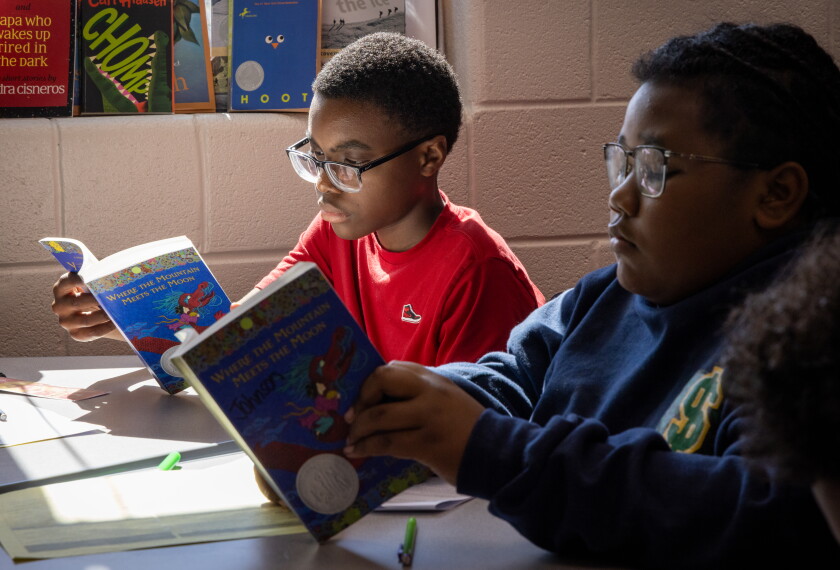
Students read Where the Mountain Meets the Moon in Jaime Johnson’s 6th grade language arts class at Murphy Middle School in Dacula, Georgia on September 22, 2026.
Students read <i>Where the Mountain Meets the Moon</i> in teacher Jaime Johnson’s 6th grade language arts class at Murphy Middle School in Dacula, Georgia on September 22, 2026. Johnson has students do most of the reading in class—to improve fluency, created a shared culture of engagement in books, and above all make sure every student completes the text.
Dustin Chambers for Education Week