The U.S. Supreme Court’s ruling that parents have rights under the main federal special education law, and thus may represent themselves in federal court without the assistance of a lawyer, has legal experts disagreeing about whether a rush to the courthouse will result.
The May 21 decision in Winkelman v. Parma City School District (Case No. 05-983) was unanimous on the idea that parents have some rights to represent themselves without a lawyer under the Individuals with Disabilities Education Act . But the justices split 7-2 in deciding that parents have substantive and procedural rights that encompass their child’s right to a free, appropriate public education under the law.
“Parents enjoy rights under IDEA; and they are, as a result, entitled to prosecute IDEA claims on their own behalf,” said the majority opinion by Justice Anthony M. Kennedy. “The decision by Congress to grant parents these rights was consistent with the purpose of IDEA and fully in accord with our social and legal traditions.”
“It is beyond dispute that the relationship between a parent and child is sufficient to support a legally cognizable interest in the education of one’s child,” Justice Kennedy added.
His opinion was joined by Chief Justice John G. Roberts Jr. and Justices John Paul Stevens, David H. Souter, Ruth Bader Ginsburg, Stephen G. Breyer, and Samuel A. Alito Jr.
Justice Antonin Scalia wrote a partial dissent that Justice Clarence Thomas joined.
Justice Scalia said he would hold that parents have the right to proceed pro se, or for themselves, under the IDEA in federal courts when they seek reimbursement for private school expenses for their child or for certain of their own procedural rights. But he would not let them proceed without a lawyer on the basic question of whether their child’s free, appropriate public education was “substantively inadequate.”
Justice Scalia also warned that cases pressed by parents without a lawyer would burden the court system.
“Since pro se complaints are prosecuted essentially for free, without screening by knowledgeable attorneys, they are much more likely to be unmeritorious,” Justice Scalia said.
Expense Cited
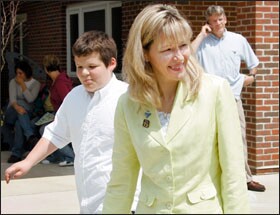
Jeff and Sandee Winkelman, who are not lawyers, brought the case. They wanted to represent their son in a lawsuit against the 13,000-student Parma, Ohio, school district, near Cleveland, over the child’s educational placement.
They could not afford a lawyer, and they argued that the special education law allowed them to represent their son, Jacob, who has a form of autism. The Winkelmans also contended that they were entitled to argue for their own rights under the federal law.
Although the parents lost on both issues in the U.S. Court of Appeals for the 6th Circuit, in Cincinnati, other federal appeals courts have recognized the right of nonlawyer parents to represent themselves, at least on procedural issues.
The Winkelmans argued that requiring parents to get lawyers means that many families are shut out of federal court because of the expense and because of a shortage of lawyers willing to take on special education cases. Supporting the family’s position were a number of disability-advocacy groups, as well as the Bush administration.
The Parma district argued that there is no language in the special education law that supports a departure from the procedural rule that a nonlawyer cannot represent another party’s interests in federal court. Parents don’t have the legal skills to represent their children in court, in contrast to less formal due-process hearings, where hearing officers may give them deference, the district said. (“Court to Hear IDEA Case on Parents’ Rights,” Feb. 21, 2007.)
The district developed an individualized education program, or IEP, for Jacob for the 2003-04 school year. The Winkelmans contended that he needed more support than the district was willing to provide. The family sought a determination that Jacob did not receive a free, appropriate public education as guaranteed under the IDEA, that his IEP was inadequate, and that they should be reimbursed for their tuition costs at a private school where they have enrolled Jacob, who is 9 years old. That school, the Monarch School in Shaker Heights, Ohio, charges tuition of about $50,000 a year.
“It’s a good day for parents,” Sandee Winkelman said on the day the decision came down. “Tomorrow we have to go back to Jacob. But today is parents’ day.”
Ms. Winkelman, who consulted the library at Cleveland State University and prevailed on sympathetic law students to help her find materials on special education law, now says the publicity has prompted lawyers to come forward and offer their assistance with the family’s case. After winning the right to argue the case on their own, it is unlikely the Winkelmans will end up doing so, she said.
“I always believed that everyone needs an attorney. You always have a better chance with one, let’s face it,” Ms. Winkelman said. “I hope parents don’t have to go without, but they can do it now.”
Christina Henagen Peer, a lawyer representing the Parma district, said in a statement that the district ultimately expects to win a ruling that it “fully complied with the requirements of IDEA.”
Lawyers for school districts said they feared that more parents would seek to press their children’s IDEA cases without a lawyer.
“Now there will be more cases, because parents know they can carry them through,” said Kathleen S. Mehfoud, a Richmond, Va., lawyer who often represents districts in special education cases.
“The federal civil rules are complex,” she added. “Parents will definitely be at a disadvantage.”
Francisco M. Negrón Jr., the general counsel of the National School Boards Association, said lawyers serve as gatekeepers, advising parents when they don’t have a strong case.
Too Emotional?
“Lawyers have an obligation not to bring forward cases that are frivolous or without merit,” said Mr. Negrón, whose Alexandria, Va.-based organization had filed a friend-of-the-court brief in the case on the side of the Parma district. “Parents are undoubtedly emotionally involved in their children’s cases. They might not be able to bring the same kind of legal analysis to bear.”
Advocates for parents and children in special education said they doubted that federal courthouses would be overrun by parent cases.
Pete Wright, a Deltaville, Va., lawyer who co-runs Wrightslaw, a Web site about special education law, agreed that nonlawyer parents are at a disadvantage when it comes to the complexities of pressing a case in federal court.
Mr. Wright placed the Winkelman decision in the top three or four in importance of about 10 IDEA cases decided by the justices.
“This is the first case where they have really focused on the rights of parents, and the role of parents,” under the law, he said.
Jim Gerl, a special education law consultant in West Virginia who sometimes serves as a hearing officer or mediator in that state, noted that the high court had recently ruled for districts in IDEA cases dealing with the burden of proof and expert witnesses in due-process hearings. (“High Court Boosts Districts in IDEA Cases,” Nov. 30, 2005, and “Justices Rule Against Parents in IDEA Case,” July 12, 2006.)
Now the pendulum has swung the other way. “This decision gives clear guidance that there is more or less a family interest in the education of the child,” Mr. Gerl said.