Reading & Literacy

How a Teacher Used an AI Tool to Help Her Students’ Reading Comprehension

By Jennifer Vilcarino — July 03, 2025 2 min read
Jessica Pack, a 6th grade language arts teacher at James Workman Middle School in Riverside County, Calif., speaks on AI and literacy at the ISTELive 25 + ASCD Annual Conference 25 in San Antonio on July 1, 2025.
  • Save to favorites
  • Print

What barriers do students face when asked to read text and show their comprehension of it?

This question was posed by an English/language arts teacher and educational consultant to a group of educators at a session at the ISTELive 25 + ASCD Annual Conference 25 here, held June 29 to July 2.

Some of the common responses among the audience of mostly teachers included limited vocabulary, boredom, and difficulty decoding.

The session—led by Jessica Pack, a 6th grade language arts teacher at James Workman Middle School in Riverside County, Calif., made the case that smart, strategic use of artificial intelligence tools could help boost reading skills. (However, it’s important to note that many educators say AI tools do the exact opposite—they stifle creativity, lead to plagiarism, and give students an easy way out of tackling challenging assignments.)

Improving reading skills is one of the top priorities in schools across the country because of data showing that those skills are declining. The 2024 National Assessment of Educational Progress has shown declining reading scores for 4th and 8th graders for years.

Those trends have prompted growing interest in the “science of reading,” the use of proven, evidence-based methods for teaching reading that include teaching the foundations of language in a structured progression.

Pack has been using AI tools to bolster reading comprehension lessons, she said during the ISTE session, titled “Enhancing Literacy Through Creativity Using AI-Powered Tools.”

“A lot of folks are landing on AI as a purely teacher-centered type of tool, so what we are going to do today is encourage a bit of student-centered use,” Pack told the audience of educators at the conference here.

How this teacher used an AI image generator to work on reading skills

Pack said her 6th grade students from last school year had an average reading level of about 2nd or 3rd grade.

To address this learning gap, students were first asked to examine paragraphs from a book and generate keywords from that text. They would use those keywords to create a prompt for an AI image generator.

The students would then work in small groups to evaluate the image to see if it was missing something that was important to the text from the book. Finally, they would submit additional AI prompts to get the image to more accurately represent the text.

“This is huge. This is the metacognitive moment where they’re demonstrating their comprehension—their full comprehension of the text—by being able to connect it back to whatever it is they were able to generate,” said Pack.

Research shows that asking students to monitor and correct their own understanding of text as they read can boost their comprehension—though using AI for this purpose hasn’t been studied extensively.

Pack emphasized that it is important for students to be taught to cite the images they create as generative AI images, because that instills the value of citing sources for content they create.

“They need to be aware of what content is AI-generated, and it starts building that digital citizenship foundation for citation of AI and being aware that not all the things we are creating are actual factual things,” she said.

Events

School & District Management Webinar EdMarketer Quick Hit: Build Campaigns That Engage K-12 Leaders
We’ll share what’s resonating with Education Week’s K-12 audience based on user behavior across platforms and other proprietary data.
This content is provided by our sponsor. It is not written by and does not necessarily reflect the views of Education Week's editorial staff.
Sponsor
Assessment Webinar
Measuring What Matters: How District Leaders Are Redefining Student Assessment
In this panel discussion, district leaders and systems experts will examine the gap between the outcomes we want and the systems in place.
Content provided by Otus
Early Childhood Webinar Selling Into Early Learning: New Survey Data and Strategies for Marketers
Selling into PreK? Get fresh EdWeek Research Center data and strategies to position your products and reach the right early learning buyers.

EdWeek Top School Jobs

Teacher Jobs
Search over ten thousand teaching jobs nationwide — elementary, middle, high school and more.
View Jobs
Principal Jobs
Find hundreds of jobs for principals, assistant principals, and other school leadership roles.
View Jobs
Administrator Jobs
Over a thousand district-level jobs: superintendents, directors, more.
View Jobs
Support Staff Jobs
Search thousands of jobs, from paraprofessionals to counselors and more.
View Jobs

Read Next

Reading & Literacy 'Long Form' vs. 'Short' Reading: What's Going on Inside A Student's Brain?
Reading a novel and reading short text messages work the brain differently. Here's what that means.
3 min read
Pieces of a book page and a cellphone.
Collage by Laura Baker/Education Week + Getty
Reading & Literacy Creating a Culture of Reading for Pleasure Amid a Focus on Basics
School librarians at Missouri's Clayton school district bring a culture of reading to all students.
9 min read
Tom Bober
Students read books in the library at Captain Elementary School in Clayton, Mo., on Tuesday, Sept. 29, 2026. School Librarian Tom Bober works with teachers at the school to help instill a culture of reading early in students' lives.
Neeta Satam for Education Week
Reading & Literacy Getting Middle Schoolers to Do the Reading Is Hard. Can Communal Reading Help?
New classroom methods aim to help kids internalize the message that engaging in print is worth it.
11 min read
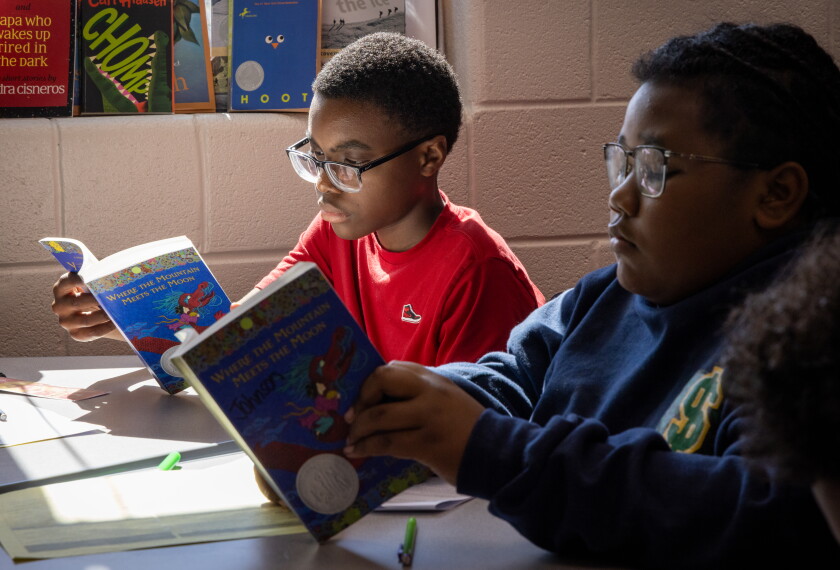
Students read Where the Mountain Meets the Moon in Jaime Johnson’s 6th grade language arts class at Murphy Middle School in Dacula, Georgia on September 22, 2026.
Students read <i>Where the Mountain Meets the Moon</i> in teacher Jaime Johnson’s 6th grade language arts class at Murphy Middle School in Dacula, Georgia on September 22, 2026. Johnson has students do most of the reading in class—to improve fluency, created a shared culture of engagement in books, and above all make sure every student completes the text.
Dustin Chambers for Education Week
Reading & Literacy Can Pizza Hut-Style Rewards Spark Lifelong Reading Habits?
Schools need to partner with parents and community organizations to help students read more.
8 min read
EL 20261015 TurningThePage 15
Ivana Moore, 33, reads a book to her son, Jahlil Moore, 4, during a community night hosted by the nonprofit Turning the Page at Lee Montessori-East End elementary school in Washington on Oct. 15, 2026.
Eric Lee for Education Week