In a recent opinion essay, I defended the primacy of traditional literacy skills against the National Council of Teachers of English ’s mystifying call to “decenter” them. In this essay, I will describe how any teacher can effectively impart core literacy skills. Then I’ll provide examples of schools where such efforts have had a decisive impact on student learning.
For starters: We need to maximize opportunities for students to engage in purposeful reading, discussion, and writing. We should aim for 90-120 minutes per day, spread across the curriculum.
All three elements require suitable amounts of explicit or “scaffolded” instruction.

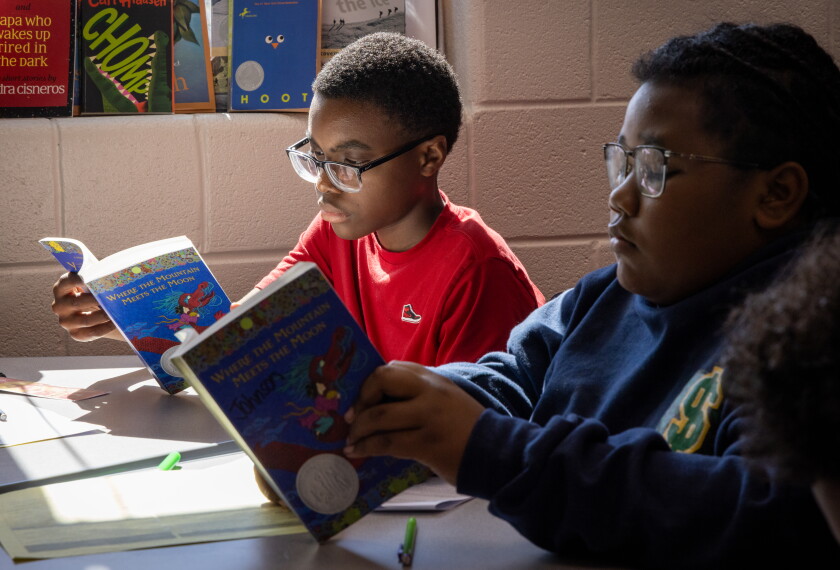
1. Let’s begin with reading.
Every student will enjoy and glean far more meaning from any text if we start with some background (and a dash of enthusiasm) to establish relevance.
Then, provide brief simple definitions for potentially unfamiliar words in the text. This boosts comprehension by about 3 grade levels for struggling readers, according to education researcher Robert J. Marzano’s 1999 Essential Knowledge: The Debate Over What American Students Should Know.
Finish by writing an arresting question or prompt on the board—which gives students a reason to read. For nonfiction, pose questions that require them to analyze, compare, or evaluate as they read. As a former teacher and now as a guest instructor, I’ve had success asking middle and high school students to compare historical figures, argue for or against nuclear power, and evaluate the logic of Supreme Court decisions. (Middle schoolers are quite adept at detecting the weaknesses of the “separate but equal” doctrine.)
For literature, lean hard on character analysis: Is Jack a hero or a jerk in “Jack and the Beanstalk”? Is Gatsby a lout or a lovesick victim of the decadent ‘20s? Students enjoy such inquiry, which is an excellent entry point into theme and meaning. (Structure and symbolism? Not so much.)
To fully engage with texts, students need to be apprenticed in the indispensable tools of analytic reading—how to underline, annotate, and note-take at increasing levels of sophistication. We need to show them how to employ these, in step-by-step cycles of scaffolded instruction, checks for understanding, and re-teaching—until they gain command of these strategies.
And please: Never stop reading out loud to them, with expression, as they read along. This promotes fluency, comprehension, and literary appreciation.
2. Now, students are ready to discuss. Start by having them briefly pair up to share what they underlined and why. This is the perfect rehearsal for the ensuing whole-class discussion.
Discussion must also be taught explicitly, with liberal amounts of random “cold calling” to ensure that all students participate. Throughout, provide gentle but specific guidance to ensure that they speak audibly, clearly, and always with civility. When I ask students to clarify a jumbled or muffled remark, their subsequent attempts are always fruitful. Students enjoy these discussions and are honored to have their thoughts taken seriously.
3. Finish with writing. We can intersperse reading and discussion with short bursts of writing, which generate and clarify thought before the discussion. Every teacher should be apprised of one of education’s best kept secrets: Analyzing, then arguing the issues in a text may have more impact on student motivation and writing quality than any other factor.
Students also need structured instruction on the rudiments of writing. Nothing exotic here: Simply show them—through cycles of whole-class modeling, monitoring, and reteaching—how to: write an interesting introduction, rough out a working outline, integrate quotes, and explain how quotes or paraphrased material supports their claim.
None of these is particularly difficult to teach if we develop and refine such lessons with colleagues. Such instruction is exceedingly effective and vastly reduces time spent grading papers.
Make no mistake: When schools conscientiously apply such evidence-based approaches, they achieve “stunningly powerful consequences” in as little as a school year, according to Michael Fullan’s research. I’ve worked with elementary teams who developed and refined reading and writing lessons at monthly meetings at which they routinely celebrated double-digit writing gains.
For decades, schools that adopt these methods have proven the power of such a focus. In 2009, New Dorp High school, in the Bronx, performed so poorly it was marked for closure—until Judith Hochman guided faculty as a consultant in how to systematically teach reading, speaking, and writing. In two years, scores soared and the school became an educational mecca.
Starting in 2001, Massachusetts’ Brockton High School made immediate, then meteoric and sustained gains the moment that school leaders made explicit instruction in “reading, writing, thinking, and reasoning” their schoolwide focus, the principal told me in an interview not long after.
I heard a similar success story when I interviewed the assistant principal at View Park Preparatory High School in Los Angeles in the early 2000s. The school experienced a surge in achievement when it applied such practices in English/language arts, then across the curriculum. It became the highest-achieving majority-minority school in California.
In the Tucson-area district where I formerly worked at the central office, a middle school English and social studies team made a radical move in the 1990s: They rebuilt their curriculum exclusively around systematic instruction in reading, discussion, and weekly argumentative writing assignments. In one year, their scores rose from just average to the highest in their metropolitan area. That doesn’t begin to capture what I saw those students learn in terms of their ability to speak, listen, weigh ideas and write well.
That’s the power of focusing on the elements of traditional literacy. When we commit to it, tens of millions more students will receive a life-changing education, even as we manage the academic fallout from the pandemic.