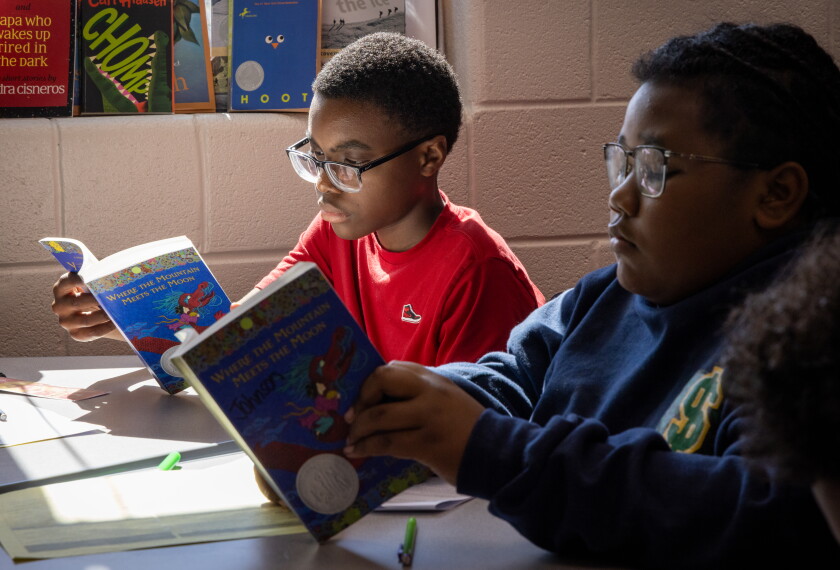
My favorite moments with my students happen one-on-one. These moments often take place when a child is reading to me while I observe, take notes, and share what I notice about her strengths and needs as a reader.
Whether you’re collecting information by listening to a student read, doing a formal assessment, or holding a reading conference, here are six ideas for making the most of that valuable one-on-one time.
Tip #1. Go for quality over quantity but allot plenty of time for your struggling readers.
Time is a scarce quantity for teachers. It can feel hectic to try to get to all 25 kids for individual reading conferences each week, like playing a teacher version of Whac-a-Mole. You don’t need to do that.
I make time for three individual conferences a day, along with pulling small groups. That means I don’t read with every child every week.
I would rather have 10 or 15 meaningful conferences than the satisfaction of putting a check mark next to all 25 kids’ names for meetings that were rushed or superficial.
I spend the most time with my emergent readers, conferencing with them almost every day. For students who are already reading above grade level, we might do these one-on-one meetings every other week.
Being equitable with our time doesn’t mean allotting it identically to each student. Our struggling readers need it most.
Tip #2: Begin each conference by pointing out a strength.
During reading conferences, I have the child read for a minute or two, and I point out a strength I noticed. Then I choose one teaching point: a specific skill or strategy the child could begin using to become a stronger reader.
It’s tempting to go straight for the teaching point. We teachers always have our hammers ready, and we’re eager to pound in every loose nail we come across. But reading out loud is a vulnerable process for many children, especially struggling readers. They tend to be more receptive to feedback on their reading abilities if we begin that feedback with one of their strengths.
Be specific. Point out the way the reader made an insightful connection, reread a part that confused her or changed her voice when the grumpy duck was talking.
Too often, we see students as a collection of deficits. Kids internalize that view. Helping young readers become aware of their strengths will help them build new skills on the foundation of everything they’re already doing well when they read.
Tip #3: Give the student time to try the teaching point while you watch.
Once you identify and explain a teaching point based on your observations of the child’s reading, make sure the student gets it. Sometimes, even when they’re eagerly nodding their heads, our students have no idea how to go off and do what we just told them to do.
Close the conference by having students try out that new skill—anything from making predictions to using a glossary—while they’re still sitting beside you. If the student does it right away, give him a high five and send him off to keep practicing. If he struggles or just gives you a blank stare, explain the skill again and model it with a different example from the book.
It’s not enough to teach. We have to make sure the kids learn.
Tip #4: Check for comprehension through conversation.
If children read a text with 100 percent accuracy but have no idea what they just read, they’re not truly reading.
Asking simple questions like, “What happened in this story?” or, for nonfiction, “What did you learn from this book?” will tell us a lot about how well a child is making meaning while they read.
Some students may not be doing the critical, invisible work of reading—visualizing, connecting, inferring, predicting—at all. Even for readers who are doing those things, translating their thoughts into words is a second step that takes practice and support, particularly for English-learners. That translation from thinking to talking builds the foundation for a third step that will be critical as readers move into the upper grades: shifting from talking about what they have read to writing about it.
If a child can think it, she can say it. If she can say it, she can write it. But those transitions take time and practice.
Authentic assessments have a double payoff: We get useful information, but the process of doing the assessment also provides precisely the kind of practice the child needs. The division between instruction and assessment isn’t so stark, the way it is with standardized tests.
When it comes to comprehension, the best way for young readers to get that practice is by talking with you about what they have just read. This is especially true if they’re not having those conversations at home. You’ll learn a lot about students’ depth of understanding, and the conversation itself will make them more thoughtful readers.
Tip #5: Don’t stick your notes in a drawer and forget about them.
When you assess a child’s reading ability, the score is not the point. Knowing a child’s reading level can be useful in various ways: to communicate a child’s progress to her parents, to guide her toward books on her level, and to form guided-reading groups. But the real point of the assessment is using everything you learned while doing the assessment.
You devoted the most precious quantity there is in a classroom—your time—to gather all kinds of information about that child’s fluency, comprehension, and strategies for figuring out tricky words. That data won’t do any good sitting in a manila folder in your filing cabinet. Use it.
If a child is baffled by medial vowel combinations, grab a little whiteboard and a marker and spend some time swapping out “vowel teams” to change “moon” to “main” to “mean.” If a child doesn’t seem to be thinking while she reads, tell her to stop every page or paragraph to think, “What happened so far? What do I predict might happen next?” Then do it alongside her, modeling some “think-alouds” if she isn’t getting it at first.
The time we spend gathering data is only useful if we actually use the data to make kids better readers. To borrow the metaphor attributed to an educator in India by Milton Chen, weighing the elephant won’t make it any heavier. We have to feed it, too.
Tip #6: Teach the reader, not just the reading.
While I have the child sitting beside me for a conference, I usually take a minute before or after we read to ask questions like, “How’s our class going for you? Any problems? How’s your baby sister doing?”
Taking that half-minute to ask how students are doing can convey that we care about them as human beings, not just as a collection of reading levels and test scores. Over time, those little human moments can strengthen, reinforce, or repair the relationship at the heart of teaching.
On a webinar I led for the National Network of State Teachers of the Year about home libraries, one of the teachers said, “You know, I’m a great mom. I think I need to bring more of who I am as a parent into who I am as a teacher.”
We need to bring that parental patience, care, and tenderness to our teaching. We need to build plenty of one-on-one time into our classes and use that time not just to speak but to listen.
Making the time for meaningful one-on-one reading conferences provides a powerful way to listen. It can also remind us just how much we like these complicated, insightful human beings we get this one chance to know and teach.