The reauthorized Individuals with Disabilities in Education Act will attempt to eliminate one of the longest-running problems in special education: the overrepresentation of minority students.
The latest version of the main federal special education law, which President Bush signed into law on Dec. 3, includes provisions that will require states to keep track of how many minority-group members are in special education classes and provide “comprehensive, coordinated, early-intervention programs” for children in groups deemed to be overrepresented.
Rep. John A. Boehner, R-Ohio, the chairman of the House Education and the Workforce Committee, said during a House-Senate conference committee meeting on the measure that too many children are “inappropriately placed in special education.”
“In fact, many of these children simply have not been taught to read,” Rep. Boehner said on Nov. 17. “The overidentification and misidentification of children for special education is an issue we must address for the good of our education system as a whole.”
School administrators and researchers said the provision appears to put a new focus on an issue that has been discussed for years and is severe in some school districts.
The Schott Foundation for Public Education, a Cambridge, Mass.-based organization created to promote equity in education, recently released a report on education and black males that showed black students accounted for 72 percent of the total number of students with mental retardation classifications in Chicago’s public schools, while black students accounted for 52 percent of overall enrollment. In Charlotte, N.C., black students accounted for 78 percent of students with mental retardation, even though they represented just 43 percent of the district’s enrollment. The statistics were based on numbers gathered in 2000, according to the Schott Foundation.
In addition to overenrollment, researchers say that black and Hispanic students, once they are determined to be in need of special education services, are more likely than white students to spend time outside the regular classroom. According to an Education Week analysis of 2002-03 data from the Department of Education, 30 percent of black students in special education spend more than half the school day outside a regular classroom, compared with 15 percent of white students in special education.
New Priorities
“It’s not a new issue, but there’s some meat now behind it,” said Don Blagg, the coordinator for psychological services for the 280,000-student Clark County, Nev., school district, which includes Las Vegas and is one of the fastest-growing district in the country. Mr. Blagg also serves as the chairman of a school district committee on minority overrepresentation that is in its second year of studying the issue locally.
He said the renewed IDEA will build on provisions in the federal No Child Left Behind Act that emphasize achievement for special education students.
“No Child Left Behind has done a lot of things, some positive, some negative,” Mr. Blagg said. “This might be one of the positives.”
Since 1997, the last time the IDEA was revised, the Education Department has required states to compile data on the racial and ethnic makeup of children receiving special education services. The new version adds several new provisions. In addition to making such monitoring a priority, districts must start early-intervention programs for children in overrepresented minority groups. The districts must also make public what they’re doing to address the problem.
By bringing overrepresentation to the forefront, Congress has “raised the level of awareness,” said Daniel J. Losen, a legal and policy research associate with the Civil Rights Project at Harvard University, which has studied the issue.
“The expectation is that most, if not all, states would have an action plan,” Mr. Losen said. “That’s the good news. They have to set some very clear indicators and targets for addressing the problem. You don’t want to just look at the numbers. They’re going to look at the educational outcomes for these kids.”
Under the reauthorized IDEA, school districts will also be able to spend up to 15 percent of their federal special education funds on early-intervention programs designed to help children before they end up in special education.
“That’s really unprecedented,” said W. Alan Coulter, the director of the National Center for Special Education Accountability Monitoring, based at Louisiana State University in Baton Rouge. The national monitoring center is federally financed through the Education Department’s office of special education programs.
The requirement for districts to report on new policies and procedures will allow the public to see whether changes are really happening, Mr. Coulter said.
“You and everyone else would be able to track what they do, and whether or not the change occurs,” he said. “It’s not that they’re reporting on the 15 new computers they got for the classroom or the three new teachers they hired.”
In Clark County, Mr. Blagg said, the district is already taking on some of the steps that would be required under the reauthorized IDEA. The district is working with researchers around the nation, as well as local administrators, teachers, and parents.
From an early analysis of the data, Mr. Blagg said, the district appears to have a problem with overrepresentation of minority students in special education.
“It’s not a major problem, but it is a problem. It’s a national problem,” he said. To address it, the school district has started some early-intervention programs and is making sure principals and teachers know about them.
“You have building-level teams that want help for the kid, and so they think special ed,” Mr. Blagg said.
Before a child enters special education, the principal must say that the other intervention methods have been tried.
“We need to use those other resources we have in regular education,” Mr. Blagg added. “They could be beneficial for those kids.”
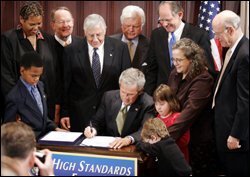
In signing the bill last week, President Bush stressed his administration’s mantra that all children are capable of learning. “Children with disabilities deserve high hopes, high expectations, and extra help,” he said.