Early Childhood

San Francisco Touts Gains From Pre-K Program

By Julie Blair — October 08, 2013 3 min read
  • Save to favorites
  • Print

Nine years after it began, one of the nation’s oldest city-run preschool programs—San Francisco’s Preschool for All—has significantly boosted minority enrollment in early-childhood education and made a marked difference in all participants’ numeracy, literacy and social skills, its administrators report.

An assessment of participants found that Latino and African-American enrollment in public prekindergarten jumped from 54 percent and 68 percent, respectively, in the 2007-08 school year to 80 percent for both in the 2009-10 school year, said Executive Director Laurel Kloomok, in an email interview. Pre-K enrollment for all racial and ethnic groups during those years went from 72 percent to 83 percent during that same time period, she added.

In addition, Preschool for All students tested three to four months ahead of peers in mathematics and three months beyond them in letter-word recognition in the 2012-13 school year, according to the report from Applied Survey Research, an independent firm, which was released in August of this year.

Among the social gains the program claims at the nine-year mark: Children enrolled in Preschool for All scored an average of 6 percentile points higher on a 2012-13 exam testing self-regulation skills than students who had not participated, Ms. Kloomok said. The scores of Spanish-speaking children were nearly double—12 points, she added.

“San Francisco’s preschool success stems from a combination of factors, but primarily from an unwavering emphasis on both improving equal education opportunity and increasing preschool program quality,” Ms. Kloomok said.

Cities Push Pre-K

San Francisco is one of a growing number of cities to offer city-run pre-K programs, along with Boston, Miami, San Antonio, and Seattle, among others, according to W. Steven Barnett, the director of the New Brunswick, N.J.-based National Institute for Early Education Research at Rutgers University.

In 2004, San Francisco voters agreed to channel $20 million annually to Preschool for All with the intent of offering half-day pre-K to any child who was 4 years old and lived in the city.

The First 5 agency was charged with running the early-childhood program, and then partnered with various vendors including the 55,000-student San Francisco Unified School District, the federal Head Start program, nonprofits, for-profit centers and family child-care providers, Ms. Kloomok said. Families often qualify for more than one program and thus are able to build a full-day model for their children.

Today, 3,400 4-year-old children are participating in the Preschool for All program in the 2013-14 school year, Ms. Kloomok said. A sliding scale based on income is used to determine what each family will pay; many children attend for free.

“Preschool shouldn’t be considered a luxury,” said San Francisco parent Joanna Koon, who is unemployed but was afforded the opportunity to send her now 6-year-old son to Preschool for All. “It benefits children for the rest of their lives.”

But Susan Solomon, the executive vice president of the United Educators of San Francisco, worries about quality and consistency.

Independent Providers

Currently, there are 137 providers in the Preschool for All program—many of which are run independently of the public school system.

“Having more [providers] underthe [school district] would be preferable,” Ms. Solomon said.

Parent John Monson, however, said Preschool for All exceeded his expectations.

“The experience was astonishing,” said Mr. Monson, who picked the public program for his son after assessing 10 different preschools, including some “swanky” options. “The teacher-to-student ratio was great,” he said. “They adopted all these modern teaching methods which are conceptual and child-led.”

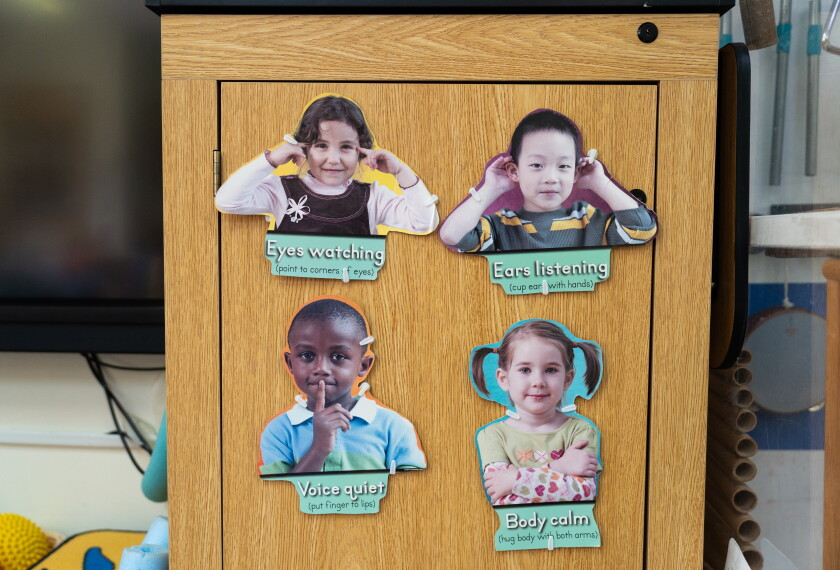
Mr. Monson’s son, now a 1st-grader, matriculated to the elementary school where the Preschool for All program is located along with a cohort of fellow graduates who, he says, are changing the culture there for the better. The graduates, he said, are excited to learn, sit quietly, pay attention, and set the bar for others.

Events

This content is provided by our sponsor. It is not written by and does not necessarily reflect the views of Education Week's editorial staff.
Sponsor
Assessment Webinar
Measuring What Matters: How District Leaders Are Redefining Student Assessment
In this panel discussion, district leaders and systems experts will examine the gap between the outcomes we want and the systems in place.
Content provided by Otus
Early Childhood Webinar Selling Into Early Learning: New Survey Data and Strategies for Marketers
Selling into PreK? Get fresh EdWeek Research Center data and strategies to position your products and reach the right early learning buyers.
Artificial Intelligence Webinar AI and 'Techlash' Are on a Collision Course. How Should Schools Respond?
Learn what strategies and tactics schools can develop to encourage smart and responsible AI use, while also enforcing tech guardrails.

EdWeek Top School Jobs

Teacher Jobs
Search over ten thousand teaching jobs nationwide — elementary, middle, high school and more.
View Jobs
Principal Jobs
Find hundreds of jobs for principals, assistant principals, and other school leadership roles.
View Jobs
Administrator Jobs
Over a thousand district-level jobs: superintendents, directors, more.
View Jobs
Support Staff Jobs
Search thousands of jobs, from paraprofessionals to counselors and more.
View Jobs

Read Next

Early Childhood Puerto Rico Balks at Trump's Proposal to Require English at Head Start Centers
Parents and educators warn the change could undermine children's connection to their culture.
5 min read
A Puerto Rican flag is displayed on a screen in a classroom at the John Cardinal O’Connor Center for Parent and Child Development, a Head Start center operated by The New York Foundling, in San Juan, Puerto Rico, Tuesday, Oct. 13, 2026.
A Puerto Rican flag is displayed on a screen in a classroom at the John Cardinal O’Connor Center for Parent and Child Development, a Head Start center operated by The New York Foundling, in San Juan, Puerto Rico, Tuesday, Oct. 13, 2026. A Trump administration proposal would require instruction in English only in Head Start, which has caused concern in Spanish-speaking Puerto Rico.
Alejandro Granadillo/AP
Early Childhood 'Whoa Whisper' and 'Busy Hands': 7 Ways to Teach Kindergartners Impulse Control
Teachers report that young students struggle to control their impulses. Here's why, and how to help.
5 min read
At the start of her 26th year as a kindergarten teacher in Cinnaminson, Maureen Coller comforts Logan Santos on the first day of school at the New Albany School on Sept. 4, 2026. After hugging him, Coller showed him a photo on her phone of his sister, who is two years ahead of him at the school. His grandmother is also a lunchtime cafeteria worker, so he was fine. Coller graduated from the district in 1997 and was inducted into the Educator Hall of Fame this week.
Kindergarten teacher Maureen Coller comforts Logan Santos on the first day of school at the New Albany School in Cinnaminson, N.J., on Sept. 4, 2026. Early elementary teachers say their students are struggling with impulse control and other executive function skills.
Tom Gralish/Philadelphia Inquirer via TNS
Early Childhood Video How Play-Based Learning Helps Children Practice Math and Literacy Skills
See how elementary teachers use play-based learning to reinforce math and literacy instruction.
1 min read
Children enjoy a morning at the writing center at the Coltrane-Webb STEM Elementary School in Concord, N.C., on Sept. 3, 2026. Educators at the school use play to reinforce math and literacy instruction.
Peyton Sickles for Education Week
Early Childhood Here’s Where RFK Jr.’s Head Start Deregulation Would Hit Hardest
The Trump administration has proposed dismantling several key Head Start regulations.
6 min read
DSC01507
Educational posters and stickers are displayed in a Head Start center classroom in Athens, Pa., on Aug. 13, 2026. The Trump administration has proposed sweeping changes to Head Start regulations.
MD. ZOBAYER HOSSAIN JOATI for Education Week