Reading & Literacy

This District Made Writing an Integral Part of Its Teaching, and It’s Paying Off

By Caitlynn Peetz Stephens — February 23, 2023 1 min read
  • Save to favorites
  • Print

In elementary schools, writing instruction is often segmented from reading instruction, despite research showing that the two disciplines are closely connected, and an intentional focus on writing instruction pays off in the form of improved academic performance in reading and other subjects.

But in Sumner County, Tenn., district leaders have intentionally embedded writing instruction in the English curriculum to help the youngest learners make strides in reading comprehension.

The district was highlighted for its work in a recent Education Week special report that examined how writing instruction intersects with the science of reading.

See Also

Third graders identify the different components of a strong paragraph, practicing with a sample piece of writing. Teachers at Kegonsa use models like this to help students master the frameworks that they will use in their own writing.
Narayan Mahon for Education Week

In a live event with Education Week, curriculum leaders in Sumner County explained how the 29,000-student district has overhauled its curriculum to more explicitly embed writing instruction.

Sumner County’s work began in 2019, after district leaders noticed students’ reading scores on standardized tests were lagging. The new English/language arts curriculum incorporates writing as a main focus of students’ lessons. Rather than focusing on memoirs and personal essays, students are asked to write about what they’re learning in the classroom.

Scott Langford, Sumner County’s chief academic officer, and Frankie Skinner, the district’s supervisor of federal programs, said the transition took time and required patience from teachers and students, but the results have been worth what Langford called a “productive struggle.”

Yes, students’ reading comprehension and test scores are improving, but so is their self-confidence because they are better able to engage with and understand the world around them.

“The self-esteem boost kids get out of that is a big deal, too, because they’re not just getting used to talking about what they see or how things make them feel but they’re grounding that in knowledge that they’ve acquired, so their confidence grows by leaps and bounds,” Langford said.

Reading & Literacy Q&A How One District Found Success by Overhauling Writing Instruction
The district anchored its new approach to writing in rich content linked to its new English/language arts curriculum.
9 min read

Events

This content is provided by our sponsor. It is not written by and does not necessarily reflect the views of Education Week's editorial staff.
Sponsor
Assessment Webinar
Measuring What Matters: How District Leaders Are Redefining Student Assessment
In this panel discussion, district leaders and systems experts will examine the gap between the outcomes we want and the systems in place.
Content provided by Otus
Early Childhood Webinar Selling Into Early Learning: New Survey Data and Strategies for Marketers
Selling into PreK? Get fresh EdWeek Research Center data and strategies to position your products and reach the right early learning buyers.
Artificial Intelligence Webinar AI and 'Techlash' Are on a Collision Course. How Should Schools Respond?
Learn what strategies and tactics schools can develop to encourage smart and responsible AI use, while also enforcing tech guardrails.

EdWeek Top School Jobs

Teacher Jobs
Search over ten thousand teaching jobs nationwide — elementary, middle, high school and more.
View Jobs
Principal Jobs
Find hundreds of jobs for principals, assistant principals, and other school leadership roles.
View Jobs
Administrator Jobs
Over a thousand district-level jobs: superintendents, directors, more.
View Jobs
Support Staff Jobs
Search thousands of jobs, from paraprofessionals to counselors and more.
View Jobs

Read Next

Reading & Literacy Q&A Why This Under-the-Radar Piece of Literacy Reform Is One of the Most Important
Parent notification is a central piece of reading reform, this advocate says.
5 min read
Collage of a Black female reading a book with her young daughter on her lap. Other pieces of the collage show an open book with non-legible text, speech bubbles, the letter "A" and a butterfly.
Collage by Gina Tomko/Education Week + Canva
Reading & Literacy 'Long Form' vs. 'Short' Reading: What's Going on Inside A Student's Brain?
Reading a novel and reading short text messages work the brain differently. Here's what that means.
3 min read
Pieces of a book page and a cellphone.
Collage by Laura Baker/Education Week + Getty
Reading & Literacy Creating a Culture of Reading for Pleasure Amid a Focus on Basics
School librarians at Missouri's Clayton school district bring a culture of reading to all students.
9 min read
Tom Bober
Students read books in the library at Captain Elementary School in Clayton, Mo., on Tuesday, Sept. 29, 2026. School Librarian Tom Bober works with teachers at the school to help instill a culture of reading early in students' lives.
Neeta Satam for Education Week
Reading & Literacy Getting Middle Schoolers to Do the Reading Is Hard. Can Communal Reading Help?
New classroom methods aim to help kids internalize the message that engaging in print is worth it.
11 min read
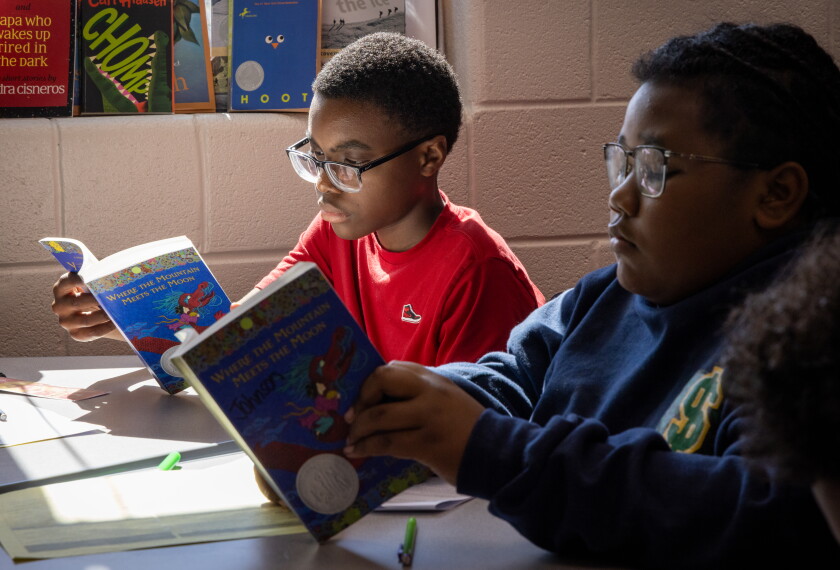
Students read Where the Mountain Meets the Moon in Jaime Johnson’s 6th grade language arts class at Murphy Middle School in Dacula, Georgia on September 22, 2026.
Students read <i>Where the Mountain Meets the Moon</i> in teacher Jaime Johnson’s 6th grade language arts class at Murphy Middle School in Dacula, Georgia on September 22, 2026. Johnson has students do most of the reading in class—to improve fluency, created a shared culture of engagement in books, and above all make sure every student completes the text.
Dustin Chambers for Education Week