
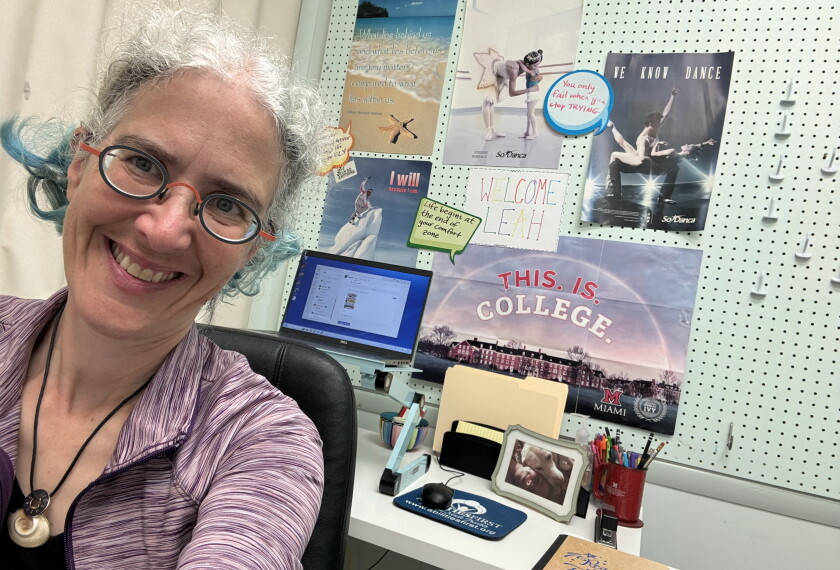
After decades of preparing K-12 educators to support students with disabilities, Leah Wasburn-Moses returned to the special education classroom this fall for the first time in 25 years.
She lasted one week.
Confronted with the modern special education intervention classroom’s blizzard of administrative and technology tasks that she said ate up instructional and personal time alike, Wasburn-Moses stepped down from her position in a large, urban Ohio middle school intervention classroom before the end of August.
“It was humiliating, right?” said Wasburn-Moses. “That’s the whole stereotype about the professors in the ivory tower who don’t know what it’s like in the real world, despite our best efforts.”
Now, Wasburn-Moses works directly with students and parents through Abilities First, a nonprofit agency serving students on Ohio’s private school voucher program for students with autism. But her experience, she said, served as a harsh wake-up call about the kind of supports preservice and early career special education teachers need to thrive in public education over the long haul.
This conversation has been edited for length and clarity.
On the decision to return to the classroom
I just became increasingly frustrated with the inability of the academy to do what works in teacher education. After so many reports and so much really solid research by incredible researchers, it’s so clear what we need to do to structure our coursework around high-quality clinical experiences and what it takes to develop and sustain them, but we’re still doing a collection of courses with just some field experience built in. That frustration point really hit, and I’m the kind of person who needs to feel like I’m doing something every day that makes a difference.
I would say everything about my experience returning to the classroom was typical: middle school students with moderate needs who were still held to general education standards, but were placed in pullout settings. I was expected to do some specially designed instruction with [8-12 students] while supervising a classroom. And there was a new math curriculum. ... I actually really, really loved teaching the math, although I could tell it was going to become a increasing challenge.
The instructional practice was not different from what I was expecting. What’s changed since 2001 is really positive, which is the expectation that students will learn grade-level content. That is really a step forward.
The software tsunami was an eye-opener
We’d always in teacher education deliberately ignored one of the largest pieces that was overwhelming to me: all the software. We ignore teaching specific software because it turns over all the time—which is quite legitimate, but ... that software piece was just enormous.
I really had expected there to be a huge increase in workload. I was not prepared for all the discrete systems that didn’t interact with each other.
Two weeks before the start of school, ... I was handed a laptop with 21 tabs open. There was ClassDojo [a classroom-management tool], the math curriculum site, ProgressBook; there was the professional development classes that we had to take; state testing sites, district testing sites, and a software dashboard with 14 tabs, including the learning management system and Google Classroom. And of course, there was the Securly so you can monitor kids’ use of the Chromebooks.
Even with paraprofessionals to help me—they were trying to help kids log in as I’m trying to work on individual goals with others, and figure out where each student is to assign individualized work, and tracking progress for individualized education programs—I was working every hour I was awake.
I would not want to go back to the old days, when there was no accountability. But it’s really tough to look suddenly at 25 years of paperwork bloat. It makes you realize all at once that the compliance piece has gotten so out of hand that it’s making instruction subservient.
It was really hard to walk away because my work ethic will often supersede my mental health. ... I feel like a partner would have really helped a lot: co-teaching, having time to sit down and co-plan. I had paraeducators, but they are doing different things.
I certainly did reach out to colleagues, supervisors, and everyone was willing to sit down and help, but I could see that other teachers had a similar workload.
Another special education teacher, a former student of mine, started at the same time I did, and we texted back and forth a lot; we were experiencing similar levels of stress and anxiety.
The breaking point
You know how when you go to the doctor they give you these depression and anxiety screeners? I came across something like that in my school counseling studies, but I realized that I had hit clinical levels of anxiety across the board.
After I left the middle school, I was only out of work for about three weeks, but it was a terrible three weeks. I was able to recover most of my professional dignity by working as a special educator at a special school for children with autism probably a four-minute drive from the middle school where I was working. I work with two amazing colleagues, and we oversee and plan interventions in four classrooms each.
it's really tough to look suddenly at 25 years of paperwork bloat. It makes you realize all at once that the compliance piece has gotten so out of hand that it's making instruction subservient.
I’m in and out of classrooms all day, and there’s a lot of the same IEP paperwork, but ... the big difference is I’m not trying to do all the administrative tech at the same time I’m teaching classes.
There’s plenty of time to do the administrative stuff that needs to get done, and nobody brings anything home with them. For the first time in my life, when I go home, I’m done with work.
In the college classroom, what I would do differently is design coursework around the field work. I would say to make sure preservice teachers are really immersed in all aspects of the job.
In the traditional way of teacher preparation we’ve always said, “OK, we need a credit in this, credit in this, credit in this.” And that’s how we think about designing the curriculum. So we end up checking off boxes, and then our field placement ends up being an afterthought instead of the very first thing that we plan, and plan with our school partners.
We end up getting pushback on our assignments. Like, we’ll say, “Teach a lesson.” Well, maybe that doesn’t work with what the teachers want and need for the classroom. You need to go into a field placement knowing what the school’s goals are, and how they want to use the teacher candidates to help with the school goals.
You know, people talk about money and really, even though of course our teachers need to be compensated for the hard work they do, that’s way down on the list of stressors. We have really good surveys of teachers saying why they left the profession, and it’s really just that it’s too much, and there’s a lack of support.


