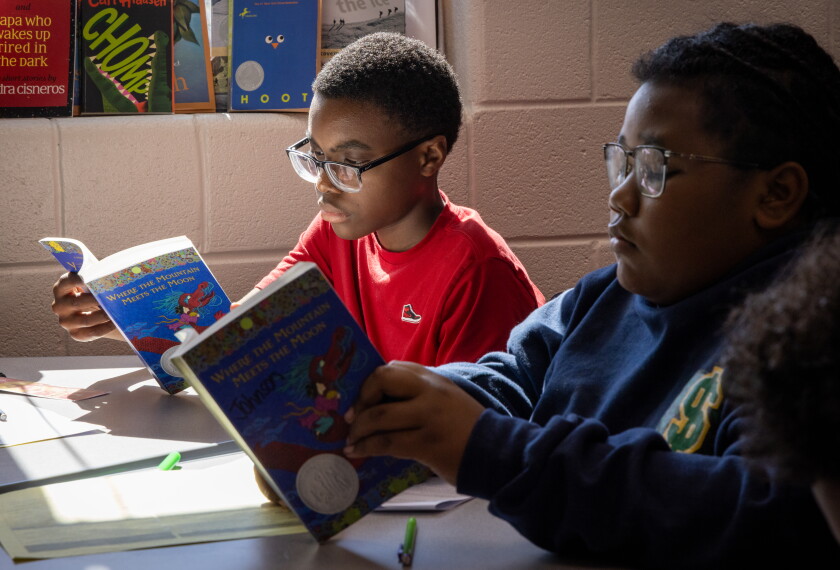
For the millions of students who struggle to read at grade level, every school day can bring feelings of anxiety, frustration, and shame.
That’s why it’s critical to support students’ social-emotional needs alongside their reading instruction, experts say, especially in later years. After 3rd grade, students are expected to switch from learning to read to reading to learn. But if students haven’t mastered the foundational reading skills at that point, they may never become strong readers. They may disengage from school as the years go on, and many—especially students from low-income families—will not graduate.
“By the time kids hit 3rd or 4th grade, if they’re still having a tough time [with reading], they view it as a failing on their part,” said Elizabeth Jaeger, an associate professor in the University of Arizona College of Education. “Reading is such a core part of being successful in school, and they see themselves as not being able to do that. … ‘All these other kids just like me are doing just fine, and I can’t seem to get it together.’ That’s just a really heavy burden, I think, for a lot of kids and that’s the heart of their vulnerability.”
They’ve really internalized these messages that school isn’t a place for them, that they’re not smart, and that reading isn’t an enjoyable activity.
School can be a minefield for those students, particularly as they reach middle and high school. Reading is woven throughout every subject area, meaning that children who don’t receive appropriate support can fall behind in multiple classes, even though they are capable of intellectually understanding the material. Teachers may call on students to read aloud in front of the entire class, opening them up to potential judgment or snickers from their peers. And sometimes, students who lack decoding skills are given early-reader texts to practice, which feel babyish and boring.
Often, students who are not progressing at the same rate as their peers are ashamed and try to hide their lagging reading skills, said Ann Monroe, the assistant dean of the University of Mississippi School of Education who studies shame in the classroom. That desire to hide can manifest itself in four ways, as defined in psychiatrist Donald Nathanson’s model of the Compass of Shame:
- Attack self. This can range from verbal self-put-downs (“I’m so stupid”) to self-harm.
- Attack others. A student may lash out at a teacher or classmate who exposes their weakness in reading.
- Withdrawal. A student who is ashamed of their reading abilities may avoid participating in class or stop showing up altogether.
- Avoidance. A student may try to deflect attention by exhibiting disruptive behaviors, such as being the class clown or acting out.
“It’s a rare occasion for a kid … who knows they’re struggling to be willing to be brave enough to ask for help,” said Jeanne Schopf, a middle school reading specialist, interventionist, and coach in Sturgeon Bay, Wis.
Many students don’t master foundational skills in early grades
Research shows that systematic, explicit phonics instruction is the most reliable way to make sure that children learn how to read words. Yet many elementary teachers aren’t trained in this type of instruction, so students are often taught to identify a word by guessing with the help of context clues. They might learn some letter-sound patterns but not others. They can’t reliably decode words but may be able to mask their reading difficulties if they understand the meaning of the story and can predict words that make sense and look right on the page.
The opposite is also true: Some students may be able to decode, but they don’t have a deep enough understanding of oral language to make meaning of the words they are saying.
Often, children who can’t reliably decode words continue to advance through school at a substandard level without receiving any evidence-based instruction, said Sarah Part, a policy analyst at the nonprofit Advocates for Children of New York, which offers legal and advocacy support for students from low-income backgrounds in New York City who are struggling in school.
“The problem just gets worse and worse and worse over the years, and the student gets increasingly frustrated and falls further and further behind,” she said. “They’re students who could have learned to read, no question, had they gotten the type of instruction they needed.”
Small deficits students may have in reading compound over time—a phenomenon known as the Matthew Effect in Reading, after the Bible verse in which the rich get richer and the poor get poorer. A student who struggles with decoding can’t access the information in grade-level texts, unless teachers provide other avenues. If they can’t access the information, they can’t use it to make sense of future texts, and their comprehension and background knowledge suffers.
By the time students who struggle to read get to middle or high school, many of them have been in ineffective reading-intervention programs for years, experts say. They may develop low self-esteem or anxiety, and many are angry, both at themselves and at educators who have not been able to teach them to read.
“They’ve really internalized these messages that school isn’t a place for them, that they’re not smart, and that reading isn’t an enjoyable activity,” Part said.
Sometimes, these students disengage or act out so frequently that teachers assume they’re not applying themselves or don’t care about school. But in reality, Part said, “it’s all stemming from the fact that it’s really frustrating and humiliating to be older and not be able to read.”
Teachers can help mitigate feelings of shame
Teachers can support students’ social-emotional needs by maximizing their positive feelings, minimizing negative ones, and creating a culture where students feel comfortable talking about their emotions surrounding reading, Monroe said.
To start, teachers must create a classroom environment where students feel comfortable asking for help and making mistakes in public without fear of mockery. Meg Tegerdine, a 5th and 6th grade special education teacher in Florissant, Mo., said her students often feel like educators in their past have given up on them. It takes time for them to get to a place where they feel comfortable being vulnerable and taking risks in reading, she said.
“Nothing works if you don’t have relationships” with students, she said. “I try really hard every year to let them know … they’re worth fighting for and I’m going to be the one fighting for them.”
But pedagogical strategies like “popcorn reading,” in which students are randomly called on to read aloud for a short period of time, can cause anxiety for students who are below grade level in reading, educators say. “That is a really easy way for a kid to feel discouraged or put on the spot,” Tegerdine said.
Instead, teachers could use strategies like “choral reading,” in which the entire class reads aloud in unison, or private read-alouds, in which a student reads directly to the teacher, to build fluency and oral-language skills, Monroe said.
Older students who have not mastered reading are at risk for disengaging from school. Here are some expert-recommended do’s and don’ts for teachers:
- Do build a supportive classroom environment where students feel empowered to be vulnerable and make mistakes.
- Don’t force students to read aloud in front of their peers.
- Do offer scaffolding and supports so that students can access grade-level content even if they are not reading at grade level.
- Don’t always group students who are reading below grade level together. Instead, utilize flexible grouping that are sometimes homogenous and sometimes heterogeneous.
- Do give struggling readers books that are interesting and age-appropriate while still being accessible in terms of reading level.
- Don’t assume that a student who is refusing to engage in classwork is lazy or doesn’t care about school. Embarrassment and shame might be at the root of their behavior issues.
- Do incorporate students’ strengths and interests into reading instruction.
Teachers should also carefully consider how often they’re grouping students of similar reading skills together, because that can stigmatize struggling readers, Monroe said. While ability-based reading groups are meant to target instruction to students’ learning needs, research shows that students in lower-level reading groups are slow to progress academically and less likely to move up to higher-level reading groups in later grades.
“A lot of times, students get stuck in groups,” Monroe said. “They notice it, and this can create a feeling of shame.”
She recommends teachers use flexible grouping, a strategy that puts students in different reading groups depending on the day and the lesson. Sometimes, the groups may be homogeneous in terms of reading skills, while other groups might consist of students of varied abilities.
Also, it’s important to capitalize on the strengths students already have. For example, Monroe said she worked with a high school teacher who had many students reading below grade level. However, the students were artistic and enjoyed illustrating comic books—so the teacher encouraged them to add more text into their comic books and then swap their books with peers to read.
“When you’re doing something you’re good at, you’re much more motivated,” Monroe said. And “when kids are motivated, they tend to do better.”
Teachers should meet students where they are
Experts say older students who are reading below grade level should have access to age-appropriate texts that are engaging while still being accessible. High/low books—short for high interest, low reading level—can help build fluency and vocabulary skills while also maintaining interest in reading.
Nonfiction texts often strike a good balance between having sophisticated content and relatively simple sentences, the University of Arizona’s Jaeger said. And Tegerdine said she uses a lot of comic books and graphic novels with her students, since the subject areas are usually more mature, but there’s less text.
Schopf, the middle school reading interventionist in Wisconsin, said she gives students who are reading below grade level the same books as their classmates as long as there is additional support. For example, students can listen to an audiobook, which will help them develop more vocabulary and meet certain grade-level standards, such as identifying the theme or the main character. (Students will also meet with Schopf for explicit phonics instruction.)
But often, middle and high schools don’t provide students who are below grade level in reading with the assistive technology they need, said Part of the Advocates for Children of New York.
“Not being able to read at grade level should not be a barrier to getting other grade-level academic content,” she said. “That’s what’s going to help students engage in school.”
After all, by middle school, students who struggle with reading have often experienced what could be considered trauma, educators said.
“It’s very important—in addition to getting students evidence-based instruction—to validate their past experiences,” Part said. “They’ve been struggling for a long time, and no one has helped them. It’s not their fault: The school system failed them.”