I’m not typically one for public confessionals, but too many musings are scrambling my brain. And, as I tell my students often, sometimes to make sense of them, you just have to write them down.
First, I find myself—as do most of my teaching brethren—in the unique position of having abruptly transitioned into a remote instructor. Cool. I’ve been looking forward to experimenting more with Google form quizzes anyway.
But as I sit here trying to plan for (at least) two weeks’ worth of online English lessons, reading checks, and assessments, I feel troublingly unmotivated (at least in part) to do a good job of it. Mind you, I won’t slack. But I’m not entirely hopeful. As I told my students last week (when in every class someone asked the what-if-we-close question): “Trust me ... you don’t want this. You don’t want two straight weeks of online school.” (And that was also back when we thought schools would just be closed for 14 days.)
“Why not?” they’d say.
“Because,” I’d respond, “Imagine getting one of my ‘Today’s Tasks’ emails that you get when I’m sick ... every day. Times eight. For two weeks.”
I find myself—as do most of my teaching brethren—in the unique position of having abruptly transitioned into a remote instructor."
[Long pause.] “Oh. Yeah, that’ll suck.”
And they’re right. It will suck. But not necessarily for the reasons that might seem more obvious. Yeah, it’s a lot of work. And, yeah, they didn’t sign up for online schooling, and, yeah, some of them don’t have great—or any—internet access at home. But that’s just the surface.
Long before we knew anything about coronavirus, I decided to completely revise and retool my research paper unit for the 2019-2020 school year: new prompt, new materials, new models and samples, interactive Google doc tools, templates, thesis submission forms, peer-review strategies, special tutorials—the works. The results were unreal. I had 100 percent of my juniors fully engaged, even invested, in their work. They’ve learned how to take a topic and turn it into a research question. They’ve learned not to cherry-pick data from sources that merely echo their preferred media and have instead gone through the intellectual challenge of first finding credible information and then making up their minds about an issue. They’ve wrestled with preconceptions they once had about their topics and recognized, in some cases, aspects about their subject matter that they’d never thought to explore. They used to ask me questions like, “So, do I have to, like, use quotes in my paper?” This year, they’re asking things like, “So when I did my research initially, I found this source, but I don’t think it’s really relevant to my thesis anymore. Can I switch it out for this new article I found because it’s much more in line with what my topic turned into. And, oh yeah, I think I figured out how to cite it. But can you double check that I did it right because it’s an old newspaper article I found from my public library’s database?”
Do I ramble on to toot my own horn? No. (Or at least, I don’t think so.) I merely reflect on just one of the many multi-faceted disciplines I and my colleagues are tasked with teaching and engaging young minds in every day, and I know that in this case, at the very least, my students are engaged because I’m engaged. I’m right there with them. I’m flipping the classroom. I’m hopping between desks and helping them realize they’re halfway to solving their problems before I can even reach them. I’m answering their questions with questions of my own and helping them see they already have the answers. I’m watching a kid who once struggled in my class now beautifully articulate why the Houston Astros cheating scandal is going to forever change the game of baseball and watch how proud he is that he has dozens of testimonials and evidence from his MLB favorites backing him up. And that last verb is key: I’m watching it. Or at least ... I was.
Coronavirus is serious. I’m not disputing that. We have to take measures to minimize what we can in a national health crisis, and as an almost mother-of-two with a frail 92-year-old grandfather who—regardless of quarantine measures—still must leave his residence every three weeks for treatment at a heavily trafficked, urban hospital, I’m on board with what our Ohio Gov. DeWine and others have recommended. So, yes, online schooling, here we come.
But am I risking a Jerry Maguire moment here? Am I holding up that incendiary company memo that will get me promptly fired if I suggest that maybe ... we try not to be too good at it? That a statewide shut-down of schools once and for all confirms for everyone the vital role of the teacher in the classroom?
I’ve endured a lot of chatter over the years: Someday, school is gonna be all online ...
“You know, we could learn most of this from Google and YouTube ... ”
“This is so lame; school is so pointless ... ”
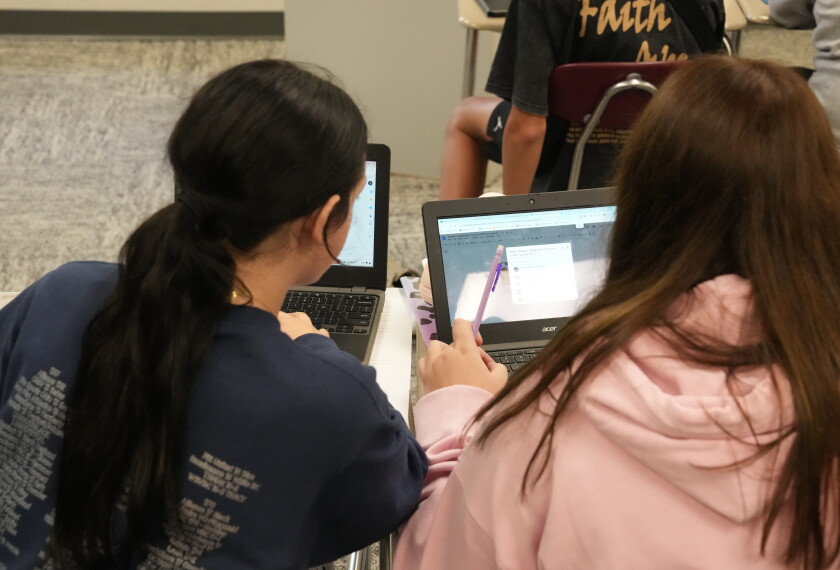
Maybe not. In fact, assuredly not. But sometimes it feels like we on the inside of education are the only ones who know it anymore. The only ones who remember it. Could it be that from this crisis emerges a happy little accidental epiphany? That a Chromebook is simply no substitute for a teacher? And a cluttered desk surrounded by laundry and candy wrappers (even if you do get to work in the comfort of your boxers and slippers) is simply no substitute for an active classroom teeming with friends, comrades, and even foes?
Look, I’m gonna do my best here. I promise. But if we as teachers manage to be as effective online as we are in the classroom, then we’ve failed. We’ve tragically, irreparably failed.
It’s day one, and I already miss my students. I miss them terribly.