
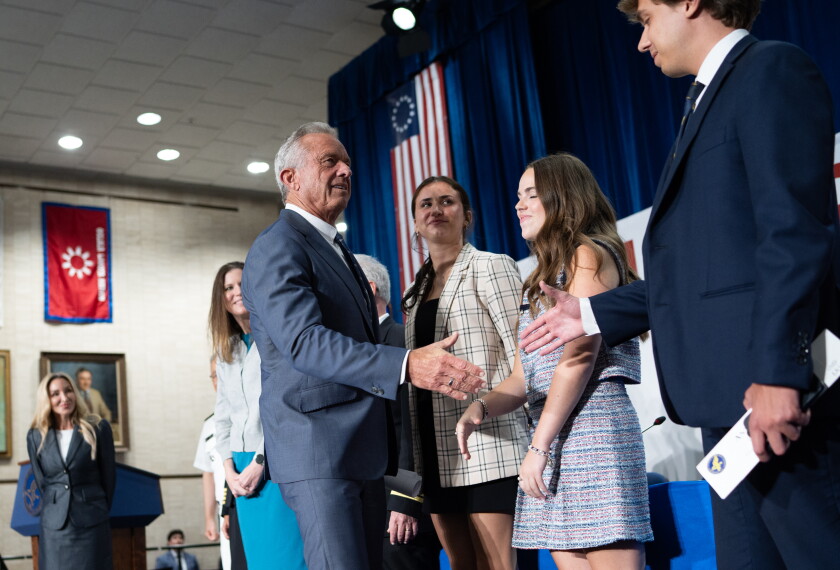
As concerns about screen time become more acute, the U.S. Department of Health and Human Services this week brought together researchers, school leaders, and physicians to discuss how families and educators can encourage children to have meaningful real-world experiences.
“American children need less screen time and more real life,” said HHS Secretary Robert F. Kennedy Jr., while closing the Live Real Life Symposium here on Tuesday.
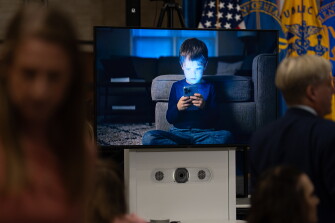
A growing body of research has found that kids’ physical health, mental health, and learning suffer the more time they spend on screens. Yet teens and children, at increasingly younger ages, are spending a lot of time on their devices.

The symposium comes as both Donald Trump’s administration and lawmakers have pushed to limit digital use in school and strengthen protections for children online.
In the last year, Democrats and Republicans across the country have supported legislation that limits screen time in schools and implements age-related restrictions on social media.
In addition, at least 39 states and the District of Columbia have banned or restricted student cellphone use during the school day, in an effort to cut distractions that many lawmakers and educators believe impede student learning and well-being.
The U.S. Office of the Surgeon General also recommended that schools cut back on screen time to improve students’ focus and learning capabilities, and Kennedy has called for districts to end their 1-to-1 computer programs in favor of computer labs and pen and paper assignments.
Just last week, the social media giant Meta agreed to pay $17 billion to 51 states and territories to settle claims that the company’s products are addictive and harmful to children. Meta will also disable push notifications for teen users at certain times of day, including school hours, in the landmark settlement.
Kennedy applauded the settlement and noted that Meta also called on the rest of the industry to follow suit.
“Children spend enormous amounts of their waking time in technology ecosystems, and that is why big tech has to act to protect our children,” he said.
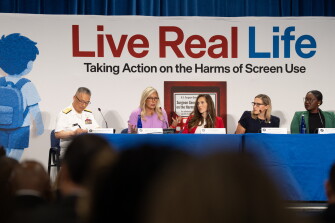
The impact of screen use and social media
At the symposium, a panel brought together Adnan Alkhalili, the founder and CEO of nonprofit Touch Grass Together; Holly Grosshans, senior counsel for tech for Common Sense Media; Katie Jenner, Indiana’s Secretary of Education; Clare Morell, a fellow at the Ethics and Public Policy Center; Zainab Okolo, senior vice president of policy advocacy and government relations at The Jed Foundation; and Paul Jung, the deputy surgeon general who moderated the discussion.
Jenner discussed how it was easy to implement Indiana’s bell-to-bell cellphone ban this year—building from a previous law in 2024 that required schools to adopt policies prohibiting students from using “any portable wireless device during instructional time—but when it came to navigating students’ use of social media, it was a lot harder.
Also this year, the Indiana General Assembly passed a law requiring children aged 15 and younger to get verifiable parental consent before creating social media accounts.
Still, Jenner said children tend to find ways around these restrictions. “We have to do more—the kids are getting around it; they’re beating us as adults,” she said.
The panelists also noted how addictive social media can be for adolescents, which is reinforced through companies’ data collection on their young users.
Grosshans, of Common Sense Media, said 76 million data points are collected by the time a child is 14 years old.
“The data that’s collected is used to really form the experience that kids are having online,” she said.
For example, she said, if a child looks up exercise content, their algorithm could quickly lead them to content about disordered eating. Or if a kid is really interested in sports content, that can lead to online gambling.
“It’s being cultivated in order to engage them, and that’s the problem,” Grosshans said.
How to help students get off the screens
To get students off their screens, educators and parents need to engage them enough in the real world, the panelists said.
In Indiana, Jenner said, high school students are off their devices voluntarily when they are at their work-based learning experience.
“Get them from out behind a desk and out in a manufacturing or healthcare environment—then they don’t even know that they don’t have their cellphones,” she said.

Communities should also consider creating “third spaces"—places children can be outside of their home or classroom—within and outside of schools, said Okolo of The Jed Foundation.
There is a growing number of students relying on social media and chatbots for connection, the panelists said. But if educators and parents encourage students to volunteer or join sports and other social activities, they could meet new people and create an in-person community to rely on.
“Giving [students] space to connect with folks outside of their own bubble expands the way that they think, the way that they grow, and the way that they learn,” said Okolo.


