Through years of experience as a high school principal, I have learned to get really nervous whenever I hear someone proclaim what “all” schools and “all” students should do. Likewise, I have learned to be wary of people who propose simple solutions to complex problems.
I have the same reaction to the goal of preparing all students for college. Is that what we really mean? Is college what we really want for all students? Have the experts asked the students? Have they spoken with parents? Have they consulted teachers and school leaders? Based on experience, my guess is that they have not.
Agreed, there are some things that we do want for all students, including graduating from high school, a rigorous and relevant curriculum, quality teaching, a personalized, safe, warm, and inviting school environment coupled with high expectations, and a willingness on the part of the staff to take responsibility to help each student succeed.
| Diplomas Count 2009: Commentaries | |||||
|---|---|---|---|---|---|
|
After spending a decade leading what National Geographic called “the most diverse high school in America,” J.E.B. Stuart High School in Falls Church, Va., I know that raising student achievement must be done one student at a time. Changes that sound good on paper don’t make sense in the real world. They don’t do justice to the students or to the complexities that public schools must address in the face of dramatic increases in the number of at-risk students who are poorer, more diverse, and may speak English as a second language.
Reformers admit that there are no quick fixes, yet they continue to propose “all student” measures, including that all students will take algebra, or something called algebra, in the 8th grade, and that all students will graduate college-ready.
Isn’t “college for all” simply the old factory model dressed up in more attractive clothing? Kids were started down the same educational conveyor belt and were expected to arrive equally prepared in the same time frame at the end of the assembly line.
In practice, the factory model efficiently weeded out the defective, so that only the best and brightest students reached the end of the line. In truth, kids were sorted for success. Some succeeded, some failed, and that was the way it was supposed to be. After all, the rationale was, we don’t want every child to go to college; we don’t have any jobs for them.
In theory, the factory model gave everyone access to a basic education, but an excellent education was reserved for the few, most of whom were the children of the more privileged. Today, we must educate all students to high levels—access combined with excellence. On that point, reformers and practitioners seem to agree. The real question is, how do we go about raising the bar?
If we are really serious about the success of each and every student and about guaranteeing both access and excellence, we will have to do away with the assembly line and think in terms of customization—one student at a time. We must treat each student as an individual. After all, isn’t that the way we would want our own child treated?
Customization—access and excellence for each student—is expensive, time-consuming, inconvenient, and a lot of hard work. We are already paying a big price for our “weeding out” system, however. School dropouts cost us hundreds of millions of dollars each year. Worse yet, we are ensuring that, for a significant number of the adults in this country, the American dream is out of reach.
The idea of “college for everyone” is a road paved with good intentions, but locking every student into a college path is actually limiting. I would argue instead that every student must be prepared for a variety of postsecondary experiences, which include two- and four-year colleges, and technical and career schools.
We know that children do not grow physically, socially, or emotionally at the same rate, nor do they have the same interests. Is it really wise to force students into situations where they all must learn at the same rate and simultaneously pursue the same interests? When we do so, we are perpetuating the assembly-line mentality and ensuring that the results will look much like a bell curve, which guarantees that many students should and will fail.
Instead, we need to set students up to succeed. Our students need and deserve the option of multiple pathways to success. Some need additional time to get there. Some need more resources. Some students need mentors and tutors. The key is to hold high standards constant and allow individual students many pathways to success.
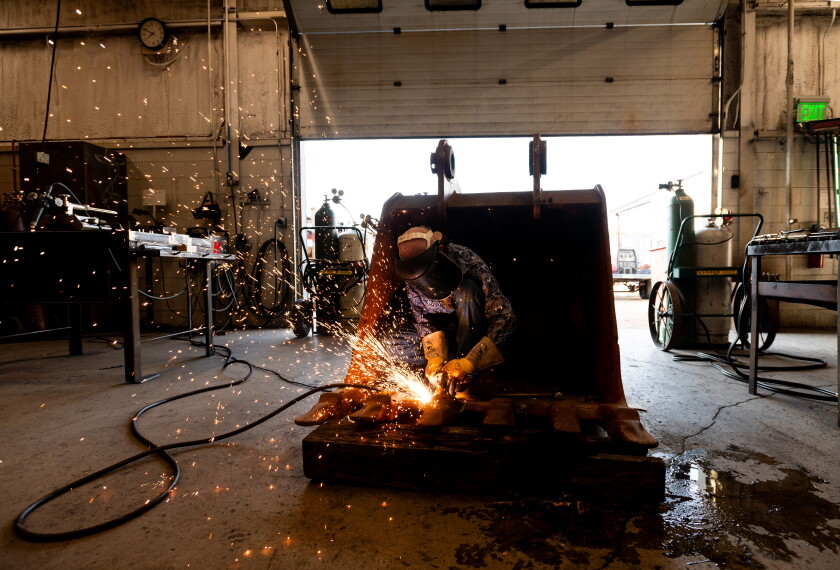
Some might conclude that this is code for lowering standards. But anyone who believes that preparing graduates for something other than college is lowering our standards hasn’t done his homework. For example, today’s career and technical education programs are not yesterday’s old vocational education programs. I am referring to true CTE programs that are designed to lead to apprenticeships, internships, or industry certification, or that serve as a bridge to technical and trade schools.
We all know that technology has driven up the complexity of just about everything we do. That same complexity has driven up the literacy and mathematics requirements of virtually every one of the 16 occupational clusters defined by the U.S. Department of Labor.
“Same path” solutions ensure failure. In broadening our objective from “college-ready for all” to “college-, workplace-, and career-ready for all,” we are simultaneously raising standards and increasing the chances for student success. If we are to reach each and every student, our educational system needs more requisite variety. Schools need more flexibility, not less. Students need more options, not fewer.

Schools succeed or fail one student at a time. They need to focus teams of educational professionals on the needs of individual students. Students should have education plans customized to their learning needs. Time must become a variable, and learning outcomes a constant, not the reverse, as is now the case in many areas. Students should not matriculate through school based on seat time and age. Instead, progress must be measured on mastery of course content.
Our students need to be prepared to live and work in their world, the 21st century, not the world we grew up in. Their world demands postsecondary education and training. We must continually remind ourselves that any graduate who is not ready for college, a career, and the workplace has effectively been sentenced to a lifetime of marginal employment and second-class citizenship. It is our responsibility to teach them, to prepare them, and to raise each of them up to new heights, not run them down an assembly line, screen them out, or sort them for success.