This story is part of a special project called Big Ideas in which EdWeek reporters ask hard questions about K-12 education’s biggest challenges and offer insights based on their extensive coverage and expertise.
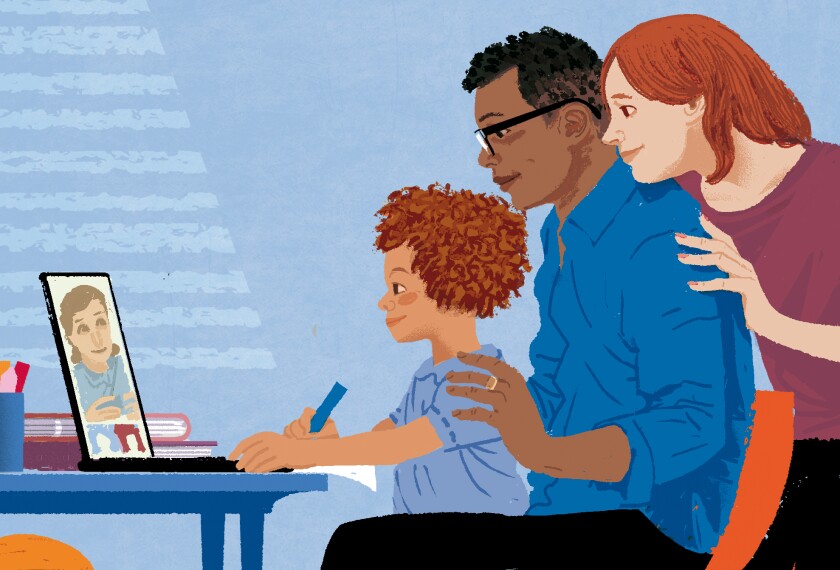
The tumultuous experience of teaching during the COVID-19 pandemic has given many educators an unprecedented glimpse into their students’ out-of-school lives.
Even before the spring of 2020, most teachers would be quick to agree that students’ resources at home, their access to technology and a quiet place to study always affect their ability to succeed in school. But those factors, and others, took on newfound significance during the pandemic.
Starting in the earliest months of the crisis, schools rushed—through ad hoc surveys and conversations with students and teachers— to assess their students’ ability to learn from home. Could they get online? Were they sharing an iPad with three siblings? Did they have paper to write on?
The Education Week Research Center surveyed 886 K-12 educators in July: Nineteen percent said they knew “a lot” about their students’ home learning environments before the pandemic; 43 percent said they know a lot now. That’s a pretty big jump.
How might schools build on that awareness and use it to improve their future work? A new tool in Oregon might provide some grounds for discussion.
Alongside traditional spring state tests on subjects like math and reading, students there piloted a new survey tool called the Student Educational Equity Development Survey, or SEEDS. The state expects to release initial results from the survey later in the fall.
It builds on years of efforts around the country to expand schools’ understanding of their students’ experiences. Through the “Conditions for Learning” and other school climate surveys, districts like those in Cleveland and Nevada’s Washoe County track students’ feelings of safety, support, and engagement at school. Through social-emotional learning assessments, districts ask students to evaluate their own skills in areas like problem-solving and relationship building.
Oregon’s SEEDS includes such questions and adds another element: access to learning resources. In that section, students answer questions not only about their Wi-Fi access, but also about the conditions at home that can help them with their schoolwork. Do they have books or magazines to read for fun? Do they have access to a flat writing surface, like a desk? Do they have a quiet place to study? Friends or adults who can help them if they get stuck on assignments?
Oregon state officials first got the idea to build a student experience survey when they held listening sessions with teachers, students, and community groups in 2017 to create their plan under the federal Every Student Succeeds Act, said Dan Farley, the director of assessment at the Oregon Department of Education.
The state moved to create that survey during the pandemic.
Oregon hopes its schools will eventually use the SEEDS results to “provide a valuable context to [students’] performance,” said Josh Rew, the lead Oregon psychometrician who helped develop the survey.
To quickly build a collection of reliable, actionable questions during the pandemic, Rew reviewed items included in tools like international benchmark exams, school climate surveys, and even student experience surveys from other continents.
If contagious variants, like Delta, force a return to remote learning in their state, the results may help schools be more prepared.
The aim was to build a flexible instrument that the state can quickly adapt to meet the inevitability of changing circumstances, Farley said.
Oregon officials hope the SEEDS survey will give schools a systemic way of reviewing some simple out-of-school factors so that they can act on them well after the pandemic is over. And, if contagious variants, like Delta, force a return to remote learning in their state, the results may help schools be more prepared.
There are some barriers to collecting such data on a larger scale. In the EdWeek Research Center survey, 69 percent of respondents who indicated they don’t already collect a lot of data said their district doesn’t collect more information about home learning environments because of “difficulties getting families to respond or share information.” In some districts, parents have pushed back when schools asked their children questions about things like social-emotional learning. Some say the questions are too invasive, and those concerns may extend to new questions about home learning environments.
Rew said Oregon officials tried to keep their questions as focused as possible, and the state has developed communications materials to explain the purpose to parents and educators.
“We tried to make sure that we are asking questions that have the most reach, the most actionability, and the most likelihood of changing the system,” Farley said.
There’s a cliché among school leaders that what gets measured is what matters most in schools. But measurement alone doesn’t fix problems, especially those rooted in systemic inequalities, like poverty.
The degree to which Oregon’s effort inspires other states may depend on whether schools find a successful way to use the data to actually change their practices. But, whether or not more schools set up similar formal surveys themselves, the pandemic has provided a valuable reminder that what happens at home matters in schools.