On the morning everyone remembers, when the World Trade Center and Pentagon were attacked on Sept. 11, a 6th grade teacher in the nation’s capital led her class to an adjoining building in her school. There they could see the black smoke from the Pentagon fire for themselves, minutes after a hijacked airliner smashed into it.
Never in a nightmare would teacher Myrna Shields and her students have figured that the smoke signaled the loss of a boy in their Ketcham Elementary School class, and a beloved teacher whose room was just downstairs.
In the wake of the terrorist attack, some at the school find strength in the knowledge that teacher James Debeuneure, one of their best, and 11-year-old Rodney Dickens, a promising student, were together at the end.
“I’m sure he wrapped his arms around little Rodney and said, ‘Everything’s going to be all right,’” said Principal Romaine Thomas, who has led the school for 30 years.
With such a stunning event striking so close to home, getting back to the business of running a school seems both obvious and impossible.
Except for the day after the attacks, classes went on as usual at Ketcham Elementary, situated in a section of the city called Anacostia, named for the river that separates it from the rest of Washington.
Tests to find weak spots in the children’s math skills were given last week. A PTA meeting was held.
Yet nothing was the same. The piano at the PTA meeting was cloaked in black, the two names written on it. During the day, children broke down or wouldn’t talk at all. Teachers strained to keep from crying—weary from the simple grief of losing friends, along with the burden of vulnerability now shared by many other Americans.
“That has been so heavy,” said Jean Duren, a retired education professor who now teaches reading at the 425-student school. “And you know what makes it extra heavy? It’s that there is so much happening in the world.”
A New Week Begins
Ketcham Elementary wasn’t the only place suffering in the District of Columbia school system. Two other schools in the city lost both a teacher and a student, all of whom were on the same flight to Los Angeles, all of them headed to a science expedition sponsored by the National Geographic Society.
Backus Middle School lost 6th grade teacher Sarah Clark and 11-year-old student Asia Cottom. Leckie Elementary lost 6th grade teacher Hilda Taylor and 11-year-old student Bernard Brown. Traveling with them were two staff members from the Washington-based geographic society: educational outreach director Joe Ferguson and travel director Ann Judge.
|
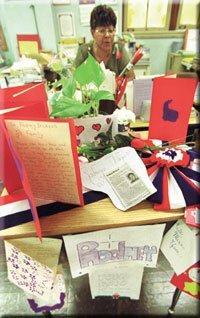
| Teacher Myrna Shields peers over an impromptu memorial to Rodney Dickens atop the desk where the boy sat. —Allison Shelley/Education Week |
The group was headed for what surely would have been three memorable days of field study on Santa Cruz Island in the Channel Islands National Marine Sanctuary, two hours by boat from the Pacific Coast. After the attacks, organizers called off the workshop, which was to have included 27 teachers and students from California as well as Washington.
At Ketcham Elementary, big red hearts cut from construction paper were hanging on the front doors last week, beside a baby- blue funeral wreath. Inside, the heart of the school seemed broken into too many pieces to count.
Mr. Debeuneure, whose classroom sits just inside the doors, was a teddy bear of a man, his colleagues say, with a close-cropped beard and toothy smile. A widower and father of three, he taught for 10 years at Ketcham, where he is remembered as a real gentleman and a father figure to many youngsters.
One person called him “God-gifted,” a man who cared more than usual for his students and read Harry Potter books to them and made funny faces.
When he died, at age 58, he was escorting Rodney on the boy’s first airplane ride.
Rodney had a cheeky grin, and was close to his mother and four young brothers and sisters. He was big fan of professional wrestling on TV. Teachers say that his schoolwork was impressive, and that he held his pencil oddly upright as he wrote. He rarely gave anyone trouble, and a girl he knew says that one time, Rodney bought her a snack at the movies.
Teachers here learned about their loss on the afternoon of the attacks when Ms. Thomas gathered the staff inside the library to break the news. American Airlines Flight 77, the one with their teacher and their student, was the one that had struck the Pentagon.
Ms. Thomas, the principal, dressed in a dark-gray business suit and silver-colored shoes, said last week that was she relying on her tried-and-true ways of handling reporters and photographers clamoring to visit her school. She allowed them to come, but kept their visits short, generally outside the classrooms.
She somberly interviewed a candidate to replace Mr. Debeuneure, while two trusted members of her staff—the math resource teacher and the conflict-resolution coordinator—minded his 5th grade class. Rodney had been in that class last year, and had been in Ms. Shields’ 6th grade class for only a couple of weeks.
The Way Back
Asar Mustafa, a parent-involvement coordinator for the District of Columbia schools, has visited Ketcham Elementary several times in the past two weeks as a member of the school district’s grief task force.
“There’s sadness still in there,” he said. “The school is not going to get back to normal, no way, anytime soon.”
But they’re trying.
“Good morning, baby,” Ms. Shields told many of the students individually as they entered her classroom one morning last week. “Are you feeling better?”
Adversity isn’t a stranger to some of these children. Last year, for instance, a student from Ms. Shields’ class who had recently moved away from Ketcham was found murdered.
Despite some hardships in its history, Ketcham Elementary has never dealt with something quite like this tragedy.
Flower bouquets fill the school office. In the lobby, tables and bulletin boards display the hundreds of sympathy cards from other schools in the neighborhood, across town, even from Wisconsin and Ohio. Someone sent a basket stuffed with little American flags.
Upstairs in Ms. Shields’ room, the students have created an impromptu memorial to Rodney, covering his old desk with letters and flowers and ribbons, his papers and textbooks still inside. “He was a precious boy, really,” Ms. Shields said.