School Climate & Safety

IG Report Questions NCLB’s Unsafe-Schools Option

By Lesli A. Maxwell — August 09, 2007 3 min read
  • Save to favorites
  • Print

The inspector general’s office in the Department of Education is the latest in a steady line of critics to conclude that a provision of the No Child Left Behind Act meant to identify dangerous schools and allow students to transfer out of them is ineffective and needs an overhaul.

The “unsafe-school choice option”—a short section in the main federal K-12 law—requires states to identify public schools that are “persistently dangerous.” The law leaves it up to each state to decide which criteria it will use to determine whether schools are safe.

On Aug. 2, the Education Department’s office of the inspector general released an 11-page “perspective paper” that outlines the measure’s weaknesses and makes recommendations to both Congress and Education Department officials for improving it.

“Although the USCO provision was well intended, it is clear that it has not advanced the national effort to ensure students a safe school environment,” says the report.

'Dangerous' Schools

Department of Education figures show the relatively small number of schools that states have reported as “persistently dangerous” under the No Child Left Behind Act.

45unsafe c1

SOURCE: U.S. Department of Education Office of Inspector General

The inspector general’s report is one of several that the department will consider as it shapes its own recommendations to Congress on the provision, said William Modzeleski, an associate assistant deputy secretary of education and the second-in-command in the department’s office of safe and drug-free schools.

“This is definitely an issue that should be closely reviewed,” Mr. Modzeleski said. “Philosophically, I don’t think there’s much disagreement on why the provision is there, but there is a lot of discussion around what constitutes a safe school and what constitutes an unsafe school.”

“There is concern that the states have set the bars too high” for determining what is an unsafe school, he added.

Excluding Offenses

In most cases, according to the report, states have drawn up guidelines for complying with the provision that would rarely, if ever, result in identification of a school as unsafe. That explains, in part, why only 46 public schools out of roughly 94,000 nationwide were identified as “persistently dangerous” at the end of the 2006-07 school year.

Most states have never labeled any of their schools unsafe under the NCLB provision.

In Ohio, for example, at least 2 percent of the student enrollment at a school would have to be victims of a violent crime in each year for two consecutive years before the school would be labeled unsafe, according to the federal report. Under the state’s policy, the inspector general’s office concludes, a school with 1,000 students “could experience four homicides and seize a weapon from students on 10 occasions each year without qualifying as persistently dangerous.”

Educators have chafed at using the “persistently dangerous” label, arguing that it is too harsh and burdens schools with a negative tag. Under the 5½-year-old NCLB law, students who attend schools identified as dangerous are allowed to transfer to a safe school within the same district.

A panel appointed to advise Secretary of Education Margaret Spellings on school safety and anti-drug programs has also found fault with the way the provision is working. (“Law’s ‘Persistently Dangerous’ Tag Weighed,” Nov. 1, 2006.)

The inspector general’s office found that common offenses such as simple assault or bullying were often excluded from some states’ criteria, and that disciplinary actions such as suspensions and expulsions were often the main criteria for labeling a school, rather than actual violent incidents. The review also revealed that several states don’t consider a single year of data, instead requiring two- and three-year thresholds to be met before labeling a school unsafe.

To improve the provision, the report calls for requiring states to factor in all violent incidents that occur at schools, not just those that necessarily result in students’ suspension or expulsion from school. It also recommends that states be allowed to use only the most current year of data in deciding whether to label a school safe or unsafe.

A version of this article appeared in the August 15, 2007 edition of Education Week as IG Report Questions NCLB’s Unsafe Schools Option

Events

Artificial Intelligence Webinar AI and 'Techlash' Are on a Collision Course. How Should Schools Respond?
Learn what strategies and tactics schools can develop to encourage smart and responsible AI use, while also enforcing tech guardrails.
This content is provided by our sponsor. It is not written by and does not necessarily reflect the views of Education Week's editorial staff.
Sponsor
Special Education Webinar
Special Education Disputes & Rising Costs: Protecting Your District
Special education costs and risks are rising. Learn how stronger IEP and Medicaid processes help districts protect funding and compliance.
Content provided by Relay
This content is provided by our sponsor. It is not written by and does not necessarily reflect the views of Education Week's editorial staff.
Sponsor
Personalized Learning Webinar
Differentiation That Delivers: Proven Practices From High-Growth Districts
Make every minute count. Proven strategies from educators and leaders driving real student growth. Save your seat!
Content provided by i-Ready, Curriculum Associates

EdWeek Top School Jobs

Teacher Jobs
Search over ten thousand teaching jobs nationwide — elementary, middle, high school and more.
View Jobs
Principal Jobs
Find hundreds of jobs for principals, assistant principals, and other school leadership roles.
View Jobs
Administrator Jobs
Over a thousand district-level jobs: superintendents, directors, more.
View Jobs
Support Staff Jobs
Search thousands of jobs, from paraprofessionals to counselors and more.
View Jobs

Read Next

School Climate & Safety A Shooting Strikes an Elementary School. Some Doubt Policy Change Will Follow
Tragedies like the one in Bend, Ore., draw public outcry, but typically not swift change on school safety.
5 min read
Children place flowers at a makeshift memorial outside Silver Rail Elementary in Bend, Ore., Friday, Oct. 16, 2026, a day after a deadly shooting.
Children place flowers at a makeshift memorial outside Silver Rail Elementary in Bend, Ore., Friday, Oct. 16, 2026, a day after a deadly shooting. The child victims, ages 5, 8, and 11, include the youngest person killed in a school shooting since Education Week began<a href="https://www-edweek-org.ezproxy.baylor.edu/leadership/school-shootings-this-year-how-many-and-where/2026/01" target="_blank" link-data="{&quot;cms.site.owner&quot;:{&quot;_ref&quot;:&quot;00000173-0561-d1f0-a17f-adef4bee0000&quot;,&quot;_type&quot;:&quot;ae3387cc-b875-31b7-b82d-63fd8d758c20&quot;},&quot;cms.content.publishDate&quot;:1792177418426,&quot;cms.content.publishUser&quot;:{&quot;_ref&quot;:&quot;00000180-d7b2-d193-a1b2-dfbba3aa0001&quot;,&quot;_type&quot;:&quot;6aa69ae1-35be-30dc-87e9-410da9e1cdcc&quot;},&quot;cms.content.updateDate&quot;:1792177418426,&quot;cms.content.updateUser&quot;:{&quot;_ref&quot;:&quot;00000180-d7b2-d193-a1b2-dfbba3aa0001&quot;,&quot;_type&quot;:&quot;6aa69ae1-35be-30dc-87e9-410da9e1cdcc&quot;},&quot;link&quot;:{&quot;disableUtmTracking&quot;:false,&quot;target&quot;:&quot;NEW&quot;,&quot;attributes&quot;:[],&quot;url&quot;:&quot;https://www-edweek-org.ezproxy.baylor.edu/leadership/school-shootings-this-year-how-many-and-where/2026/01&quot;,&quot;_id&quot;:&quot;000001a1-4619-d1d1-a3f3-f77b151b0000&quot;,&quot;_type&quot;:&quot;ff658216-e70f-39d0-b660-bdfe57a5599a&quot;},&quot;linkText&quot;:&quot; tracking these incidents&quot;,&quot;theme.brightspot-theme-default.:core:enhancement:Enhancement.hbs.enhancementAlignment&quot;:null,&quot;theme.brightspot-theme-default.:core:link:Link.hbs._template&quot;:null,&quot;theme.brightspot-theme-default.:core:link:Link.hbs.type&quot;:null,&quot;theme.brightspot-theme-default.:core:link:Link.hbs._preset&quot;:null,&quot;theme.brightspot-theme-default.:core:enhancement:Enhancement.hbs._preset&quot;:null,&quot;_id&quot;:&quot;000001a1-4619-d1d1-a3f3-f77b14b10001&quot;,&quot;_type&quot;:&quot;809caec9-30e2-3666-8b71-b32ddbffc288&quot;}"> </a>tracking those incidents eight years ago.
Joe Kline/AP
School Climate & Safety Three Children and Teacher Killed in Oregon Elementary School Shooting
Authorities in Bend, Ore., said the attacker gained entry by shooting through locked doors.
2 min read
Police tape is placed outside Silver Rail Elementary school following a shooting, on Oct. 15, 2026 in Bend, Ore.
Police tape is placed outside Silver Rail Elementary School following a shooting, on Oct. 15, 2026 in Bend, Ore. Authorities said an attacker shot through locked school doors to enter the building.
Joe Kline/AP
School Climate & Safety 4 Ways AI Data Centers Can Affect Schools
From health to productivity and finances, data centers could pose risks for students and schools.
3 min read
Carroll
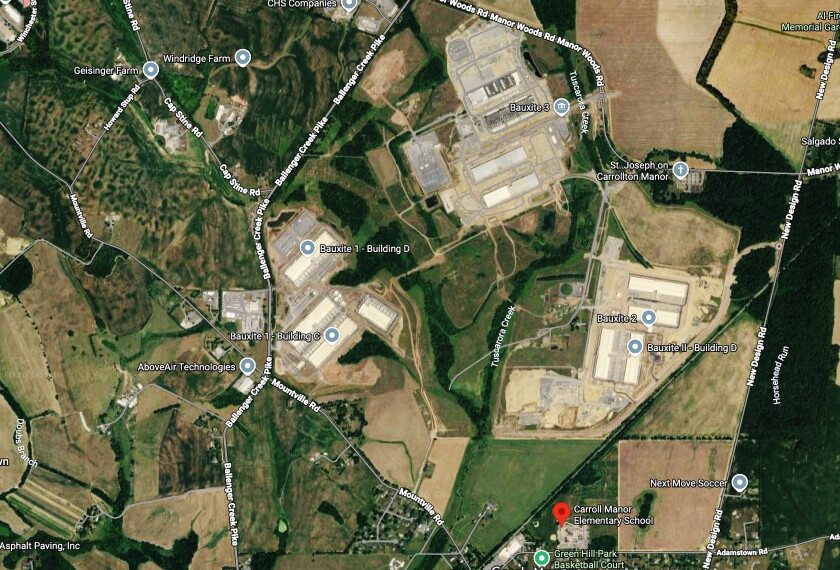
The Quantum Frederick Data Center Campus near the Carroll Manor Elementary School.
Map data ©2026 Google, Imagery ©2026
School Climate & Safety For Students Walking to School, the Route Can Be Deadly. What Can Make It Safer?
School districts, including New York City, have rolled out a number of strategies to reduce risks.
5 min read
A student leaving Greenspun Junior High School in Henderson, Nev., enters a car in the travel lane of Valle Verde Drive on Sept. 14, 2022. Pedestrian fatalities near schools are most likely to occur in the early morning and early evening hours, federal data show.
Rachel Aston/Las Vegas Review-Journal via TNS