Gov. Arnold Schwarzenegger’s fiscal 2006 budget plan for California may be balanced, but it is drawing the ire of education groups that say it reneges on a promise made last year to restore school aid to levels called for in the state constitution.
The proposed budget, released last week, would increase overall spending for public schools above current levels, and for the first time bring average per-student funding to more than $10,000.
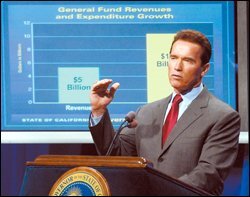
“Of course we would like to spend more … but that’s all the revenue we have and we must be fiscally responsible,” the governor said during the Jan. 10 release of his budget. “Because it’s the right thing to do and it’s what I promised the people last year—that we would not spend more money than the state takes in.”
The $36 billion K-12 education budget calls for maintaining the current levels of $31.7 million for professional-development programs to improve teachers’ skills in reading and mathematics and $5 million for the fifth year of a training program for principals in instructional standards and management practices.
Gov. Schwarzenegger, a Republican, is also recommending new nutrition programs to combat child obesity, an “accelerated” program for English-language learners in 4th through 8th grades, and a plan to convert some of the state’s largest elementary, middle, and high schools into smaller schools or schools-within-schools.
But state education groups say the governor is breaking a promise he made in 2004 when he and the legislature temporarily suspended Proposition 98, a 1988 constitutional amendment that requires that about 40 percent of the state’s general fund go to education. Teachers agreed to the deal, which resulted in more than $2 billion worth of spending cuts, because the administration said it would make it up to schools when the state economy improved.
“He is planning to go against the will of the people by attacking Proposition 98, which voters approved long ago to make sure there is at least minimum funding to help our 6.2 million students continue to achieve in our classrooms,” Barbara E. Kerr, the president of the California Teachers Association, an affiliate of the National Education Association, said in a statement.
The state’s major education organizations, which gathered for a press conference following the release of the governor’s budget proposal, dispute Mr. Schwarzenegger’s statement that the $36 billion for precollegiate education would represent an increase of 7.1 percent. They say it would be only a 3 percent increase. Officials with the state’s higher education system were more pleased with the governor’s budget. Under his proposal, funding for higher education would increase 6.9 percent to $12.8 billion. Included in that figure is a 5 percent increase for the state’s community colleges.
Reforming Prop. 98
Mr. Schwarzenegger would give schools about $1 billion less than they are supposed to receive under Proposition 98 for a second year to help deal with a $9.1 billion deficit in a $111.2 billion total budget. He also proposes taking 15 years to repay the money owed to the state’s education system.
The governor, during a special legislative session that began last week, said he wants to stop what he calls “autopilot formulas” such as Proposition 98 from allowing spending to exceed revenues.
“Formula-driven budgeting ties the hands of the folks that are elected and makes it very difficult to balance competing priorities,” agreed George Passatino, the government-affairs director for the Los Angeles-based Reason Foundation, a think tank that espouses free-market approaches to policy.
Still, education groups predicted that under the plan, class sizes would increase, schools wouldn’t have enough money for books and other teaching materials, and some districts would be in danger of going bankrupt.
“Regrettably, we are funding education in the dark ages,” the elected state superintendent of public instruction, Jack O’Connell, said during last week’s press conference with education groups. “Our schools continue to starve.”
Mr. Passatino, however, said that the situation was not as critical as Mr. O’Connell and others said. He added that “some of the money they think they’re entitled to comes from unanticipated revenues,” and that schools weren’t counting on that money anyway.
The education coalition is also angry over Mr. Schwarzenegger’s plan to shift more than $450 million in payments for teachers’ pensions to local districts.
“To put schools in a position in which teachers are looking for either textbooks or retirement in their old age makes no sense,” Ms. Kerr of the CTA said.
In another proposal blasted by the union, Gov. Schwarzenegger in his Jan. 5 State of the State Address proposed linking teachers’ pay to their performance in the classroom. (“California: Schwarzenegger Targets Teacher-Pay Structure,” Jan. 12, 2005.)
Meanwhile, in an effort to strengthen oversight of charter schools, the governor’s budget includes a plan to allow colleges and universities approved by the state education department to authorize charter school applications.
The proposal was welcomed by charter school advocates. “Charter schools have proven to be a promising solution for California’s schoolchildren, despite a current oversight process that has demonstrated time and time again to be flawed,” Caprice Young, the president of the California Charter School Association, said in a statement. “Enacting the governor’s proposal will only improve charter school accountability.”


