
Student Well-Being & Movement

Teens Are Looking for Mental Health Support Online. What That Means for Schools

By Lauraine Langreo — July 19, 2024 4 min read
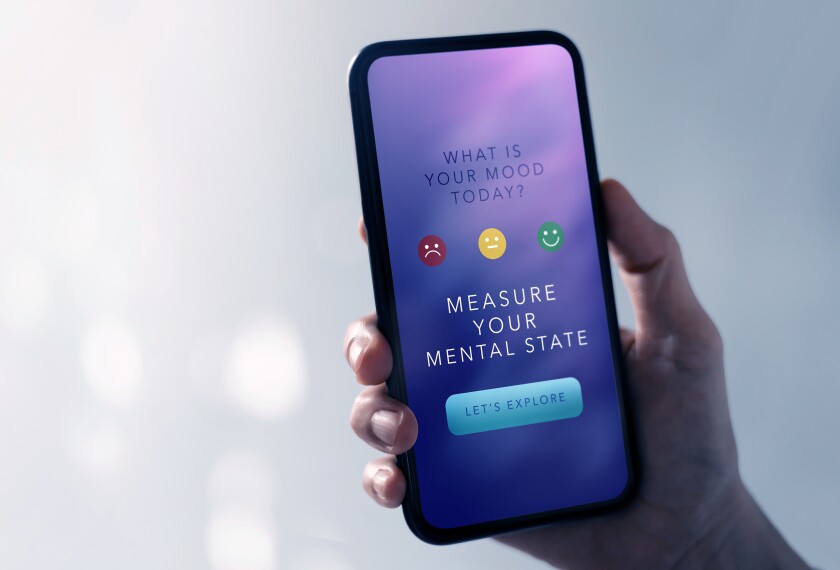
Hand holding a mobile phone with an app asking "What is Your Mood Today? Measure Your Mental State" with a blue "Let's Explore" button
  • Save to favorites
  • Print

More than half of young people regularly look up mental health information online and use mental health support apps, according to a recent Common Sense report.

But the quality of these resources isn’t always up to par, and experts say schools have a role to play in providing the support that students are looking for.

The report found almost two-thirds (65 percent) of teens and young adults have searched online for any behavioral health topics; more than half (54 percent) say they have used apps to support their mental health and well-being; and more than a quarter (26 percent) say they have attended online therapy.

The report, published in June, is based on a nationally representative survey of 1,274 young people ages 14-22 in the United States and was conducted in October and November of 2023.

The findings come as young people struggle with record-high rates of anxiety and depression, and as educators and policymakers have focused greater attention on student well-being and mental health.

“There’s nothing surprising to me that students are looking for ways that they can get support,” said Eric Rossen, the executive director of the National Association of School Psychologists. The report “makes a case about the need for continued access to mental health supports and services,” and having access to school-based mental health professionals is “so critical.”

Youth rely on websites, social media, and apps

Among those who said they search online for mental health information, a majority (53 percent) said they turn to medical websites. However, social media sites are also an important source of information for a lot of young people.

For instance, 38 percent said they’ve searched YouTube for information related to behavioral health, 34 percent have searched TikTok, and 23 percent have searched Instagram. A smaller percentage (6 percent) have used generative artificial intelligence tools.

But contrary to the narrative that young people believe everything they see online, most young people do not take the information they find at face value, according to the report. Young people say they consider the trustworthiness of the source, take information “with a grain of salt,” compare information across multiple sources, and run information by their friends and family.

“I do think we see that young people are, in some ways, a lot more thoughtful about this than they get credit for from adults,” said Amanda Lenhart, the head of research for Common Sense.

See Also

Notes from students expressing support and sharing coping strategies paper a wall, as members of the Miami Arts Studio mental health club raise awareness on World Mental Health Day on Oct. 10, 2023, at Miami Arts Studio, a public 6th-12th grade magnet school, in Miami.
Notes from students express support and share coping strategies at Miami Arts Studio, a public magnet school for grades 6-12, on Oct. 10, 2023. Studies find teachers need training to navigate their own stress while managing classes with high-need students.
Rebecca Blackwell/AP/AP

Anjali Verma, president of the National Student Council and an incoming 12th grader at a charter school in West Chester, Pa., said growing up with this technology has helped teens be “more critical and curious, with a lens that’s inquisitive, and make sure that what were seeing online is vetted.”

Many young people have also turned to apps to support their well-being, the report found. They said they’ve downloaded apps for meditation, mindfulness, tracking habits and sleep, and journaling.

Rossen said there are probably several reasons students turn to an app: They might not want to go through the process of going through the logistics of seeking professional mental health support; they are more comfortable using technology to get information and communicate with other people; and a phone app is accessible all the time.

Young people give mixed reviews on the helpfulness of apps, though. Among respondents who have ever used an app for their mental health and well-being, 47 percent found the app to be very helpful or somewhat helpful, while 37 percent found the app a little helpful or not at all helpful, the report found.

Anjali said she and her peers will often see ads for these apps and will try them to figure out if they will be helpful. More often than not, her peers say they delete the apps after a while, she said, because they aren’t helpful or because of the cost.

The role schools can play

The report should be a “wake-up call” for adults that young people need more accessible mental health support, Anjali said. And schools should be a “safe haven” for them to reach out for support, she said.

School and district leaders need to make sure that students and families are aware that there’s help available within their school buildings, Rossen said.

See Also

Image of a student with their head down on their arms, at a desk.
Olga Beliaeva/iStock/Getty

Schools could start providing a list of vetted apps and websites that students and families could use to support their well-being, Rossen said. But it shouldn’t stop there. Schools could help families navigate through the apps and remind them that there are school-based health professionals who can help them process their experiences with the apps.

Schools could also teach students the skills they need to determine what’s a good source of mental health information and what makes a good mental health app, too, Anjali said.

Anjali said it’s “critical” for schools to involve young people in identifying other supports they can provide to students.

“When these adults are having conversations about teen mental health, they’re not on the ground, they’re not experiencing it themselves,” she said. “When kids are given a platform, it allows for openness and trust” that create a better school culture around mental health.

Events

This content is provided by our sponsor. It is not written by and does not necessarily reflect the views of Education Week's editorial staff.
Sponsor
Recruitment & Retention Webinar
Hiring, Retention, and Fill Rates: A Data-Driven Sub Strategy
Explore what keeps substitutes coming back and hear how one district rebuilt its substitute hiring process and improved its fill rate.
Content provided by Frontline Education
Early Childhood K-12 Essentials Forum Early Childhood Education: Building Essential Skills for Success
Join this free virtual event to examine the biggest challenges in supporting young children, from preschool through elementary school. 
This content is provided by our sponsor. It is not written by and does not necessarily reflect the views of Education Week's editorial staff.
Sponsor
Student Absenteeism Webinar
Attendance Isn't an Attendance Problem
Boost attendance by strengthening relationships, belonging, and support with practical strategies from Doug Fisher & Nancy Frey.
Content provided by Corwin

EdWeek Top School Jobs

Teacher Jobs
Search over ten thousand teaching jobs nationwide — elementary, middle, high school and more.
View Jobs
Principal Jobs
Find hundreds of jobs for principals, assistant principals, and other school leadership roles.
View Jobs
Administrator Jobs
Over a thousand district-level jobs: superintendents, directors, more.
View Jobs
Support Staff Jobs
Search thousands of jobs, from paraprofessionals to counselors and more.
View Jobs

Read Next

Student Well-Being & Movement Meta Reaches $17B Settlement With States Over Teen Social Media Addiction
The deal with 47 states requires Meta to add child-safety measures to Facebook and Instagram.
4 min read
Head of Instagram, Adam Mosseri, leaves the Ronald V. Dellums Federal Building & United States Courthouse as Meta is on trial over social media addiction in Oakland, California, on August 25, 2026. A coalition of US states is seeking around $200 billion in damages against Meta, which they accuse of intentionally designing Facebook and Instagram to be addictive for children, in a landmark trial.
Adam Mosseri, the head of Instagram, leaves the Ronald V. Dellums Federal Building and United States Courthouse in Oakland, Calif., on Aug. 25, 2026. Meta, Instagram's parent company, has agreed to a $17 billion settlement with 47 states to end a trial over teens' social media addiction.
Karl Mondon / AFP via Getty Images
Student Well-Being & Movement Nebraska's Largest School District Asks Police to Not Use Electric Shock Gloves on Students
Omaha's superintendent made the request after a report that federal immigration officials planned to to use the tools.
5 min read
A look at a Compliant Technologies Generated Low Output Voltage Emitter, G.L.O.V.E., at Omaha Police Headquarters in Omaha, Neb. on Friday, Aug. 14, 2026. The Generated Low Output Voltage Emitter, G.L.O.V.E., "is a less-lethal tool intended to provide officers with an additional option when responding to resistance or a potentially volatile situation," according to the Omaha Police Department.
A photo taken at Omaha, Neb., police headquarters on Aug. 14, 2026, shows a technology known as Generated Low Output Voltage Emitter, or G.L.O.V.E. Photo by Nikos Frazier/Omaha World-Herald via Getty Images. Police in the city agreed this week to stop carrying the gloves, which can deliver electric shocks, while working in schools in Nebraska’s largest public school district.
Nikos Frazier/Omaha World-Herald via Getty Images
Student Well-Being & Movement Opinion Why ‘Just Ask for Help’ Isn't Enough for Teens—and What Schools Can Do Instead
Mental health messaging is out of step with what students actually need, explains one high schooler.
Aanya Remi
4 min read
082024 Opinion REMI hesitant to seek help ly
Liz Yap/Education Week and Canva
Student Well-Being & Movement How a School Bus Will Serve as a Sensory Reprieve for Little Learners
A rural Head Start program will deploy the bus to give young kids tools to manage their emotions.
4 min read
HB A4346
An activity table inside the Pocono Services for Families and Children's new sensory bus on Aug. 20, 2026, in East Stroudsburg, Pa. The bus is set to hit the road this spring to help teach young students how to regulate their emotions through play.
Hannah Beier for Education Week
