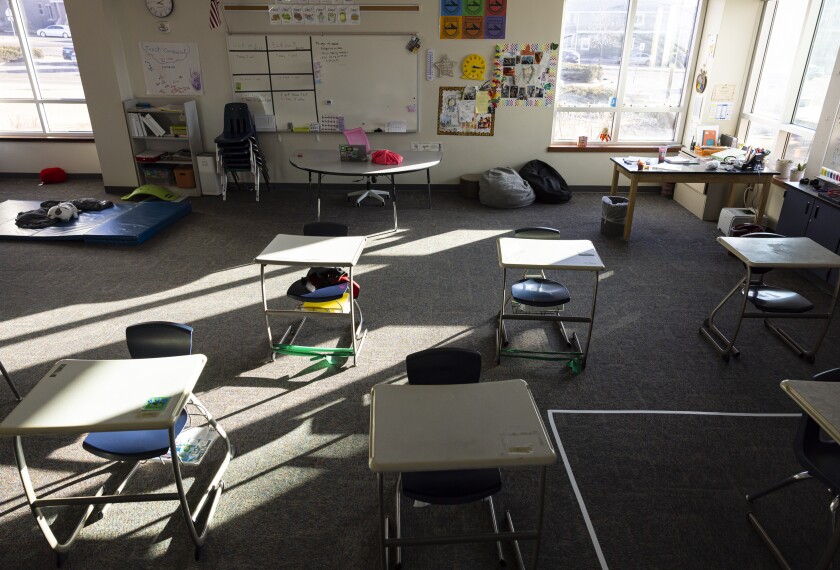
Before the pandemic, the most unstable Nevada schools had nearly 1 in 5 students chronically absent, which meant they missed at least 10 percent of the time school was in session. Now, 1 in 3 students on average fall into that category across all schools in the state.
Nevada’s not alone. Absenteeism rates in the bottom 10 percent of schools before the pandemic have become the new normal for all schools in 32 states, according to new analysis of state data by the American Enterprise Institute’s Return to Learn Tracker. In fact, out of 39 states that collect absenteeism data, 30 states now have average chronic absenteeism rates significantly worse than those in their lowest 10 percent of schools for student attendance rates in 2017-18, AEI senior fellow Nat Malkus found.
While all but six of the 39 states improved attendance from 2022 to 2023—by about 2 percent on average—none are back to pre-pandemic levels.
“We’re still going the wrong way, where what we really want to see are big drops,” said Malkus, AEI’s deputy director of education policy. “Two percent is not enough, especially given the drop in COVID threat. If that holds, we’ll get back to pre-pandemic chronic absenteeism in about 2030—that’s not good.”
Absenteeism rates grew faster in districts that had higher chronic absenteeism to begin with, but the increases were across the board. Districts of different sizes and income levels, different levels of student diversity, and in all regions of the country saw large, sustained increases in chronic absenteeism.
The AEI analysis generally aligns with a separate study of state data released earlier this month by Stanford education researcher Thomas Dee. Both studies find that the share of students considered chronically absent rose about 90 percent since the pandemic.
Dee’s study, published in the Proceedings of the National Academy of Sciences journal, similarly found that chronic absenteeism spiked 91 percent nationwide from 2018-19 to 2021-22, marking 6.5 million more students in 2021-22 who missed 10 percent or more of school days.
Using a model that compared changes in chronic absenteeism over time, Dee found COVID-19 case rates, school masking policies, overall enrollment changes and rising youth mental health problems—all of which have been pointed to as potential causes of rising absenteeism—made no significant difference in the rise of chronic absenteeism across districts.
According to UNESCO’s global school closure tracker, the United States has not had a COVID-19-related school closure since late January 2022, but Malkus noted that many schools still have policies urging caution for parents around respiratory illnesses and the tightening of school release practices.
“I don’t think we ever saw a pivot,” Malkus said. “Even where you saw leadership on returning [to school] in person and so forth, we haven’t seen a broad enough push to say, ‘All right, pandemic-era, exceptional practices are over; let’s get back to work.’”
Both Malkus and Dee suggested that norms around attending school regularly have weakened during the pandemic, and federal and state efforts to help students recover academically and mentally from the disruption have not focused enough on rebuilding those academic habits.
“Culture eats policy for breakfast day in and day out,” Malkus said. “If what we are seeing are problems with post-pandemic school culture, then we really do need to bring every bit of attention to this, because we are not going to see this correct itself naturally. We’re going to see serious problems long term, especially if we let this become the new normal—and right now, that is exactly what we’re seeing.”
Despite the small declines in absenteeism, neither researcher has so far found clear instances of states making significant progress in bringing absenteeism back to pre-COVID levels. Both suggested policymakers and educators will need to prioritize attendance to make any other academic recovery intervention effective.
“You’ve got a double-edged sword here,” Malkus said. “Blunt efforts at criminalizing missing school are not simply going to get us where we want to go. At the same time, being gun-shy about the nature of the problem and … only bringing positive supports is also unlikely to meet the needs of the moment.”