Blog

Your Education Road Map

Politics K-12

Politics K-12 kept watch on education policy and politics in the nation’s capital and in the states. This blog is no longer being updated, but you can continue to explore these issues on edweek.org by visiting our related topic pages: Federal, States.

Federal

7 Takeaways for Educators From Biden’s State of the Union

By Evie Blad — March 02, 2022 3 min read
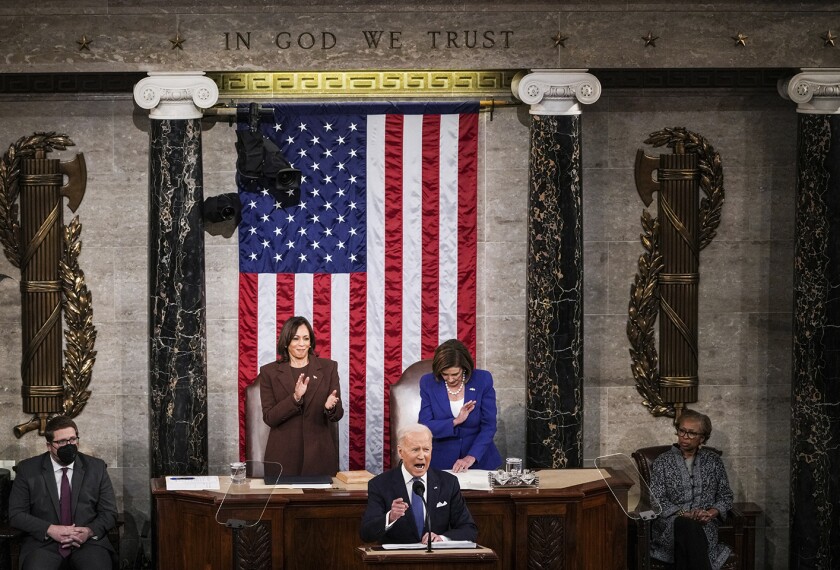
President Joe Biden delivers his first State of the Union address to a joint session of Congress at the Capitol, Tuesday, March 1, 2022, in Washington as Vice President Kamala Harris applauds and House speaker Nancy Pelosi of Calif., looks on.
  • Save to favorites
  • Print

President Joe Biden’s first State of the Union address mentioned students and schools alongside pressing national issues like COVID-19 recovery and foreign relations.

But maybe you’re a stressed out educator who was too busy to watch? We’ve got your back. Here’s a cheat sheet of K-12 education mentions in the address. Read complete coverage of the State of the Union here.

Mental health: Biden called for bipartisan action to respond to a national mental health crisis, paying particular attention to concerns about children and teens. He will propose $1 billion in new federal spending for school psychologists and counselors, and he wants to cut red tape to make it easier for schools to bill Medicaid for mental health services. “Let’s take on mental health,” Biden said. “Especially among our children, whose lives and education have been turned upside down.”

Tutoring and mentoring: In making the pitch that"we can all play a part in schools’ COVID-19 recovery,” Biden urged Americans to “sign up to be a tutor or a mentor.” His comments came as schools report staffing and volunteer shortages for things like after-school programs.

How parents can keep the pressure on: “The American Rescue Plan gave schools money to hire teachers and help students make up for lost learning,” Biden said. “I urge every parent to make sure your school does just that.” In a fact sheet, the administration said it would continue encouraging schools to spend relief funds on things like individual and small group instruction, more instructional staff, tutoring programs, and after-school and summer learning efforts. But some education advocates have lamented the lack of transparency in how schools spend $130 billion in aid provided through the American Rescue Plan. And organizations like the National Parents Union have urged families to speak up about how their schools use the funds.

COVID-19 and school closures: “Our schools are open,” Biden said. “Let’s keep it that way.” Republicans have raised school closures in midterm campaigns, and the Biden administration has stressed that schools have the tools they need to stay open, even if future variants emerge. Federal health officials gave schools in most of the country the green light to lift mask requirements in new guidance Friday.

Infrastructure: Biden touted measures in the $1.2 trillion bipartisan infrastructure bill he signed in November that will help expand broadband access and to close the “homework gap” for students without internet at home. The bill also provides some funding to replace major lead pipes that lead to schools.

Pre-K and college: Biden called for “pre-K for every 3- and 4-year-old,” a proposal that was part of his Build Back Better plan, which stalled in the Senate. It’s unclear how he may repackage some of those social spending priorities in another legislative push. He also called for expanding the maximum Pell grant for low-income students, a less- ambitious version of his previous proposal, which called for two years of free college for all Americans. And he made a pitch for increased support for historically Black colleges and universities.

Transgender students: Biden had a message for transgender young people: “I will always have your back as your president, so you can be yourself and reach your God-given potential.” His administration has asserted that transgender student rights are protected under Title IX, but some advocates have called for more-aggressive action as states like Florida consider bills to limit discussion of gender identity in schools and as Texas moves to investigate gender-affirming care as child abuse.

Related Tags:

A version of this news article first appeared in the Politics K-12 blog.

Events

School & District Management Webinar EdMarketer Quick Hit: Build Campaigns That Engage K-12 Leaders
We’ll share what’s resonating with Education Week’s K-12 audience based on user behavior across platforms and other proprietary data.
This content is provided by our sponsor. It is not written by and does not necessarily reflect the views of Education Week's editorial staff.
Sponsor
Assessment Webinar
Measuring What Matters: How District Leaders Are Redefining Student Assessment
In this panel discussion, district leaders and systems experts will examine the gap between the outcomes we want and the systems in place.
Content provided by Otus
Early Childhood Webinar Selling Into Early Learning: New Survey Data and Strategies for Marketers
Selling into PreK? Get fresh EdWeek Research Center data and strategies to position your products and reach the right early learning buyers.

EdWeek Top School Jobs

Teacher Jobs
Search over ten thousand teaching jobs nationwide — elementary, middle, high school and more.
View Jobs
Principal Jobs
Find hundreds of jobs for principals, assistant principals, and other school leadership roles.
View Jobs
Administrator Jobs
Over a thousand district-level jobs: superintendents, directors, more.
View Jobs
Support Staff Jobs
Search thousands of jobs, from paraprofessionals to counselors and more.
View Jobs

Read Next

Federal Q&A A Top Democrat Breaks Down His Party's Plans for K-12 in a House Majority
If Democrats retake the House, Rep. Bobby Scott may be in a position to set his chamber’s K-12 agenda.
5 min read
Rep. Bobby Scott, D-Va., speaks during a prayer vigil held by the Chesapeake Coalition of Black Pastors at The Mount (Mount Lebanon Baptist Church) in Chesapeake, Va., Sunday, Nov. 27, 2022, for the six people killed at a Walmart in Chesapeake, Va., when a manager opened fire with a handgun before an employee meeting Tuesday night.
Rep. Bobby Scott, D-Va., speaks during a prayer vigil in Chesapeake, Va., on Nov. 27, 2022. Scott is the ranking Democrat on the U.S. House of Representatives' education committee and will seek the panel's chairmanship if Democrats win a House majority in next month's elections.
Carolyn Kaster/AP
Federal What a Democratic Congress Could Mean for Trump's K-12 Agenda
They may try to reverse—or at least investigate—the Trump admin.'s efforts to dismantle the Ed. Dept.
9 min read
House Minority Leader Hakeem Jeffries, D-N.Y., the top Democrat in the Republican-majority House, is joined by Rep. Pete Aguilar, D-Calif., chair of the House Democratic Caucus, as they criticize President Donald Trump and his policies while talking to reporters about the approaching midterm election, at the Capitol in Washington, Thursday, Sept. 17, 2026.
House Democratic Leader Hakeem Jeffries speaks at the U.S. Capitol on Sept. 17, 2026. He's joined by Rep. Pete Aguilar, D-Calif., who chairs the House Democratic Caucus. If Democrats gain a majority of either chamber of Congress after next month's elections, they'll be able to hold oversight hearings on and launch investigations into the dismantling of the U.S. Department of Education.
J. Scott Applewhite/AP
Federal The Future of Education Research: More Partisan and Largely Left to States?
As Trump administration works to change federal grants, outside researchers try to regroup.
6 min read
Image of file folders with tabs called "funding" "grants" "projects" and a blank note paper paperclipped to the outside.
Collage by Laura Baker/Education Week + Getty
Federal Bipartisan Bill in Congress Would Help Schools Put Cellphone Bans or Restrictions in Place
The bill would establish a federal grant program to support state efforts to restrict cellphones.
5 min read
Sen. Tom Cotton, R-Ark., the chairman of the Senate Intelligence Committee, center, is joined from left by Sen. John Barrasso, R-Wyo., the GOP whip, and Senate Majority Leader John Thune, R-S.D., as he speaks to reporters ahead of a Wednesday meeting with President Donald Trump, at the Capitol in Washington, Tuesday, June 23, 2026. (AP Photo/J. Scott Applewhite) Senate Minority Leader Chuck Schumer, D-N.Y., speaks to reporters at the Capitol in Washington, Tuesday, June 23, 2026.
Sen. Tom Cotton, R-Ark., speaks to reporters ahead of a meeting with President Donald Trump at the Capitol in Washington on June 23, 2026. Cotton is one of the sponsors of a bipartisan bill that would create a grant program for states to implement school cellphone bans or restrictions.
J. Scott Applewhite/AP
