Faced with what they fear will be monumental cuts in federal funding, education groups, the White House, and some congressional Republicans are looking for a way to wiggle out of the tight budget framework set for the coming fiscal year.
When Congress approved its spending limits for the fiscal 2000 federal budget last month, both chambers significantly cut the allocation for the category that includes education, health, and labor programs, leaving appropriators with less money to spend than in recent years. Unless those allocations change, most education programs will see drastic decreases in funding that will undo the large spending gains they have made in the past three years, many lobbyists here say.
“The education community should be on red alert,” said Edward R. Kealy, the executive director of the Washington-based Committee for Education Funding, a coalition of education groups. The CEF is joining with health advocates to protest the anticipated cuts. “We are taking these allocations very seriously because they are the official action of Congress,” Mr. Kealy said.
The cuts fall in line with the tight caps set by the bipartisan budget law that was approved in 1997--caps that were lifted under political pressure to hike discretionary education spending by a total of 15 percent in the past two budgets. Now, a partisan blame game is emerging as both Republicans and Democrats try to find ways to appear to hold a tight grip on the purse strings while increasing education spending--both important political goals.
“The reality’s coming home to roost, and nobody likes it,” said Elizabeth Morra, a spokeswoman for the Republicans on the House Appropriations Committee.
Under the nonbinding budget blueprint adopted earlier last month, the Senate approved an $80.3 billion allocation for the appropriations subcommittee that deals with education, labor, and health and human services, while the House allotted $78.1 billion overall for those spending categories. The Congressional Budget Office estimates it would take an appropriation of $88.8 billion to keep programs in those areas running at their current levels.
Last week, Speaker of the House J. Dennis Hastert, R-Ill., eased the situation somewhat by announcing that he would work with appropriators to shore up some domestic programs, including education, through amendments. But even with that, the funding would still fall far below the need estimated by the CBO, Ms. Morra said.
Still, many conservatives, including most Republicans on the education subcommittee, remain firmly committed to the caps. For one, Rep. Ernest Istook, R-Okla., “is definitely in support of keeping the balanced-budget resolution,” said his spokeswoman, Micah Swaford.
Administration Attack
But others, from both parties, now say the budget caps are unrealistic and should be discarded.
In a speech this month, Vice President Al Gore blasted the gop for the budget plan: “Congress is considering a budget that severely underfunds critical programs.”
The White House later distributed data that estimate the planned allotment would result in an 18 percent decrease from fiscal 1999 spending for education programs, and 21 percent less than President Clinton’s proposed fiscal 2000 budget. After-school and Head Start programs would be forced to significantly cut their enrollments, the White House maintains, and funding to hire new teachers and provide professional development in reading would be jeopardized.
Last week, Secretary of Education Richard W. Riley and freshman Democrats in the House again urged Mr. Hastert and House leaders to consider the White House’s five-year, $3.7 billion plan to help pay interest on school construction bonds. Given the big increases that the GOP has granted Mr. Clinton and congressional Democrats in recent years, some observers say the proposed cuts represent, at least in part, retaliation by fiscal conservatives. Most notably, the congressional Republicans, under pre-election political pressure last year, gave $1.2 billion to the president’s class-size-reduction initiative. (“Budget Plan Brings Education Funding Boost,” Oct. 28, 1998.)
That gesture further riled conservative Republicans, who had vowed to curb the federal role in education when the gop assumed control of Congress in 1995.
Meanwhile, Republicans say they are not to blame for the looming spending crunch. They point out that both the White House and congressional Democrats agreed to the tight guidelines in the budget resolution two years ago, and again made a pledge to support the caps in January of this year.
Even so, some Republican moderates are taking the same stance as many of their Democratic peers in Congress, knowing that the GOP would likely lose support in a much-needed constituency if its members chose to cut education programs.
Moderate Moves
|
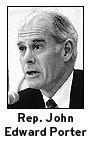
Rep. John Edward Porter of Illinois, who chairs the House appropriations subcommittee on education spending, and Rep. Michael N. Castle of Delaware, who chairs the education committee’s panel on K-12 issues, along with six other GOP House members, sent a May 26 letter to Mr. Clinton calling for new negotiations on the budget allocations.
The GOP group wants a “rational compromise” between the White House spending proposal, which they say would surpass the overall spending caps by $33 billion, and the current congressional plan for fiscal 2000.
“We strongly support continued responsible limits on discretionary spending to maintain a balanced budget and fiscal responsibility,” the letter stated. “However, to continue to pretend that essential legislation to fund the normal functions of government can be enacted under the caps is irresponsible.”
The appropriations subcommittee led by Mr. Porter will likely not begin work on its education spending bill until appropriators and the White House decide whether to renegotiate the caps, Ms. Morra said. And any renegotiation will likely take several weeks, she said, meaning the time line for completing work on appropriations would be pushed back. The new fiscal year begins Oct. 1, and the spending bill that includes education is typically one of the last, and most controversial, to be finished.
In the meantime, the member groups of the Committee for Education Funding, the main lobbying group for federal school aid, have joined with health-advocacy groups--forming a coalition that counts 254 members--to fight the pending cuts. Because health and education are included in the same budget category, such programs have typically had to compete for the same pot of money.
“They are in danger of jeopardizing two national priorities,” Mr. Kealy argued. “No way are you going to make your professed commitment to health and education with these allocations.”
The groups, which have begun a letter-writing campaign targeting members of Congress, were also planning to hold a rally on Capitol Hill this week to press for more spending for education and health.


