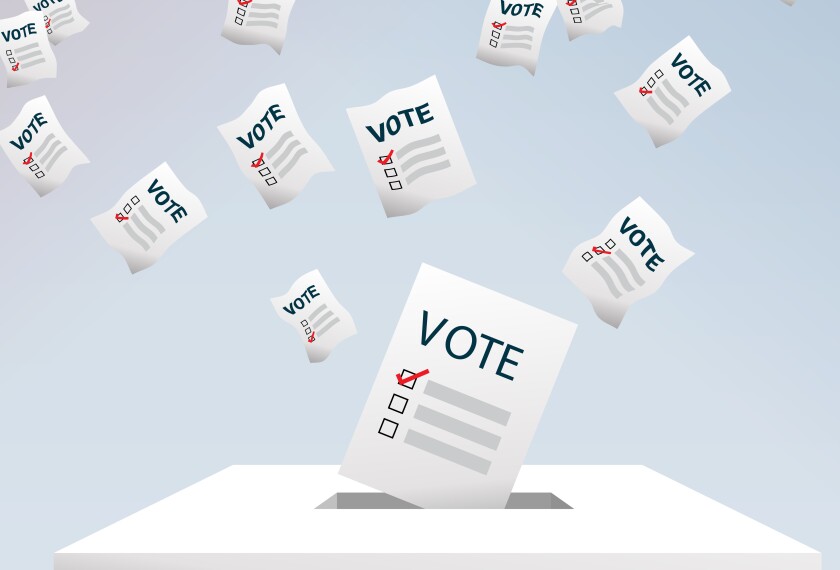
In West Virginia, voters will face this question on their November ballot: Should state lawmakers have the power to approve, amend, or reject, decisions made by the state board of education?
If the answer to the proposed constitutional amendment is “yes,” some worry it will lead to greater politicization of West Virginia’s public schools. But the amendment’s proponents argue that it’s simply a way to bring the West Virginia Education Department under the same legislative review process as the state’s other agencies.
The amendment is a standout among seven preK-12 education-related questions appearing on ballots across the country in the 2022 midterms.
The questions range from asking voters to approve a universal free meals program in Colorado to establishing a $1 billion funding stream for music and arts education in California.
Although important to the future of education in their respective states, the ballot issues don’t directly impact the cultural divides over issues such as race, gender, and parental control that have defined political candidates’ approaches to education issues.
That’s because state lawmakers often don’t need voter approval to pass laws banning critical race theory, preventing transgender students from playing sports, or limiting the presence of books and learning materials about race, gender identity, and sexuality, said David Bloomfield, an education law professor at Brooklyn College and the City University of New York Graduate Center.
“Generally, legislatures do legislation and, unless there’s a situation that implicates the necessity for a popular ballot, these things are largely resolved through the legislative rather than popular [vote] process,” Bloomfield said.
But the ballot measures, should they succeed, do have the potential to give schools more funding, open the doors for more programs, or, as in the case in West Virginia, give lawmakers more power over schools.
A bid to give West Virginia lawmakers more control over K-12
West Virginia Delegate Paul Espinosa, a Republican, has been working to place a check on the state’s board of education since 2017. After serving on the legislature’s commission on education accountability, Espinosa quickly found that state law allows its board of education to enact policies without approval of the state legislature, a privilege that is not extended to any other state agency, Espinosa said. Members of the board are appointed by the governor and confirmed by the state senate.
Espinosa’s bill to establish a constitutional amendment is meant to clarify that rules and policies made by the state board must be reviewed by the legislature, similar to “virtually all executive agencies in West Virginia,” Espinosa said.
But the proposed amendment hasn’t won the support of the state’s big associations that represent teachers and other school staff. The West Virginia Education Association, the West Virginia chapter of the American Federation of Teachers, and the West Virginia School Service Personnel Association have created a coalition to prevent the measure from passing.
The opponents worry Amendment 4 will lead to more political influence in schools and make it more difficult for necessary policies to be be approved by the board.
“There’s a reason that our constitution separates public education and the state department and state board,” said Dale Lee, president of the WVEA. “It’s to depoliticize education.”
Lee said the amendment is especially concerning in the context of the political environment surrounding education. The West Virginia legislature, which is controlled by conservative Republicans, has tried to pass at least three laws in the past year that would ban critical race theory and limit how teachers can talk about race and other divisive topics.
Lee disagrees with those efforts, stating that critical race theory, the academic concept that says race is a social construct and embedded into legal systems and policies, isn’t taught in the state’s schools. He worries that Amendment 4 would discourage teachers from entering a profession that’s already under great scrutiny. Lee estimates there are 1,500 open teaching positions in the state this year. In 2021-22, the state had 23,196 professional educators, according to the West Virginia Department of Education.
The number of teacher vacancies “has more than doubled in the last five years in a large part because of the lack of respect for educators,” he said. “This would just be another driving force to get people out of the profession.”
Espinosa denies that there’s a political agenda behind the measure, stating that its intended purpose is only to place the same check on the board of education that exists for other agencies.
Election Guide 2022
States hope to establish funding for new programs
Ballot measures in Colorado and California call for more funding to establish specific education programs.
Colorado’s Proposition FF will ask voters to approve income tax deduction caps that would create a fund for the state’s proposed Healthy School Meals for All program. The program would have Colorado join California, Maine, Massachusetts, and Vermont in offering free school meals to all students regardless of income status.
The program would provide free meals to around 60,000 more children in the state, according to Healthy School Meals for All Colorado, the campaign sponsoring the proposition. But it doesn’t sit well with some conservative lawmakers, who argue that the state shouldn’t cover the cost of free meals for students from wealthy families. Currently, the state’s free and reduced-price meals program follows federal guidelines with families having to make at or below 185 percent of the federal poverty line to qualify for free or reduced-price meals.
“If some family with two working parents is making $150,000, why would their children need free lunch?” said State Rep. Richard Holtorf, a Republican. “It’s not right. They should pay for their lunch because they can.”
California’s Proposition 28, which would use nearly $1 billion from the state’s general fund for arts and music education, has faced less opposition. The proposition would establish a grant program that gives schools full control of how to spend the money to meet their arts and music education needs, said Austin Beutner, a former superintendent of the Los Angeles Unified School District and leader of the Vote Yes on 28 campaign.
The proposition has received no formal opposition and is backed by celebrities, including Dr. Dre, John Lithgow, and Issa Rae. Beutner’s own experience playing cello and later guitar throughout school helped him develop a sense of belonging that drove the push to expand options for California students.
“Almost everyone I’ve ever met, whether it’s art, music, dance, theater, animation, filmmaking, whatever form of creative expression, I think everybody’s got a story where it starts with a sense of belonging,” he said. “You build on it, develop a desire to be at school, attendance improves, you develop a sense of accountability and a way to think critically about solving problems or creating new ideas, new sounds, or new images.”
The pandemic’s impact on voter interest in funding schools
Ballot questions in Idaho, Massachusetts, and New Mexico, all ask voters to approve more funding for K-12 education through tax increases or changes to funding formulas. School funding has always been a hit-or-miss subject, with Democrats often calling for more school funding and Republicans arguing state officials should reign in spending.
But the pandemic may have swayed voter appetite for more school funding after parents, teachers, and communities watched schools struggle with staffing shortages and inflation, Bloomfield said.
“The pandemic has had an impact [on] supporting education and concern about teacher shortages and inflation eating into education budgets,” Bloomfield said.
This may be reflected in a campaign in Idaho, which has gone through some complex turns. Reclaim Idaho, a grassroots campaign organization, withdrew an initial measure to increase education funding by $323 million by taxing people who make over $250,000 earlier this year after the state legislature nullified it with its own measure that would increase education funding by $410 million without increasing taxes. That measure will appear as Advisory Question 1 on the state’s November ballot.
Although Reclaim Idaho ultimately withdrew the initial ballot measure, Luke Mayville, one of the campaign’s founders, viewed it as a win for public schools.
“In the big picture we consider it a victory,” Mayville said. “It’s very clear that it was our initiative campaign that forced the legislature and governor to act on a large scale and make a truly large scale investment in public schools.”