Federal

Virginia Lawmakers Enact Measure Taking Aim at NCLB

By Mary Ann Zehr — March 17, 2008 3 min read
BRIC ARCHIVE
  • Save to favorites
  • Print

The following offers highlights of the recent legislative session. Precollegiate enrollment figures are based on fall 2007 data reported by state officials for public elementary and secondary schools. The figures for precollegiate education spending do not include federal flow-through funds, unless noted.

VIRGINIA

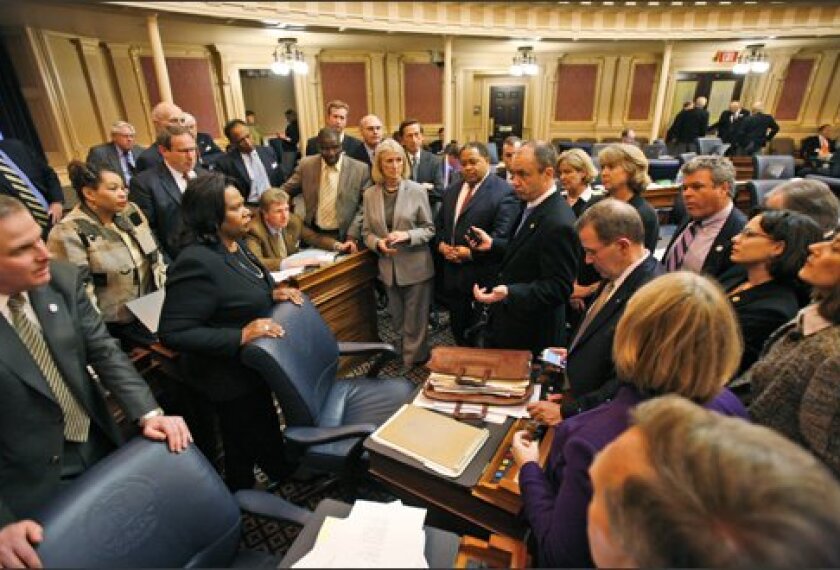
The Virginia legislature has approved a bill that would direct the state board of education to decide whether to withdraw from participation in the federal No Child Left Behind Act. But neither Gov. Tim Kaine, a Democrat, nor the board is likely to approve such a move, according to officials in the state.

Gordon Hickey, a spokesman for Mr. Kaine, said the governor—who had yet to sign the bill as of last week—doesn’t support withdrawing Virginia from the No Child Left Behind Act, which would put much of the state’s federal education funding at risk.

Gov. Tim Kaine
Democrat
Senate:
21 Democrats
19 Republicans
House:
45 Democrats
53 Republicans
Enrollment:
1.2 million

Under President Bush’s proposal for the fiscal 2009 K-12 federal education budget, Virginia is set to receive $416 million in federal education funding, according to data released by the U.S. Department of Education.

Gov. Kaine is “not going to throw that away,” Mr. Hickey said. He noted that the bill says simply that the board should study the issue, and the governor doesn’t have any problem with such a study, so he’ll likely support the bill.

The legislature’s action in its recently concluded annual session “reflects the frustration that’s been felt at the state and school district level in implementing this important legislation,” said Charles B. Pyle, the director of communications for the Virginia Department of Education.

He added, however, that “the board has never taken the position that Virginia should withdraw from No Child Left Behind.” The 6-year-old revision of the Elementary and Secondary Education Act requires that schools show annual progress toward student proficiency or face a range of possible penalties.

The Virginia legislature approved and sent to the governor on March 8 a bill that said that if the board of education should decide that withdrawal were the best option, it should submit a plan for how to do so to the governor and the legislature by June 2009.

Virginia officials have sought additional flexibility from the federal Department of Education on some NCLB issues in the past but have been rebuffed. For example, the state board had requested more flexibility in determining the order in which school districts offer certain educational options—tutoring or school choice, for example—when those districts are found to need improvement under the federal law. The federal government permitted the state to carry out that plan only as a pilot program, not statewide, according to Mr. Pyle.

Mr. Pyle also noted that some state educators are unhappy with how the federal government required Virginia to stop allowing some English-language learners to take the state’s English-language-proficiency test as a substitute for its regular reading test.

“That was a source of great frustration for Virginia school districts to have the rug pulled out from under them after administering a test for several years [to ELLs] in good faith.”

In addition to passing the NCLB-related bill, the legislature approved a bill to expand the governor’s preschool initiative that serves children who are eligible for free and reduced-price lunches. Gov. Kaine scaled back his own request for preschool funds to $43 million, from $58 million, after he realized he wouldn’t get what he had initially requested. In the end, the legislature decided to provide $22 million, according to Mr. Hickey.

The legislature also adopted a bill that would require clerks of courts in Virginia to report to the state school board and the local school board if any teachers have been convicted of sexual molestation or physical or sexual abuse or rape of a child or any felony involving drugs.

Virginia’s current K-12 budget is $6.9 billion out of the state’s $36 billion budget. As of presstime last week, legislators were still hashing out what the state budget, and K-12 budget, would be for the coming fiscal year.

A version of this article appeared in the March 19, 2008 edition of Education Week

Events

Artificial Intelligence Webinar AI and 'Techlash' Are on a Collision Course. How Should Schools Respond?
Learn what strategies and tactics schools can develop to encourage smart and responsible AI use, while also enforcing tech guardrails.
This content is provided by our sponsor. It is not written by and does not necessarily reflect the views of Education Week's editorial staff.
Sponsor
Special Education Webinar
Special Education Disputes & Rising Costs: Protecting Your District
Special education costs and risks are rising. Learn how stronger IEP and Medicaid processes help districts protect funding and compliance.
Content provided by Relay
This content is provided by our sponsor. It is not written by and does not necessarily reflect the views of Education Week's editorial staff.
Sponsor
Personalized Learning Webinar
Differentiation That Delivers: Proven Practices From High-Growth Districts
Make every minute count. Proven strategies from educators and leaders driving real student growth. Save your seat!
Content provided by i-Ready, Curriculum Associates

EdWeek Top School Jobs

Teacher Jobs
Search over ten thousand teaching jobs nationwide — elementary, middle, high school and more.
View Jobs
Principal Jobs
Find hundreds of jobs for principals, assistant principals, and other school leadership roles.
View Jobs
Administrator Jobs
Over a thousand district-level jobs: superintendents, directors, more.
View Jobs
Support Staff Jobs
Search thousands of jobs, from paraprofessionals to counselors and more.
View Jobs

Read Next

Federal Q&A A Top Democrat Breaks Down His Party's Plans for K-12 in a House Majority
If Democrats retake the House, Rep. Bobby Scott may be in a position to set his chamber’s K-12 agenda.
5 min read
Rep. Bobby Scott, D-Va., speaks during a prayer vigil held by the Chesapeake Coalition of Black Pastors at The Mount (Mount Lebanon Baptist Church) in Chesapeake, Va., Sunday, Nov. 27, 2022, for the six people killed at a Walmart in Chesapeake, Va., when a manager opened fire with a handgun before an employee meeting Tuesday night.
Rep. Bobby Scott, D-Va., speaks during a prayer vigil in Chesapeake, Va., on Nov. 27, 2022. Scott is the ranking Democrat on the U.S. House of Representatives' education committee and will seek the panel's chairmanship if Democrats win a House majority in next month's elections.
Carolyn Kaster/AP
Federal What a Democratic Congress Could Mean for Trump's K-12 Agenda
They may try to reverse—or at least investigate—the Trump admin.'s efforts to dismantle the Ed. Dept.
9 min read
House Minority Leader Hakeem Jeffries, D-N.Y., the top Democrat in the Republican-majority House, is joined by Rep. Pete Aguilar, D-Calif., chair of the House Democratic Caucus, as they criticize President Donald Trump and his policies while talking to reporters about the approaching midterm election, at the Capitol in Washington, Thursday, Sept. 17, 2026.
House Democratic Leader Hakeem Jeffries speaks at the U.S. Capitol on Sept. 17, 2026. He's joined by Rep. Pete Aguilar, D-Calif., who chairs the House Democratic Caucus. If Democrats gain a majority of either chamber of Congress after next month's elections, they'll be able to hold oversight hearings on and launch investigations into the dismantling of the U.S. Department of Education.
J. Scott Applewhite/AP
Federal The Future of Education Research: More Partisan and Largely Left to States?
As Trump administration works to change federal grants, outside researchers try to regroup.
6 min read
Image of file folders with tabs called "funding" "grants" "projects" and a blank note paper paperclipped to the outside.
Collage by Laura Baker/Education Week + Getty
Federal Bipartisan Bill in Congress Would Help Schools Put Cellphone Bans or Restrictions in Place
The bill would establish a federal grant program to support state efforts to restrict cellphones.
5 min read
Sen. Tom Cotton, R-Ark., the chairman of the Senate Intelligence Committee, center, is joined from left by Sen. John Barrasso, R-Wyo., the GOP whip, and Senate Majority Leader John Thune, R-S.D., as he speaks to reporters ahead of a Wednesday meeting with President Donald Trump, at the Capitol in Washington, Tuesday, June 23, 2026. (AP Photo/J. Scott Applewhite) Senate Minority Leader Chuck Schumer, D-N.Y., speaks to reporters at the Capitol in Washington, Tuesday, June 23, 2026.
Sen. Tom Cotton, R-Ark., speaks to reporters ahead of a meeting with President Donald Trump at the Capitol in Washington on June 23, 2026. Cotton is one of the sponsors of a bipartisan bill that would create a grant program for states to implement school cellphone bans or restrictions.
J. Scott Applewhite/AP
