Special Report
School Choice & Charters

Voucher Programs Prove District-Finance Wild Card

January 03, 2014 3 min read
  • Save to favorites
  • Print

Voucher programs and tax-credit scholarships—school choice options available in many places that allow parents to apply public resources to help enroll their children in private schools—can be a wild card for school districts, particularly in terms of fiscal planning.

Modern-day voucher programs launched in the United States in 1990 with a districtwide program in Milwaukee and have gained significant steam in the past several years, with more than 40 states considering legislation to create such programs since 2011. Still, they remain contentious and often restricted. Most voucher and other tax-credit scholarship programs, for example, are not accessible for the general student population but limited to specific subgroups such as children with disabilities, low-income students, and, in some cases, those in rural areas.

Voucher advocates maintain that the programs actually provide savings for school districts, since the amount of money allocated for each voucher is typically less than the per-pupil funding amount, making it less expensive to educate more students. Critics, however, question that philosophy, saying that many of those students receiving vouchers would have gone to private schools regardless, essentially turning the scholarships into rebates for private school students.

Selected School Choice Options

Vouchers:
State-funded scholarships given to eligible participants (typically children from low-income families, students in low-performing schools, and those with special needs) to be used toward private school tuition. Private schools that accept voucher students must comply with standards set by the state legislature, such as giving students state or national tests or requiring all teachers and administrators to have college degrees or certifications, for example. Thirteen states and the District of Columbia have voucher programs.

BRIC ARCHIVE

Tax-Credit Scholarships:
Programs that allow individuals and corporations to direct a portion of their state taxes to certain organizations that then provide money to K-12 students in the form of scholarships. Such scholarships may be used at private schools or public schools outside the district, depending on the state’s program. Thirteen states have tax-credit-scholarship programs.
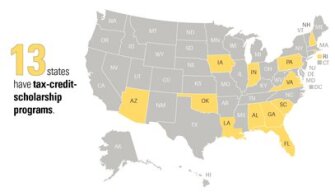
BRIC ARCHIVE

Personal Tax Credits:
Programs that allow parents to receive a tax credit for education costs such as private school tuition, textbooks, online education, tutoring, and supplies. Six states have personal-tax-credit programs.

Education Savings Accounts:
Government-authorized accounts set up for eligible students that provide money for education-related expenses such as textbooks, tutoring, private school tuition, or, in some cases, college. (What the funds can be used for depends on the parameters of each program.) There is one education savings account program, in Arizona.

BRIC ARCHIVE

District Focus:

  • Milwaukee’s voucher program started with 300 students in 1990 and had grown to 25,000 students in 2012. The state-backed program expanded to Racine, Wis., during the 2011-12 school year, when 250 students were allowed to participate. The cap was expanded to 500 students in 2012-13, and the cap has been lifted for subsequent years.
  • The District of Columbia’s voucher program is the first and only voucher program authorized by Congress. Since the program’s inception in 2004, the number of students participating has fluctuated between 1,000 and 2,000.
  • In addition to a statewide program in Ohio, Cleveland has a separate voucher program, established by the state in 1995 for students in the metropolitan area. About 6,000 participated in the 2012-13 school year.
  • The 61,000-student Douglas County school district in Colorado approved a pilot voucher program in the 2011-12 school year to provide students with up to $4,600 in per-pupil funds to go toward private school tuition. But the program has been held up in legal battles since its inception and has not been implemented.

Sources: National Conference of State Legislatures; the Friedman Foundation for Educational Choice

In March 2024, Education Week announced the end of the Quality Counts report after 25 years of serving as a comprehensive K-12 education scorecard. In response to new challenges and a shifting landscape, we are refocusing our efforts on research and analysis to better serve the K-12 community. For more information, please go here for the full context or learn more about the EdWeek Research Center.

A version of this article appeared in the January 09, 2014 edition of Education Week as Vouchers Prove Wild Card for Local Finances

Events

Artificial Intelligence Webinar AI and 'Techlash' Are on a Collision Course. How Should Schools Respond?
Learn what strategies and tactics schools can develop to encourage smart and responsible AI use, while also enforcing tech guardrails.
This content is provided by our sponsor. It is not written by and does not necessarily reflect the views of Education Week's editorial staff.
Sponsor
Special Education Webinar
Special Education Disputes & Rising Costs: Protecting Your District
Special education costs and risks are rising. Learn how stronger IEP and Medicaid processes help districts protect funding and compliance.
Content provided by Relay
This content is provided by our sponsor. It is not written by and does not necessarily reflect the views of Education Week's editorial staff.
Sponsor
Personalized Learning Webinar
Differentiation That Delivers: Proven Practices From High-Growth Districts
Make every minute count. Proven strategies from educators and leaders driving real student growth. Save your seat!
Content provided by i-Ready, Curriculum Associates

EdWeek Top School Jobs

Teacher Jobs
Search over ten thousand teaching jobs nationwide — elementary, middle, high school and more.
View Jobs
Principal Jobs
Find hundreds of jobs for principals, assistant principals, and other school leadership roles.
View Jobs
Administrator Jobs
Over a thousand district-level jobs: superintendents, directors, more.
View Jobs
Support Staff Jobs
Search thousands of jobs, from paraprofessionals to counselors and more.
View Jobs

Read Next

School Choice & Charters Democratic Governors Have Questions About the Federal School Choice Program
A letter from five Democratic governors signals some movement as state leaders decide whether to opt in.
5 min read
Mayor Michelle Wu and Gov Maura Healey arrive at the Otis Elementary School after Wu endorsed Healey in her reelection bid.
Massachusetts Gov. Maura Healey appears in Boston on Oct. 1, 2026, as part of her reelection campaign. Healey is one of five Democratic governors who sent a letter to Treasury Secretary Scott Bessent seeking more clarity on the new federal school choice program before deciding whether to opt her state in.
Stuart Cahill/Boston Herald
School Choice & Charters Opinion Don’t Be Fooled by Claims That Tax-Credit Scholarships Can Help Public Education
The latest federal school choice scheme is a Trojan horse, argue Miguel Cardona and Robert Kim.
Miguel Cardona & Robert Kim
•
5 min read
Collage-style illustration of tall vertical clippings of green lockers, a school bus and a wooden desk, all split apart. In between the images are clippings of text from the IRS webpage that has information about the Federal Scholarship Tax Credit.
Illustration by Emily Wright for Education Week + Getty
School Choice & Charters Opinion What Could a Blue Wave Mean for School Choice?
A Democratic wave could slow school choice’s momentum, but established programs are hard to undo.
•
5 min read
The United States Capitol building as a bookcase filled with red, white, and blue policy books in a Washington DC landscape.
Luca D'Urbino for Education Week
School Choice & Charters School Choice Could Prove Pivotal in Some Midterm Races This Fall
"The politics of school choice are being scrambled in real time," says one advocate.
8 min read
Maria Contreras, right, opens the door for her son, Ian Contreras, before taking him to school on Thursday, April 9, 2026, in Fort Worth, Texas.
Maria Contreras, right, opens the door for her son, Ian Contreras, before taking him to school on Thursday, April 9, 2026, in Fort Worth, Texas. Private school choice programs—such as Texas' education savings accounts—are shaping debates in close races in a handful of states.
Julio Cortez/AP
