
Federal

What the Federal ‘Don’t Say Gay’ Bill Actually Says

By Eesha Pendharkar — November 09, 2022 4 min read
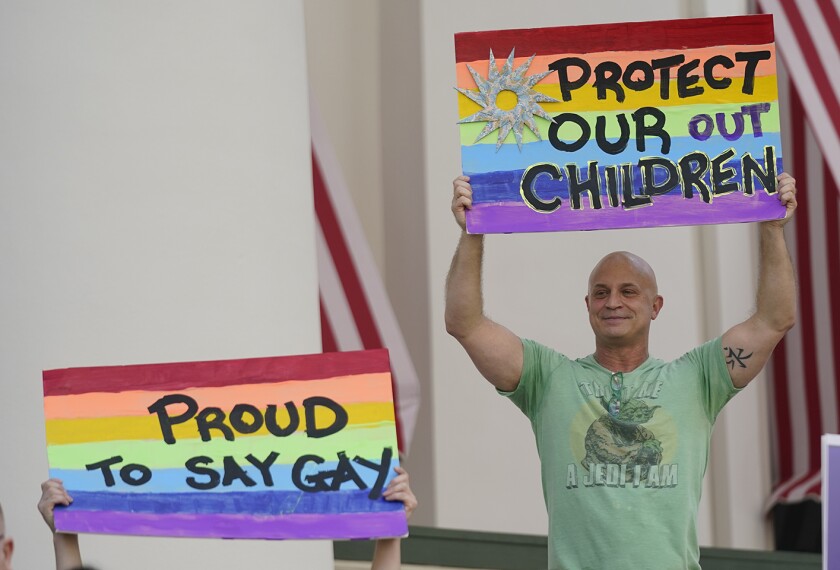
Demonstrators gather on the steps of the Florida Historic Capitol Museum in front of the Florida State Capitol on March 7, 2022, in Tallahassee, Fla. Florida House Republicans advanced a bill, dubbed by opponents as the "Don't Say Gay" bill, to forbid discussions of sexual orientation and gender identity in schools, rejecting criticism from Democrats who said the proposal demonizes LGBTQ people.
  • Save to favorites
  • Print

A federal version of Florida’s controversial “Don’t Say Gay” bill introduced last month would ban the use of federal resources to teach students about sexual activity and sexual orientation, gender identity, and dysphoria or transgenderism.

It’s highly unlikely that the bill, formally titled the “Stop the Sexualization of Children Act,” will be passed into law while Democrats control the House and Senate. But the Nov. 8 election results could offer Rep. Mike Johnson, the Louisiana Republican who proposed the bill, and his 33 co-signers, all Republicans, a chance at getting it passed.

“The Democratic Party and their cultural allies are on a misguided crusade to immerse young children in sexual imagery and radical gender ideology,” Johnson says in a statement. “This common-sense bill is straightforward. No federal tax dollars should go to any federal, state, or local government agencies, or private organizations that intentionally expose children under 10 years of age to sexually explicit material.”

But while Johnson called the bill “common-sense,” legal and LGBTQ advocacy experts say it’s concerning and a transparent political attempt at erasing LGBTQ identities.

“It’s quite important and deeply troubling that we saw these bills introduced,” said Jennifer Pizer, the chief legal officer at Lambda Legal, a civil rights organization focusing on defending the rights of LGBTQ people, “because it suggests that this issue is going to be the next anti-LGBTQ, right-wing bandwagon.”

The federal version follows a spate of anti-LGBTQ state legislation

This year, dozens of bills were introduced across the country that target LGBTQ students by restricting access to books about LGBTQ topics or lessons on sexual orientation and gender identity. Transgender students in particular have also been targeted in state legislation that attempts to restrict their use of restrooms aligned with their gender identity and limit theiraccess to team athletics, especially for trans girls.

Florida’s “Don’t Say Gay” law, officially known as the Parental Rights in Education law, is the most widely known example of that legislative genre and has inspired copycat bills across the country. Contrary to its nickname, though, that law did not specifically ban lessons on gender identity, sexual orientation, and transgender issues. Its critics dubbed it “Don’t Say Gay” because of its anti-LGBTQ intent, which was made evident by statements state lawmakers made when they were introducing the bill. For example, Gov. Ron DeSantis’ spokesperson, Christina Pushaw, called opponents of the bill “groomers” on Twitter, an accusation often aimed baselessly at LGBTQ rights advocates.

“Whether it’s this new bill introduced in Congress or the hundreds of bills that have been introduced in state legislatures around the country, it’s all the same,” said Aaron Ridings, chief of staff and deputy executive director for public policy and research at GLSEN, an LGBTQ advocacy organization.

“It’s about discrimination and exclusion, and that has extremely harmful impacts on young people’s long-term well-being and ability to achieve their full potential,” he said.

Bill language and enforcement

The federal bill outlaws any use of federal funds or facilities for “sexually oriented” education for children younger than 10 years old. Sexually oriented education is defined as any description or depiction of sexual activity and any topic including sexual orientation, gender identity, dysphoria, and transgenderism, according to the bill.

It also bans exposure of elementary students to “nude adults, individuals who are stripping, or lewd or lascivious dancing.”

“Many newly implemented sexual education curriculums encourage discussions of sexuality, sexual orientation, transgenderism, and gender ideology as early as kindergarten,” the bill says in citing the need for the proposed bans.

Its restrictions would also apply to public libraries that “target preadolescent children and teach them about concepts like masturbation, pornography, sexual acts, and gender transition,” and local government and private organizations that use federal money “to host and promote sexually oriented events like drag queen story hours and burlesque shows.”

The bill would also allow parents to file a civil lawsuit in federal district court against a government official, government agency, or private entity for violating the measure. It also says schools can’t receive federal money for three fiscal years if they receive two or more injunctions for violations.

“If this bill or a similar one were to pass at the federal level, that would be utterly appalling; it would be a throwback to prior generations, when information about LGBTQ people was widely censored,” Pizer said. “It would be scary and very harmful to young people in educational environments, to get the official message that there’s something wrong with them, there’s something wrong with their families.”

Events

This content is provided by our sponsor. It is not written by and does not necessarily reflect the views of Education Week's editorial staff.
Sponsor
Recruitment & Retention Webinar
Hiring, Retention, and Fill Rates: A Data-Driven Sub Strategy
Explore what keeps substitutes coming back and hear how one district rebuilt its substitute hiring process and improved its fill rate.
Content provided by Frontline Education
Early Childhood K-12 Essentials Forum Early Childhood Education: Building Essential Skills for Success
Join this free virtual event to examine the biggest challenges in supporting young children, from preschool through elementary school. 
This content is provided by our sponsor. It is not written by and does not necessarily reflect the views of Education Week's editorial staff.
Sponsor
Student Absenteeism Webinar
Attendance Isn't an Attendance Problem
Boost attendance by strengthening relationships, belonging, and support with practical strategies from Doug Fisher & Nancy Frey.
Content provided by Corwin

EdWeek Top School Jobs

Teacher Jobs
Search over ten thousand teaching jobs nationwide — elementary, middle, high school and more.
View Jobs
Principal Jobs
Find hundreds of jobs for principals, assistant principals, and other school leadership roles.
View Jobs
Administrator Jobs
Over a thousand district-level jobs: superintendents, directors, more.
View Jobs
Support Staff Jobs
Search thousands of jobs, from paraprofessionals to counselors and more.
View Jobs

Read Next

Federal Ed. Dept. Would Have More Power to Cut Off Grants Under New Rules
The agency last year ended in-progress grants worth more than $2 billion, with courts often objecting.
5 min read
Jeanette Vyhanek, a counselor at Wellstone Elementary, teaches a class of kindergarten students at the St. Paul school on Oct. 31, 2025 in Minnesota.
Jeanette Vyhanek, a counselor at Wellstone Elementary in St. Paul, Minn., teaches a class of kindergarten students on Oct. 31, 2025. Federal grants to expand the ranks of school counselors and other school mental health services were among hundreds terminated by the Trump administration in 2025. New rules from the U.S. Department of Education would give the federal agency greater latitude to end in-progress grants.
Alex Kormann/The Minnesota Star Tribune via TNS
Federal Q&A Education Data Collection Has Cratered Under Trump. Can It Be Rebuilt?
Ed. Dept.'s data-gathering agency is too unstable to adapt to changing needs, a new report claims.
6 min read
A student raises her hand to ask a question in her third grade classroom at Highland Elementary School in Columbus, Kan., on Oct. 17, 2022. The arm of the government that oversees education data which tracks educational outcomes for students, faces major challenges ahead due to financial cuts.
A student raises her hand to ask a question in her 3rd grade classroom at Highland Elementary School in Columbus, Kan., on Oct. 17, 2022. Federal education data-gathering, like the Condition of Education report, includes baseline information on students and schools. But cuts to the Education Department's statistics wings and mounting criticism of how it operates raise questions about how it can best fulfill its mission.
Charlie Riedel/AP
Federal Education Department Tells Schools Race Can’t Factor Into Student Discipline
A letter to educators follows up on last month's rescission of longstanding discrimination rules.
5 min read
Assistant Secretary for Civil Rights for the Department of Education nominee Kimberly Richey testifies before the Health, Education, Labor and Pensions committee about her nomination in Washington, D.C., on June 5, 2025.
Assistant Secretary for Civil Rights Kimberley Richey testifies before the Senate's Health, Education, Labor and Pensions committee at her nomination hearing in Washington on June 5, 2025. A new letter to educators from Richey instructs schools not to consider race at all in school discipline policies, following the Trump administration's rescission of longtime anti-discrimination rules.
Jason Andrew for Education Week
Federal Q&A What Head Start's English-Only Rule Could Mean for English Learners
Research shows it's not necessary to lose a home language to learn English.
3 min read
Long Beach, CA - March 20 : Teacher Monica Alvarado, left, leads activities with staff in the infant class at Educare Los Angeles at Long Beach , a very high-quality child care center in Long Beach on Wednesday, March 20, 2024 in Long Beach, CA.
Teacher Monica Alvarado, left, leads activities with staff in the infant class at Educare Los Angeles at Long Beach, a very high-quality child care center in Long Beach on Wednesday, March 20, 2024 in Long Beach, Calif. Head Start programs for early childhood education will no longer promote bilingualism under a proposed rule change.
Brian van der Brug / Los Angeles Times via TNS
