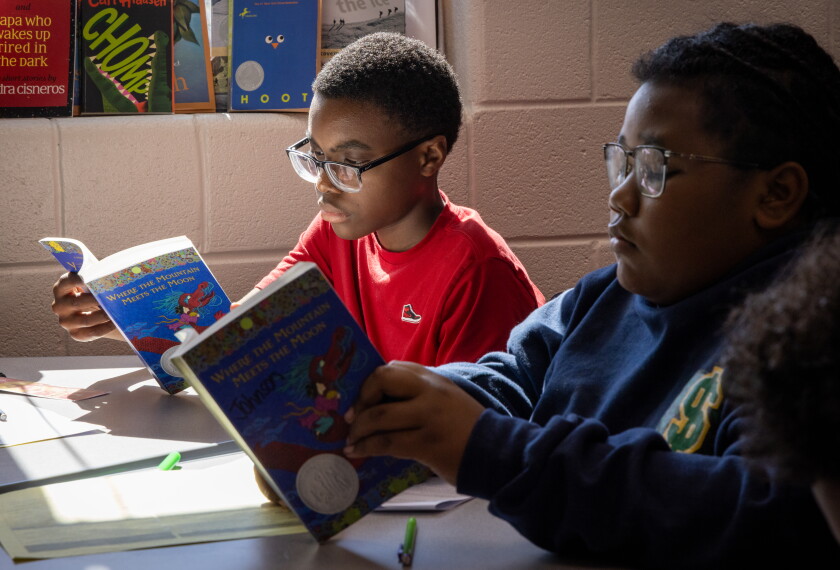
By now, most everyone with a stake in children’s literacy has heard of evidence-based reading instruction. And if asked what the term means, chances are strong that phonics and its use in teaching word reading will be central to the response. But if educators focus primarily on phonics to create strong readers, say some literacy experts, they are missing a critical component to literacy instruction: stimulating language development.
Tiffany Hogan, a professor at the MGH Institute of Health Professions in Boston and the director of its speech and language literacy lab, and MaryKate DeSantis, a school-based reading specialist-turned-clinical research practitioner at the MGH Institute, spoke to Education Week about language development as the often-missing link in literacy instruction. They argue that nurturing language development, the process by which children learn to use and understand language, is as important as teaching phonics and the processes associated with it. And they say that there are explicit and systematic ways to do so, just as there are in evidenced-based reading instruction.
This conversation has been edited for length and clarity.
You assert that two primary skills are associated with evidence-based reading instruction, correct? Tell us about them.

Hogan: Yes. There are two separate skills that come together for reading comprehension. Right now, we see a lot of focus on word reading. And people have argued that the science of reading only covers word reading. But no, it doesn’t. It covers all of the science around reading and reading comprehension. There’s also a large and rich science around language comprehension, and how to improve it in the classroom, and how to measure it as well.
Let’s start by breaking down the components of language development.
Hogan: Oral or spoken language is actually quite complex. We usually describe language in three components: One is the form of language, or the sounds in a language used to convey meaning. There’s also the content of language, that’s more of the meaning aspect of language, which includes vocabulary and morphosyntax, the study of how words and sentences are formed. Then there’s the use of language, the pragmatics of language, or how we socially use language. So when we think about language development, we’re thinking of these three components: form, use, and content.
Explain how the development of language aids in reading comprehension.
The form of language is most directly related to children’s ability to read words, because they’re connecting letters and sounds, and then they decode these letters to make them into sounds, that gives it the form. And the listening comprehension is primarily underpinned by the content and use of language. So the knowledge of form, use, and content that children are developing from utero—there are actually some really cool studies saying they are developing it in utero and across the lifespan—that’s setting the foundation for comprehension through supporting both word reading and language comprehension.
Are teachers trained to use oral language in their literacy instruction?

DeSantis: Thinking about oral language and being really intentional about creating an environment in which oral language develops was not top of my mind as a teacher. In the classroom, I had kids in front of me, and when it came to how I thought about comprehension of language, I generally thought about reading comprehension. I was going to focus all my energy and my time on that. And, very early in my [teaching] career, that’s what I did.
Why do language competencies get overlooked in early literacy instruction?
As a teacher, if students are struggling with reading, there are lots of screeners and formal assessments to be able to get that data [around reading] and use it to inform instruction. But it’s really rare for teachers to have at their fingertips a screener for oral language, specifically. It wasn’t until later in my teaching career, when I started reading the research and the evidence—a lot of which Dr. Hogan has led—that I began to understand that this foundational language is the glue.
Right now, schools are so focused on that reading comprehension piece, that the emphasis is on decoding—breaking down the code and seeing that growth in the scores. Oftentimes, the reason why we’re not seeing that growth or we’re seeing it for a little bit and then it stops and we see kids start to fall apart in those upper elementary grades is because educators don’t know to be focusing intentionally on teaching language.
What can educators do to gauge and grow oral language skills?
Hogan: We want to see the same attention that’s paid to word reading paid to oral language. We hear about the science of reading and “word reading,” making sure we have systematic, explicit instruction and that we monitor children’s progress over time, and that we meet them over time with differentiated instruction. We want to see that exact same specificity for oral language.
Several high-quality language interventions are out there but, unfortunately, most of them have not been incorporated into the curricular materials that teachers see in front of them. They’ve been created by researchers like myself, and a lot of them are available free online, which I call pre-paid, because they were paid for with government tax dollars, they aren’t readily marketed to educators. But in the work we’ve done, we’ve shown that if you systematically and explicitly stimulate language, you can see increases over time that promote reading comprehension.
What does teaching oral language look like in the classroom?
Hogan: It looks like systematically choosing age-appropriate vocabulary words to use in context in books that are rich and that don’t have to be read by children, but that teachers can read to them. It looks like having a focus on grammatical morphology and tense morphology, derivational morphology; through child-appropriate play; through activities and interactions with text; having some instruction, very explicitly in the components of a story. We know that when children are taught components of stories, they’re better likely to comprehend them; this is referred to as story grammar–setting, character, problem, and solution. Incorporating that systematically into the curriculum is very helpful. Teaching students to have better inferencing skills; the ability to fill in gaps in stories. Also teaching comprehension monitoring—active comprehension: to summarize the main idea, to look for main details. All of these things have been shown to be evidence-based in terms of stimulating language as it relates to reading comprehension and using language in everyday life activities.
Provide an example of focusing on language usage in the classroom.
DeSantis: When we talk about language, in particular, what’s really important is usage. Hearing language is one thing, but actually using it, and having fun with it, and playing with it, is another. For example, if you’re reading a story out loud and you come across a line that says, “the boy shrieked,” you can ask the students: What does that word shriek mean? What does it not mean? Can you whisper and shriek at the same time? Having those ‘in the moment’ discussions to monitor student comprehension, and detecting inconsistencies in stories—that’s how we’re monitoring our comprehension when we’re reading.
We want to make sure we’re checking in on our students’ comprehension that’s spoken aloud. Making sure that directions are simplified. And by that, I don’t mean dumbed down, because exposure to rich and complex language is so important. Maybe you have fewer clauses in a sentence, or perhaps you pause after each direction. Thinking about more repetitions and more visual aids—things that spark language, just by showing a quick visual.
For example, if we ask a student to do a story retelling, if they don’t have the language to do that, you can show them a visual and that’s going to support that language and be more explicit. It’s all these built-in scaffolds to support that expressive language.
So, there is a systematic, explicit approach to language comprehension?
Hogan: The teachers we work with know they need to stimulate language for comprehension, but what’s missing is the systematic and explicit approach. So instead of just playing with language, reading books, talking about them, we’re talking about very systematic building skills over time using explicit instruction, scaffolding, all of that. When teachers do these explicit language instruction time periods, we hear from them that it helps them to feel more confident teaching language skills across the curriculum or even when they’re at recess and a student asks, “What does this mean?” And teachers respond using context instead of just saying the meaning. So it gives teachers a skill set for teaching language throughout the day. Critically important is that it has to be as systematic and explicit as phonics instruction.
Comment on the significance of word reading and language acquisition simultaneously.
Hogan: Schools tend to want to focus only on word reading early on, because they’re like, “we have to break the code, we have to get them to be word reading, and then that will result in language.” That is true, but what we know is that language and word reading need to be built across the curriculum so that we don’t neglect language early on, but we don’t want to neglect word reading later. It’s not a relay race, where word reading is handed off to language. It’s a parallel structure.
DeSantis: As an early career teacher, if you had asked me what explicit and systematic instruction in language was, I would not have been able to tell you. We have all this spotlight on word reading and phonics right now, which is wonderful, because that’s part of the puzzle, but the other huge piece that has to go hand in hand is knowing about how to stimulate language explicitly and systematically.