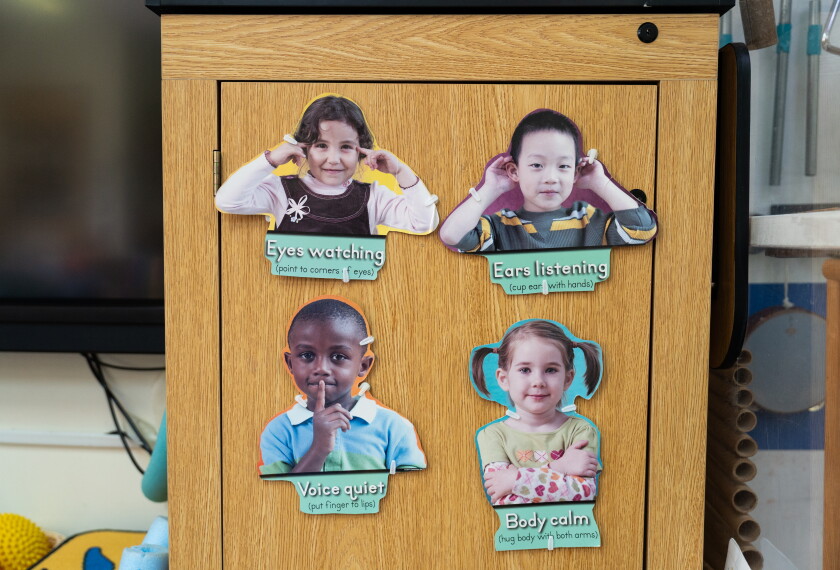
With a new school year underway, teachers may be feeling the pinch in their wallets after stocking up on classroom supplies, from tissues to snacks to books. One estimate puts educators’ average annual out-of-pocket expenses for classroom supplies at $895.
A federal educator expense deduction provides some relief. Launched in 2002, it allows K-12 teachers to deduct $350 annually on their tax returns for the out-of-pocket expenses incurred for classroom supplies. Now, early childhood educators will get this benefit, too.
The bipartisan Early-Childhood Educators’ Deductions (SEED) Act, signed into law on Sept. 19, expands the federal educator expense deduction to include pre-K and early childhood educators.

“Early educators play an essential role in giving young children a strong start and building the foundation for their future success. But for too long, they have been left out of a tax benefit available to their K-12 peers,” said Sarah Rittling, the executive director of the First Five Years Fund, a Washington-based nonprofit.
That’s not the only thing they’ve been left out of, say experts.
Early educators tend to lag far behind their K-12 counterparts in pay and benefits. And although the newly announced tax deduction may not make much of a financial difference to early educators’ overall income, advocates believe it signals a change in how policymakers view the profession.
“It’s an important message to have come from a bipartisan group of members of Congress—that the work that happens in early childhood is complex, that it’s educational work, that the professionals who are supporting our younger children are doing valuable work that deserves recognition,” said Daniel Hains, the managing director of policy and professional advancement for the National Association for the Education of Young Children.
“I hope it’s something we can build on to start talking about increased support for these programs that allows professionals who are doing this work to be compensated more in line with the value of the work that they’re doing.”
High turnover among early educators stems from low pay, feelings of disrespect
High staff turnover has long been a challenge in preschools and childcare settings.
A 2026 analysis by the Buffett Early Childhood Institute at the University of Nebraska examined workforce turnover between 2023 and 2025 across eight states, looking at teachers, program directors, and home-based childcare owners. Researchers found that 90,000 early childhood employees—44% of those in the sample who worked directly with children—left the field by the end of that two-year period.
Walter S. Gilliam, the executive director of the institute, said in addition to low pay and benefits, feeling disrespected ranks high among educators’ reasons for leaving their jobs.
“I don’t know of any early educator, especially those who work in a public school building, who isn’t keenly aware that [the educator expense deduction] tax break is available to her kindergarten teacher colleague across the hall and not to her,” Gilliam said.
As more school districts begin to offer pre-K programs, fueled by increases in state funding, that scenario may have become increasingly common.
For a pre-K teacher and a kindergarten teacher in the same district, “they had the same credentials. They did exactly the same work, except one of them worked with 4-year-olds instead of 5-year-olds. They still dipped into their own pockets to buy crayons,” Gilliam said.
Wage disparities persist
The expanded tax deduction will help defray out-of-pocket expenses for early childhood educators. But pay disparities remain.
In 2025, the average salary of public school pre-K teachers rose roughly 5%, to about $66,800 from $63,600 in 2024, according to RAND Corp. survey data. The average K-12 teacher salary in the 2024-25 school year was $74,177, according to the National Education Association.
A 2024 analysis by the Center for the Study of Child Care Employment out of the University of California Berkley reported that on average, early childhood educators earn $13.07 an hour. The report drew data from the American Community Survey and includes employees who teach in private childcare centers, home-based settings, Head Start programs, and public school pre-K classrooms.
Childcare workers earned the least, an average of $11.81 an hour; preschool teachers made an average of $13.74 hourly; and directors averaged $20.38 an hour. The report drew data from the American Community Survey.
Dissatisfaction with one’s earnings is intertwined with feelings of disrespect. By expanding the educator tax deduction to early childhood educators, policymakers are beginning to address the respect issue, advocates say.
“The first step to being seen as educators is to avoid in policy actively not seeing them as educators,” said Gilliam of the Buffett Early Childhood Institute. “And when there’s a tax deduction called the educator expense deduction that explicitly did not include them, that was actively not considering them educators.”
Advocates hope the tax deduction is just a first step for early educators toward more equality with their colleagues who teach older children.
“This is meaningful for educators in the sense that having an additional $350 in your pocket at the end of the year is meaningful for anybody,” said NAEYC’s Hains. “But it’s not the same as professional compensation, benefits—all the things that we know the field needs to thrive.”