College & Workforce Readiness Q&A

Are Some Students Taking Too Many AP Courses? A College Board Official Responds

By Ileana Najarro — August 28, 2023 3 min read
Stuart Wexler leads his Advanced Placement government class in a discussion at Hightstown High School in Hightstown, N.J., on Feb. 19, 2019.
  • Save to favorites
  • Print

In recent months, College Board’s AP program has been at the white-hot center of debates over what should and shouldn’t be taught in some of America’s classrooms—particularly in Florida.

But the influential nonprofit, which also owns and administers the SAT, continues to focus on other pressing issues facing its Advanced Placement program. One of those is equity—understanding which students have access to AP courses and identifying the impediments that are keeping a more diverse population of students from taking the college-prep classes.

Trevor Packer, the head of the AP program for College Board, talked with Education Week recently about the challenges of AP course access, a topic he discussed with thousands of AP teachers and school and district leaders earlier this summer in Seattle. The interview has been edited for clarity and length. (Read a longer interview with Packer about College Board’s stance on AP African American studies, AP Psychology, and how it’s responding to state and district policies that challenge what can be taught.)

What are the priorities for the AP program moving forward?

Our very top priority is to be thoughtful and effective at solving a really strange dichotomy in AP. There are a few students—2 to 3 percent of American high school students—that take a large number of AP courses, perhaps to their detriment, perhaps incurring a degree of stress or sacrificing other valuable opportunities in high school as some sort of arms race to take as many AP classes as possible.

Our own research shows that is not necessary for college readiness. Simply taking one or two AP classes at most per year of high school optimizes the type of college readiness that comes from taking that type of challenging class.

And we’re worried about the other extreme, which is that the majority of American high school students get access to zero such classes, which really moves them off of a pathway to college, under-prepares them for what they will encounter if they do make it to a two-year or four-year institution, sends a message to them that they are not part of a college-going culture.

We are trying to blast the education community with the new research, we’ve distilled it to a single page to make it very accessible both for school boards, for admissions officers to use to send a strong message that moderation should be used as we think about how we counsel students, and the sort of pressures that are placed upon them as they think about college admissions.

At this point in American education, the number of seats in AP classes are finite. So if a small number of students are taking five AP courses a year and a large number of students are taking zero, one of the most immediate moves that needs to be made is to think more deliberately about how to ensure that those seats are made equitably available.

The other move is to train more AP teachers to create more sections in AP schools. While most American high schools have a large number of AP courses, or a significant number of AP courses, they mostly just have one section of each class, which means that there are a very limited number of seats. So something we tried this past year that has been very successful and exceeded our expectations in many ways is we’ve gone out to districts across the country and said, “If you are willing to add more sections, so that there is more opportunity in your district, more seats available, we will pay all the teacher-training costs. And in fact, if you have a significant number of teachers, we will send trainers to you so your teachers don’t even have to leave their school district.”

So we’ve done more teacher training for free this past year than we’ve ever done before. And that will be our model moving forward. We want to remove any barriers that are related to the cost of training teachers, for any school that wants to create more seats, and thus make AP more available.

Events

This content is provided by our sponsor. It is not written by and does not necessarily reflect the views of Education Week's editorial staff.
Sponsor
College & Workforce Readiness Webinar
From Exposure to Experience: Designing Accessible Work-Based Learning
Learn how schools can create meaningful experiences that help every student build skills, connections, and a clearer path to their future.
Content provided by Project Lead The Way
This content is provided by our sponsor. It is not written by and does not necessarily reflect the views of Education Week's editorial staff.
Sponsor
School & District Management Webinar
A Tale of Two School Districts: Forecasting Enrollment
Forecasting enrollment is hard. Here’s how two different districts are navigating times of change with data that considers the whole picture.
Content provided by Zonda Education
Reading & Literacy K-12 Essentials Forum Strategies to Create a Culture of Reading in Schools
Join this free virtual event to learn how teachers and school district leaders ensure students are reading enough.

EdWeek Top School Jobs

Teacher Jobs
Search over ten thousand teaching jobs nationwide — elementary, middle, high school and more.
View Jobs
Principal Jobs
Find hundreds of jobs for principals, assistant principals, and other school leadership roles.
View Jobs
Administrator Jobs
Over a thousand district-level jobs: superintendents, directors, more.
View Jobs
Support Staff Jobs
Search thousands of jobs, from paraprofessionals to counselors and more.
View Jobs

Read Next

College & Workforce Readiness How One District Is Preparing Students for Careers Battling Online Hackers
This cybersecurity program offers students real-world experience and professional mentorship.
9 min read
Amanda Rossmann for Education Week
Elsy Prempeh, an employee of Fifth Third Bank, looks over a computer program while mentoring students at Lakota West High School in West Chester Township, Ohio, during Jennifer Circello’s class on Oct. 13, 2026. The district's Cyber Academy leans on industry partners to provide relevant experience for students interested in careers in cybersecurity.
Amanda Rossmann for Education Week
College & Workforce Readiness France Promises to Replace Its University Admissions After Riots, Mass Arrests
The concessions target the school grievances that helped ignite the unrest.
4 min read
A person holds a French national flag during a protest against under-resourced schools in Paris on Thursday, Oct. 8, 2026.
Aurelien Morissard/AP
College & Workforce Readiness Q&A Reading, Writing, and Math Skills Are Top Priorities in This CTE Program
How these teachers are connecting the dots between academic and technical skills.
4 min read
Cass Career Center
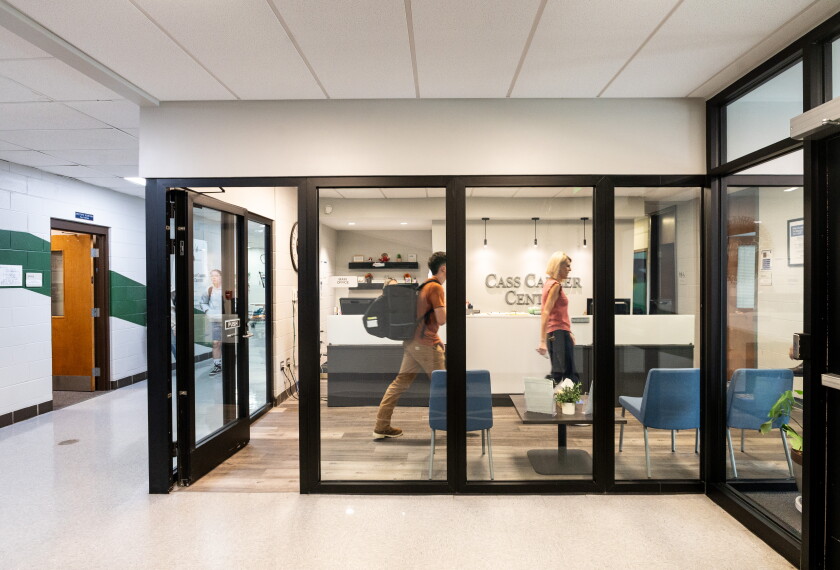
Assistant Director, Nicole Tews, walks a student through the administration office at the Cass Career Center in Harrisonville, Mo., on September 29, 2026. The center has a math and an English teacher who are integrated into students' industry-specific career programs.
Melissa Lukenbaugh for Education Week
College & Workforce Readiness Q&A Dual Enrollment Is Surging. Here's How High Schools Can Get it Right
More than 3 million high school students took a college course last year.
3 min read
Macomb Community College's South Campus in Warren, Mich. off of 12 Mile Road on Oct. 15, 2026.
Macomb Community College's South Campus in Warren, Mich., is shown on Oct. 15, 2026. In Michigan, 16 percent of community college students are high schoolers. Nationwide, dual enrollment now tops 3 million students.
Miles Oates/mlive.com via TNS