
It is a universal truth that most teachers, at some point in their careers, will get at least one student who will ask them: “When are we ever going to use this in the real world?”
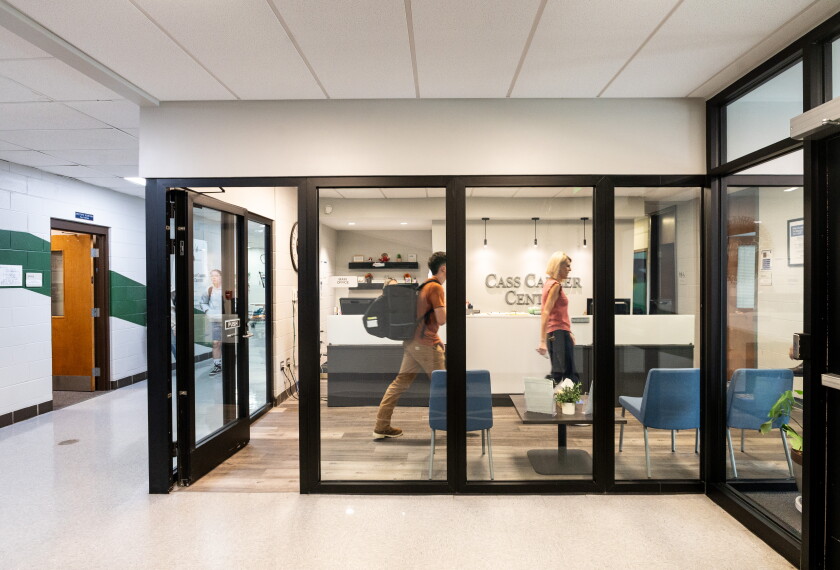
At the Cass Career Center here, students are regularly shown how academic reading, writing, and math skills are connected to the career and technical skills they are learning. The school’s integrated academics program incorporates real-world reading and writing and math skills into students’ chosen, career-oriented programs of study.
The English and math teachers work closely with the industry program instructors to ensure what students are learning is directly applicable to the careers they’re going into—from technical reading and professional writing to math equations that provide guidance for how to safely fight a fire, draw blood from a patient, or make a welding project work. Those are all career skills that are taught in the program.
At a time when schools across the country are grappling with achievement declines, chronic absenteeism, and disengagement, it’s even more important to make sure what students are learning is relevant to their lives and future careers, experts say.
Anne Hickman, the Cass Career Center director, and Nichole Tews, the assistant director, discussed how the program works and how other schools might replicate it.
This interview has been edited for length and clarity.
The integrated academics program requires a lot of collaboration between teachers. How do you make that work?
Hickman: Our teachers—it’s just kind of ingrained in all of them that they want to see their students take that next step. They’re really passionate about the industries that they come from, and so they take it upon themselves to ensure that the batch of students who come through their programs are going to be successful.
I always say that every one of the people in this building, they’re like a unicorn. They’re really, really hard to find—somebody who has the skill set needed to teach these [industry-specific] content areas, but then can also be a teacher as well and work with high school students.
There’s a lot of dynamics that really have to come together, and so finding people who want to do this work is really difficult. But they’re out there, and if you do find them, they are really passionate about seeing the outcomes come to life for their students.
Although nobody in this building shares the same content area, we all have that same objective: that we’re trying to get students to that endpoint. All teachers want their students to be successful, but we have a really clear picture of what that looks like for every one of our students when the program ends.

What are some of the challenges you’ve faced?
Tews: Initially, it was a challenge getting all of [the schools that send their students to us] on board with accepting our credits. They were leery to trust that the English and math that students were receiving here was at the same level as their high schools. It took a lot of presentations, a lot of going to the sending schools, visiting with their superintendents, bringing their superintendents here to see what it looks like.
Our students are asked to take what they’re doing and apply it at a very high level, and we have very high expectations because they need to do it on their own once they leave here. It might be one thing to make measurements in geometry class, but when they’re building in the shop, and they make [measuring] mistakes, they’re very real and very expensive mistakes.
How could other schools replicate this program?
Tews: There are definite must-haves like certified math and English teachers. If you don’t have a certified math and English teacher, it’s a different ballgame as far as that credit piece works. The credit piece is important. You need to have that English and math credit as separate grades from CTE.
Our English and math teachers could tell you almost every year they change the schedule. They’re constantly modifying the schedule to accommodate instructor and student needs, so that’s something that has to be unique to every building.
Another non-negotiable is that your curriculum is tied to state-level standards, but then the rest of it is innovative. It is school leaders and instructors figuring out how to make this work in their buildings with their unique schedules.
Hickman: Everybody has to accommodate based on what their student needs are. For us, [having dedicated math and English teachers] is a priority because if you think about the alternative, then our program instructors are held responsible for some of this really academic content that they’re not necessarily inherently natural at teaching. Even though they came from industry, they weren’t all doing really in-depth technical writing or training somebody else on the math.
I would argue that integrating English and math is essential to ensure that the students are well-rounded and get that full curriculum.

Is there anything that you would change about the program?
Hickman: I wish there was a way for me to find more people [with similar professional backgrounds as our teachers] to give them some more resources. Other than talking about general teaching strategy and best practices, as far as getting really drilled into what they do, it’s just so unique. I wish there was a way to better support their professional development.
It does seem like there’s more and more examples of what we do in pockets of places, even in the traditional high school settings or other career centers putting up a similar model. So we’ll continue to try and help them network with those individuals and share some ideas.


