Reading & Literacy Interactive

Book Bans Over the Years, in Charts

By Eesha Pendharkar — April 28, 2023 2 min read
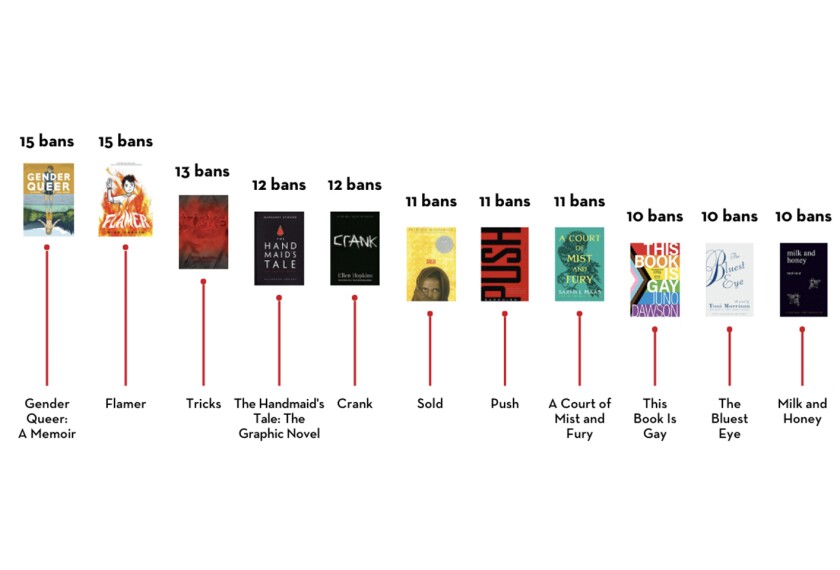
The most banned books from the fall of 2022, according to PEN America.
  • Save to favorites
  • Print

Book bans have escalated for 18 months now, hitting an all-time high in December 2022.

Since June 2021, PEN America, a free speech advocacy organization that tracks bans, has recorded more than 4,000 book challenges and bans in school districts.

The actual number is estimated to be even higher because PEN America relies on media reports, publicly available documents, and school district meeting minutes to track bans.

Book bans have impacted a wide range of topics, from titles about LGBTQ+ characters, to books on sexual health, to books featuring themes of race and racism.

Here’s a visual representation of book bans, from June 2021 to December 2022, based on PEN America data:

How many books have been banned?

Book bans reached an all-time high during the fall of 2022. But since 2021, PEN America has tracked more than 1,000 instances of book challenges and bans during each six-month period.

What is the No. 1 most banned book?

Gender Queer: A Memoir by Maia Kobabe, is the most banned book over the last 18 months. The graphic memoir both written and illustrated by Kobabe chronicles the author’s life from adolescence to adulthood, detailing their experiences with their gender and sexual identity.

It has been banned 56 times in 18 months.

What is the No. 1 reason books get banned?

Books are frequently challenged for having inappropriate or sexual content, according to PEN America. In 2021 and the first half of 2022, more than 41 percent of banned books were about LGBTQ+ characters or stories. That changed in the latter part of 2022, with most banned books being about sexual experiences, violence, or sexual health.

However, many books about gender and sexual identity that chronicle LGBTQ+ experiences fall under these categories too.

Where do books get removed from?

Books predominantly get removed from school libraries, with only a small percentage of book bans impacting classrooms specifically. Most books are removed pending investigation, meaning that a book is removed whenever there’s a challenge for review.

Many of these books are removed from student access before due process of any kind is carried out, according to PEN America. In some cases, books can also be removed without challenges for review. These books often end up being unavailable for weeks or months.

Where are book bans happening?

Most book bans are happening in Texas and Florida, according to PEN America. Over the past year, Texas has seen more than 1,200 book challenges, and Florida more than 900. In some cases, state laws are responsible for causing districts to remove books to err on the side of caution, the report found. In other cases, districts are removing hundreds of titles for review.

Book bans have been recorded in at least 32 states.

Related Tags:

Events

This content is provided by our sponsor. It is not written by and does not necessarily reflect the views of Education Week's editorial staff.
Sponsor
Assessment Webinar
Measuring What Matters: How District Leaders Are Redefining Student Assessment
In this panel discussion, district leaders and systems experts will examine the gap between the outcomes we want and the systems in place.
Content provided by Otus
Early Childhood Webinar Selling Into Early Learning: New Survey Data and Strategies for Marketers
Selling into PreK? Get fresh EdWeek Research Center data and strategies to position your products and reach the right early learning buyers.
Artificial Intelligence Webinar AI and 'Techlash' Are on a Collision Course. How Should Schools Respond?
Learn what strategies and tactics schools can develop to encourage smart and responsible AI use, while also enforcing tech guardrails.

EdWeek Top School Jobs

Teacher Jobs
Search over ten thousand teaching jobs nationwide — elementary, middle, high school and more.
View Jobs
Principal Jobs
Find hundreds of jobs for principals, assistant principals, and other school leadership roles.
View Jobs
Administrator Jobs
Over a thousand district-level jobs: superintendents, directors, more.
View Jobs
Support Staff Jobs
Search thousands of jobs, from paraprofessionals to counselors and more.
View Jobs

Read Next

Reading & Literacy Q&A Why This Under-the-Radar Piece of Literacy Reform Is One of the Most Important
Parent notification is a central piece of reading reform, this advocate says.
5 min read
Collage of a Black female reading a book with her young daughter on her lap. Other pieces of the collage show an open book with non-legible text, speech bubbles, the letter "A" and a butterfly.
Collage by Gina Tomko/Education Week + Canva
Reading & Literacy 'Long Form' vs. 'Short' Reading: What's Going on Inside A Student's Brain?
Reading a novel and reading short text messages work the brain differently. Here's what that means.
3 min read
Pieces of a book page and a cellphone.
Collage by Laura Baker/Education Week + Getty
Reading & Literacy Creating a Culture of Reading for Pleasure Amid a Focus on Basics
School librarians at Missouri's Clayton school district bring a culture of reading to all students.
9 min read
Tom Bober
Students read books in the library at Captain Elementary School in Clayton, Mo., on Tuesday, Sept. 29, 2026. School Librarian Tom Bober works with teachers at the school to help instill a culture of reading early in students' lives.
Neeta Satam for Education Week
Reading & Literacy Getting Middle Schoolers to Do the Reading Is Hard. Can Communal Reading Help?
New classroom methods aim to help kids internalize the message that engaging in print is worth it.
11 min read
Students read Where the Mountain Meets the Moon in Jaime Johnson’s 6th grade language arts class at Murphy Middle School in Dacula, Georgia on September 22, 2026.
Students read <i>Where the Mountain Meets the Moon</i> in teacher Jaime Johnson’s 6th grade language arts class at Murphy Middle School in Dacula, Georgia on September 22, 2026. Johnson has students do most of the reading in class—to improve fluency, created a shared culture of engagement in books, and above all make sure every student completes the text.
Dustin Chambers for Education Week