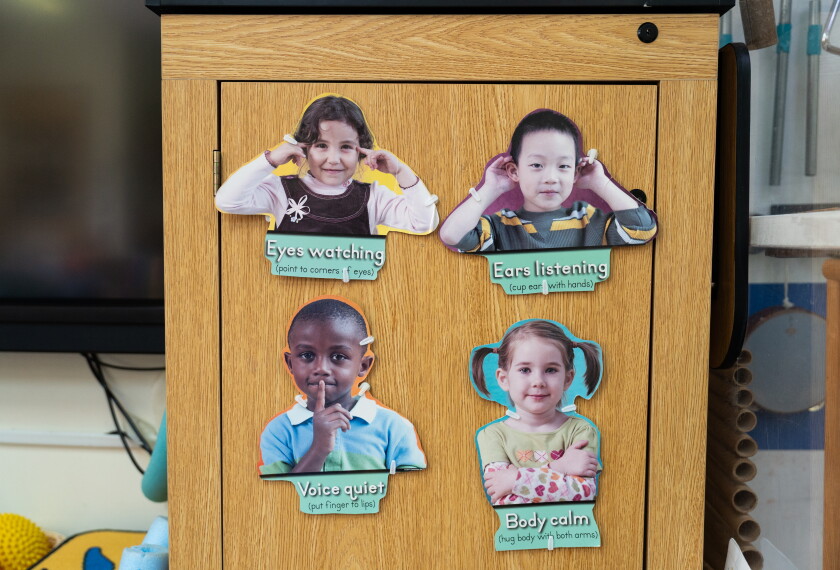
The terms “pre-K” and “TK” are popping up a lot in K-12 education circles right now, referring to pre-kindergarten or transitional kindergarten. This grade is intended as a “transition” year between preschool and kindergarten—an opportunity to help 4-year-olds get used to the greater academic and behavioral expectations of kindergarten.
In recent years, a growing number of states have pushed to make universal pre-K available to all 4-year-olds. California is the most recent to do so.
California launched its TK program in the 2012-13 school year for children turning 5 in the fall. In 2021, the state sought to expand the program by passing a universal prekindergarten program: Public schools that offer kindergarten had to add free pre-kindergarten, or TK, for all 4-year-olds by the 2025-26 school year.
This June, on the cusp of California’s full expansion of TK, the Public Policy Institute of California published an in-depth report analyzing the program, enrollment patterns, and related observations. Laura Hill, a policy director and senior fellow at PPIC and lead author of the report, spoke with Education Week about her findings, which provide insights for administrators and policymakers considering launching or expanding a TK program in their own state or district.
This interview has been edited for length and clarity.

California is expanding the availability of TK. But like kindergarten, this grade is not “required.” How is the state’s TK enrollment going?
An estimated 70% of eligible students participated in the program in 2023-24, and enrollment is actually down to about 65% now.
More children were eligible last year (2024-25) than in 2023-24 [because of the program’s incremental expansion], and more children enrolled last year than in the year prior. But because the numbers of students who were eligible went up by more than enrollment increased, the take-up rate fell.
Your report noted that TK programs are seeing less participation and stagnating numbers especially among underrepresented demographics. Can you elaborate on that?
Pacific Islander, Black, and Native American children have consistently had low take-up rates. But pre-pandemic, 86% of eligible Latino children enrolled in TK—higher than the average rate. Post-pandemic, it is down to 70%.
Among Latino English learners, take-up rates fell 23 percentage points from pre-pandemic levels to 2023-24. We’re really not sure why.
Is this a concern?
While [universal] TK is what the state is pushing toward, what they’re offering is not a requirement. So families don’t have to turn up. And if children and their families are happy with the options that they have, and they feel supported, and they have their child care needs met, and children are ready for kindergarten, then that seems fine.
If that’s not true, if families are not aware of TK, or if it doesn’t feel right to them for some reason, and their children are not as prepared for kindergarten as they might be if they were able to participate in TK, then that’s a problem. I wish we knew more about [enrollment decisions], because this is a program that is meant to help all children.
To that point, how is implementation going—broadly speaking?
It really seems to vary from district to district. We’ve heard that there are some districts that have been expanding TK aggressively, admitting children even before they were technically eligible [due to their age].
Other districts actually have waitlists, which they’re not supposed to do; they’re supposed to serve all children that are eligible. And then there are some districts that are not offering TK at all.
Yet every district that offers kindergarten is also supposed to provide TK, correct?
Correct. Every district with K is required to offer TK. Districts that receive their funding through the state’s per-pupil funding formula or local control funding formula do get funding for TK, and some of them still don’t provide TK.
There is no legislative stick for any district not providing TK, but the California Department of Education recently reminded all districts with kindergartens that they are required to provide TK.
Are certain districts with kindergarten less likely to establish TK programs?
Yes; basic aid districts. Most districts in California are funded on a per-pupil basis. But basic aid districts don’t get per-pupil funding because their property taxes are sufficiently high to cover what they would get from the state.
Basically, these [basic aid] districts keep the money that they raise from property taxes, which is often at least as much, or more, as they would have gotten through the per-pupil funding formula. And while some basic aid districts do offer TK, many of them don’t.
Most of these districts have pretty small populations of children that are eligible for free and reduced meals and English learners, but there are some. And if the district doesn’t want TK, and the families do want TK, that’s a bummer.
As we all know, child care is extremely expensive, so there are some families in these districts that would be well-served if TK was available.
There are some basic [aid] districts, however, that do provide TK. They’ve decided it’s worth it. Their thinking is: We want children to be ready for our kindergarten, and this is how we’re going to do it.
Has TK been around long enough for data to show how effective it is, in terms of kindergarten readiness or related outcomes?
We published a report in 2023 that analyzed TK pre-expansion in five unnamed districts in California. Here’s what we found: Pre-expansion TK led to earlier identification of English-learner students and students with special education needs. Evidence suggested positive social-emotional learning outcomes, but only for English-only students.
Also from that report, TK does not appear to improve test scores in grades 3 and 4 more than other pre-kindergarten options. We haven’t done any analysis yet that looks at outcomes post-expansion.
One of the district sources you interviewed for this most recent report described the first week of TK as Shark Week, because of the number of child-biting incidents taking place in the classroom. This seems like a stark reminder that, developmentally, 4- and 5-year-olds are very different, and these differences need to be considered when designing TK programs.
The [TK] teachers need to understand that this behavior the [4-year-old] child is exhibiting is totally normal, and what teachers need to do is learn how to respond to that behavior, and support the children, rather than teach the child what he’s doing is wrong.
Overall, I think TK has so much potential, and it probably already is doing lots of great things for some kids and some families, but it seems to be really dependent on how districts are implementing it. It would be great to learn more about where it’s going well so that other districts can, as much as possible, emulate and implement the things that are good. But we just don’t have enough information about that at this point.
For those states that may be considering rolling out TK programs of their own, what are the most important takeaways you can share based on the data you have gathered so far?
If you’re going to move TK into K-12, then I think as much attention as possible needs to be given to making sure that there are early childhood experts ready to help the system navigate the change: Making sure the teachers are prepared and the curriculum is ready, preparing the physical space, and helping districts’ senior leadership understand that TK children, 4-year-olds, are not just little kindergarteners—they’re really, really different.