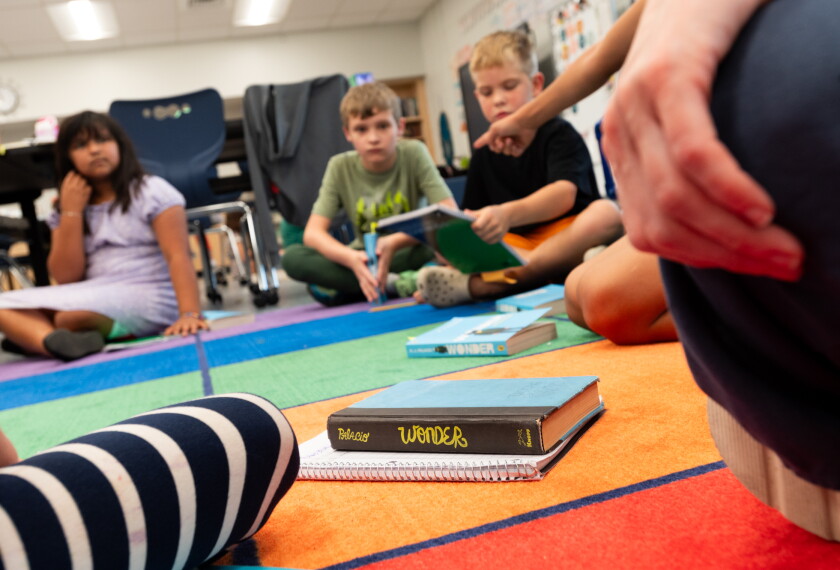
A substantial amount of time and energy is currently being spent on the so-called “reading wars,” with efforts to pit “science of reading” advocates against those labeled as “whole language” proponents.
How might a teacher navigate this situation?
Here’s a response from teacher Christie Nold:
Conversations ‘Have a Lot to Offer’
Christie Nold (she/her) is a public school teacher who teaches 9th grade social studies on unceded Abenaki land in South Burlington, Vt.:
As a public school teacher, I often bristle at the suggestion that teaching is a “calling” or “gift” or any number of expressions that seem to deprofessionalize the work we do and offer justification for low pay and poor conditions. All of that said, I have to admit to education being a central part of my identity. For me, and I imagine many others, the many decisions I make in a day are deeply personal. From content selection to pedagogical moves to determining which student to call on next, I recognize that each choice is often a reflection of my values and belief systems. It is because I feel so connected to this work that I can be slow to embrace challenges to my practice.
As a middle and secondary trained educator, the coursework and experiences I’ve had in schools revolved around reading to learn. The assumption being that by the time students reached my door, they had adequate training around learning to read. What is abundantly clear through both national and local data is that this assumption denies the reality that many of our adolescents are still between stages.
I first heard conversations involving the “science of reading” (SOR) within the last three years. At that time, I could draw a direct line between the most vocal SOR advocates (at least those that I was exposed to) and those who were pushing back against vaccinations and shaming teachers for asking for basic COVID protections in their schools. Because so many of the loudest voices in the SOR movement were espousing views that I could not reconcile with my own (like those who opposed basic COVID protections), I found it easier to simply block out all of the “noise.”
In the time since, I have come to understand that conversations around structured literacy have a lot to offer those of us across content areas and grade levels. I’ve also had to wrestle with the uncomfortable truth that some of the practices I’d learned about were not “research-based” as I had been led to believe.

In this moment now, I can feel the sense of urgency around reading instruction from family and community members. I understand that given the data alone, educators and school systems must take a hard look at our instructional practices. I also know that this work will likely not be without shame and difficult realizations.
I don’t believe any educator sets out to harm their students or to leave them without essential skills. This leaves me wondering what’s next? How might educators be systemically supported to reflect on their practice in ways that allow for the healthy metabolization of any shame that may appear while moving forward toward evolving understandings of promising practices? What is to be done about the dangerous intersection of some in the “SOR movement” and those spewing transphobic nonsense or arguing that educators actively harmed schools by asking for COVID mitigation? How do we balance the urgency that families feel around providing proper instruction to their children with the time and resources involved in training and retraining our educators?

Perhaps a start would be to frame it as less of a “war” and more an opportunity for collective growth and reflection. To look to those in the classroom as well as those most impacted to form our next steps. For educators who have been trained to support young people who are reading to learn, we might need additional training and resources to grow our practice. Additionally, the use of Universal Design for Learning can bolster a student’s ability to access content curriculum and build confidence. Finally, thoughtful classroom instruction cannot be our only tool. School systems must invest in intervention systems designed to capture those who have not yet had access to proper reading instruction.
As always, it will be important to lead from a place of support and guidance that brings needed resources into our schools. It will not be enough to remove practices; instead, we need to equip educators with the tools to continue to grow in their craft.

Thanks to Christie for contributing her thoughts!
The new question of the week is:
How might a teacher navigate the ‘reading wars’?
Consider contributing a question to be answered in a future post. You can send one to me at lferlazzo@epe.org. When you send it in, let me know if I can use your real name if it’s selected or if you’d prefer remaining anonymous and have a pseudonym in mind.
You can also contact me on Twitter at @Larryferlazzo.
Education Week has published a collection of posts from this blog, along with new material, in an e-book form. It’s titled Classroom Management Q&As: Expert Strategies for Teaching.
Just a reminder; you can subscribe and receive updates from this blog via email (The RSS feed for this blog, and for all Ed Week articles, has been changed by the new redesign—new ones are not yet available). And if you missed any of the highlights from the first 11 years of this blog, you can see a categorized list below.
- It Was Another Busy School Year. What Resonated for You?
- How to Best Address Race and Racism in the Classroom
- Schools Just Let Out, But What Are the Best Ways to Begin the Coming Year?
- Classroom Management Starts With Student Engagement
- Teacher Takeaways From the Pandemic: What’s Worked? What Hasn’t?
- The School Year Has Ended. What Are Some Lessons to Close Out Next Year?
- Student Motivation and Social-Emotional Learning Present Challenges. Here’s How to Help
- How to Challenge Normative Gender Culture to Support All Students
- What Students Like (and Don’t Like) About School
- Technology Is the Tool, Not the Teacher
- How to Make Parent Engagement Meaningful
- Teaching Social Studies Isn’t for the Faint of Heart
- Differentiated Instruction Doesn’t Need to Be a Heavy Lift
- How to Help Students Embrace Reading. Educators Weigh In
- 10 Strategies for Reaching English-Learners
- 10 Ways to Include Teachers in Important Policy Decisions
- 10 Teacher-Proofed Strategies for Improving Math Instruction
- Give Students a Role in Their Education
- Are There Better Ways Than Standardized Tests to Assess Students? Educators Think So
- How to Meet the Challenges of Teaching Science
- If I’d Only Known. Veteran Teachers Offer Advice for Beginners
- Writing Well Means Rewriting, Rewriting, Rewriting
- Christopher Emdin, Gholdy Muhammad, and More Education Authors Offer Insights to the Field
- How to Build Inclusive Classrooms
- What Science Can Teach Us About Learning
- The Best Ways for Administrators to Demonstrate Leadership
- Listen Up: Give Teachers a Voice in What Happens in Their Schools
- 10 Ways to Build a Healthier Classroom
- Educators Weigh In on Implementing the Common Core, Even Now
- What’s the Best Professional-Development Advice? Teachers and Students Have Their Say
- Plenty of Instructional Strategies Are Out There. Here’s What Works Best for Your Students
- How to Avoid Making Mistakes in the Classroom
- Looking for Ways to Organize Your Classroom? Try Out These Tips
- Want Insight Into Schooling? Here’s Advice From Some Top Experts
I am also creating a Twitter list including all contributors to this column.