Are you a teacher, instructional coach, or school leader who is concerned about how to support all students in accessing grade-level texts? If so, you are not alone. In fact, in a survey last year, less than a quarter of educators reported their school is doing “very well” in meeting the academic needs of all learners.
Exacerbating this issue is the large percentage of students who are not reading proficiently, as we were recently reminded by the declining scores captured in the latest National Assessment of Educational Progress.
So, what are educators to do? Luckily, the research is clear that one of our best strategies is scaffolding, an approach in which the teacher or more capable peers directly support developing readers. In fact, literacy researcher Timothy Shanahan has curated dozens of studies that show appropriate scaffolding can accelerate student learning by using more challenging text than a student might be able to handle independently.

In my nearly two decades first as a classroom teacher then a teacher trainer, I have found the following three strategies highly effective:
Active reading strategies
Instead of reading texts to the students, listening to an audio version, or asking the strong readers to read, we can use active engagement strategies that afford all students the opportunity to engage in grade-level text with scaffolding. Six common active reading-engagement strategies include:
- Cloze. Cloze reading occurs when a teacher reads a challenging text aloud and strategically selects words to omit. Students are prompted to fill in the missing words.
- Echo. Echo reading happens when the teacher reads aloud a portion of the text, such as a sentence, paragraph, or page, and students echo back with similar pacing, intonation, and expression.
- Choral. Choral reading takes place when two or more students, or even a whole class, read the text simultaneously. This strategy gives striving readers scaffolded support via the more proficient readers as the teacher models appropriate pacing.
- Duet. Duet reading is when two partners, one strong reader and one striving reader, are paired together to read a text aloud in unison.
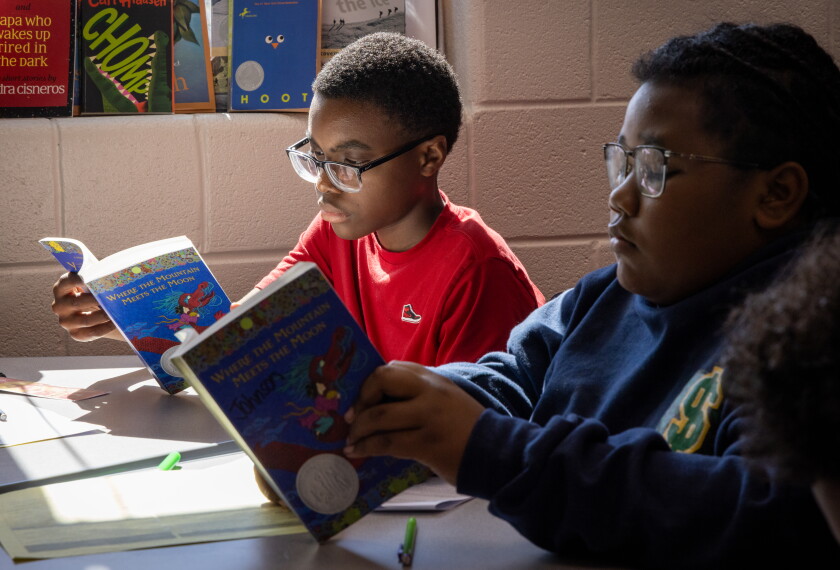
- Partner. Partner reading strategically pairs up two students who take turns reading part of the passage aloud. It may be a page at a time, a paragraph, or even a sentence depending on the length of the text and students’ stamina. Both students have the text in front of them and are tracking it. The stronger reader can provide prompts for unknown words for the striving reader.
- Whisper. Whisper reading is just what it sounds like. Students read independently in a whisper voice. It is a great replacement for silent sustained reading as it offers hard evidence of student practice instead of hope that there is.
Background knowledge activation
Depending on the text and the students you are serving, you can either activate their prior knowledge on the topic or take a few moments to build background knowledge if it is foreign to them. For example, if you’re reading about the Civil War and the topic is new to your students, then it would be best to spend some time building their knowledge. This could take the form of a short video that provides a basic overview of the conflict or preteaching some key terms that are in the text they will encounter.
However, if you’ll be reading about a topic that is known to your students—say you’re teaching about tornadoes in the Midwest—then you can use a technique like a K-W-L chart that asks students to share what they already know, what they want to know, and finally what they learned after reading. By activating prior knowledge or building background, educators can facilitate stronger and lasting connections to the new learning while increasing comprehension.
Peer-assisted learning
As researchers Douglas Fuchs, Lynn Fuchs, and Pamela Burish documented more than two decades ago, peer-assisted learning strategies are highly effective instructional practices that instantly increase the amount of scaffolding a student may receive just by providing a peer for them to engage with. The duet reading strategy mentioned above is one example.
Another is paragraph shrinking, when a capable reader and a developing reader practice summarizing a text they are reading. Within the partnership, the students take turns serving as the “coach” and the “reader.” The coach will provide the reader with feedback on each of their summary statements. The reader will read for a set amount of time or a certain amount of text before the coach and reader switch roles.
For additional scaffolding, both students could be reading the text aloud in preparation for the designated reader to summarize that portion of text. Generally, the student who coaches first is the more capable reader so that they can model the feedback process for their partner.
The coach provides feedback to the reader in a few ways: encouraging them to rethink the “who” or “what,” revisit what they identified as the most important details, or shorten their summary sentence if it exceeds the set limit of words. If the coach is unsure of what the main idea for a particular paragraph should be, they consult the teacher. (For more information, you may consider watching this three-minute video that highlights how to implement the three steps of paragraph shrinking.)
A caution: Let’s remember that scaffolding is not differentiation. When we scaffold our instruction, we are giving students access to grade-level material without altering the grade-level expectations. Unlike when we use differentiation, we are not lowering the expectations but rather identifying the scaffolds students might need to effectively access the grade-level material.
Using these types of scaffolding strategies can be powerful levers helping students successfully participate. Teachers and school leaders, ask yourselves how you can scaffold instruction to ensure all students have access to grade-level materials.