We’ve heard a lot about the science of reading this year. The term appeared 600-plus times in Education Week’s 2023 coverage alone.
Clearly, readers are interested in this topic, which refers to literacy instruction aimed at phonemic awareness, phonics, fluency, vocabulary, and comprehension. But within this scripted method of how to make children proficient readers, there’s one critical element that’s been largely overlooked: the joy of reading.
“Decoding is absolutely the foundation of reading proficiency, but it is by no means where we end our efforts. Nor should it be the only effort,” said Maryanne Wolf, director of the Center for Dyslexia, Diverse Learners, and Social Justice at the UCLA Graduate School of Education and Information Studies.
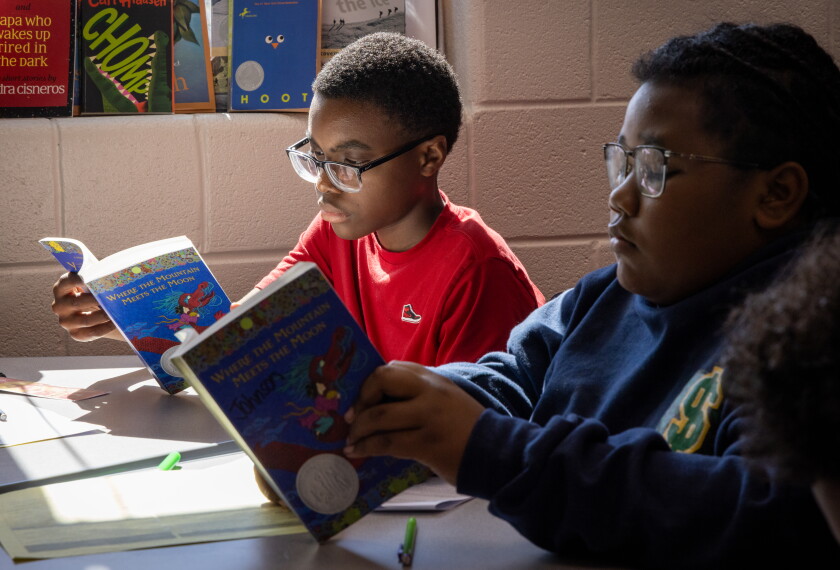
As efforts toward developing strong readers go, reading aloud to children is one that teachers’ anecdotes and research inform us is worthwhile. Before emerging readers are able to automatically link the jumble of letters they see in front of them to the riveting stories these symbols create—whether magical, frightening, whimsical, eye-opening or otherwise entertaining or informative—someone must do it for them. And teachers are the most reliable source to take up the task.
Here’s a glance at why reading out loud to students matters, the barriers teachers face in executing the read aloud, and the benefits of making it happen.
The benefits of being read to from a very young age
The single act of reading aloud to children can provide multiple benefits; perhaps most significantly, it can develop a lifelong interest in pleasure reading, according to multiple literacy experts and studies on the subject. It also comes with the ancillary benefits of increasing children’s vocabulary and background knowledge. One recent study found that parents reading to their children as young as 1 to 2.5 years of age strongly predicted later vocabulary, reading comprehension, and reading motivation.
In another study, researchers tracked the impact on children whose parents read to them a minimum of five books daily from a very young age; these children entered kindergarten with exposure to around 1.4 million more words than children who were never read to. Variations in this daily reading practice, referred to as the “million word gap,” may explain later differences in children’s vocabulary and reading development, suggested the study’s authors.
Despite the multiple proven benefits of being read to early and often, teachers can’t assume that this is happening at home. In a nationally representative sample of nearly 10,000 4-year-old children, 25 percent were never read to, and another estimated 25 percent were read to only once or twice weekly, according to data from the Early Childhood Longitudinal Study Birth Cohort. Those rates were in spite of widespread campaigns to increase awareness of the importance of reading to children. For instance, the American Academy of Pediatrics has formally recommended the practice begin in early childhood, noting that it “builds language, literacy, and social-emotional skills that last a lifetime.”
Teachers value reading aloud, but don’t always do it
Children generally come to school eager to learn and, regardless of their reading exposure at home, teachers can make up a lot of lost ground by prioritizing reading aloud to children on a routine basis. Further, most elementary classroom teachers see the value in it. In a 2019 study examining attitudes of 1st- through 4th-grade teachers about read-alouds, 100 percent deemed it important; 45 percent agreed that it was very important; and more than half considered it indispensable. Whether it’s happening widely is unclear.
There’s no reliable way to measure how frequently teachers actually read aloud to students during the school day. But data on time spent in class allowing students to read on their own could suggest that teacher read-alouds aren’t prioritized either. For instance, 82 percent of teachers surveyed recently by the International Literacy Association agreed that students should read independently for at least 20 minutes a day, but only 33 percent said their schedule permitted them to block off that amount of time during class.
When teachers do find the time to read to their students, they report positive results. Longtime elementary teacher Deloris Fowler’s efforts to instill in her students the joy of reading were captured in a 2020 article in The Atlantic. She observed that her 3rd grade students were far more engaged when she read chapter books to them than content from the basal readers that came with required literacy curriculum; she reported that they begged her to keep reading when the allotted reading time was over.
Teachers who read to students beyond elementary school report similar findings. In an opinion piece for Education Week, 8th grade teacher Christina Torres described her “read-along” strategy, in which she would read from a book and her students would follow along in their own copy, as hugely beneficial. She said it increased student enjoyment and engagement in addition to building community within the class.
Torres, a teacher at Honolulu’s Punahou School, described the reaction of her English students when she would read books aloud to them. “Should we stop for today?” Torres would ask, after reading aloud for a period, to which they would collectively respond: “Noooo!”