Special Report
Reading & Literacy From Our Research Center

Reading on Screens for Class Assignments, in Charts

By Arianna Prothero — March 15, 2023 1 min read
ed tech survey march 2023 bushweller
  • Save to favorites
  • Print

The pandemic rewrote the rules on many things in education—including how much students read digital texts compared with printed ones.

With advances in tech tools and emerging research that has found printed reading materials may not always trump digital ones when it comes to student comprehension, Education Week wanted to know: What’s actually happening in classrooms?

The EdWeek Research Center surveyed teachers nationally to probe how they use digital and printed reading materials.

Teachers’ decisions to assign digital or print texts is largely based on what they perceive will best meet students’ needs. The largest share of teachers—46 percent—say they base their decisions on what format is most effective in making reading material easy to understand.

While nearly 20 percent of teachers say that the percentage of digital reading materials they will use in their classroom in the next year will most likely increase, about three-quarters of them said they expect the ratio to remain about the same.

The following charts illustrate how much and why teachers are using digital texts in their classrooms.

Events

This content is provided by our sponsor. It is not written by and does not necessarily reflect the views of Education Week's editorial staff.
Sponsor
Teaching Profession Webinar
Evaluation Beyond the Checkbox: Turning Ratings Into Teacher Growth
Ratings alone don’t help teachers improve. Join us Nov. 10 to hear what happens after the evaluation: feedback, follow-up, and growth.
Content provided by Frontline Education
Early Childhood Webinar Selling Into Early Learning: New Survey Data and Strategies for Marketers
Selling into PreK? Get fresh EdWeek Research Center data and strategies to position your products and reach the right early learning buyers.
Artificial Intelligence Webinar AI and 'Techlash' Are on a Collision Course. How Should Schools Respond?
Learn what strategies and tactics schools can develop to encourage smart and responsible AI use, while also enforcing tech guardrails.

EdWeek Top School Jobs

Teacher Jobs
Search over ten thousand teaching jobs nationwide — elementary, middle, high school and more.
View Jobs
Principal Jobs
Find hundreds of jobs for principals, assistant principals, and other school leadership roles.
View Jobs
Administrator Jobs
Over a thousand district-level jobs: superintendents, directors, more.
View Jobs
Support Staff Jobs
Search thousands of jobs, from paraprofessionals to counselors and more.
View Jobs

Read Next

Reading & Literacy Q&A Why This Under-the-Radar Piece of Literacy Reform Is One of the Most Important
Parent notification is a central piece of reading reform, this advocate says.
5 min read
Collage of a Black female reading a book with her young daughter on her lap. Other pieces of the collage show an open book with non-legible text, speech bubbles, the letter "A" and a butterfly.
Collage by Gina Tomko/Education Week + Canva
Reading & Literacy 'Long Form' vs. 'Short' Reading: What's Going on Inside A Student's Brain?
Reading a novel and reading short text messages work the brain differently. Here's what that means.
3 min read
Pieces of a book page and a cellphone.
Collage by Laura Baker/Education Week + Getty
Reading & Literacy Creating a Culture of Reading for Pleasure Amid a Focus on Basics
School librarians at Missouri's Clayton school district bring a culture of reading to all students.
9 min read
Tom Bober
Students read books in the library at Captain Elementary School in Clayton, Mo., on Tuesday, Sept. 29, 2026. School Librarian Tom Bober works with teachers at the school to help instill a culture of reading early in students' lives.
Neeta Satam for Education Week
Reading & Literacy Getting Middle Schoolers to Do the Reading Is Hard. Can Communal Reading Help?
New classroom methods aim to help kids internalize the message that engaging in print is worth it.
11 min read
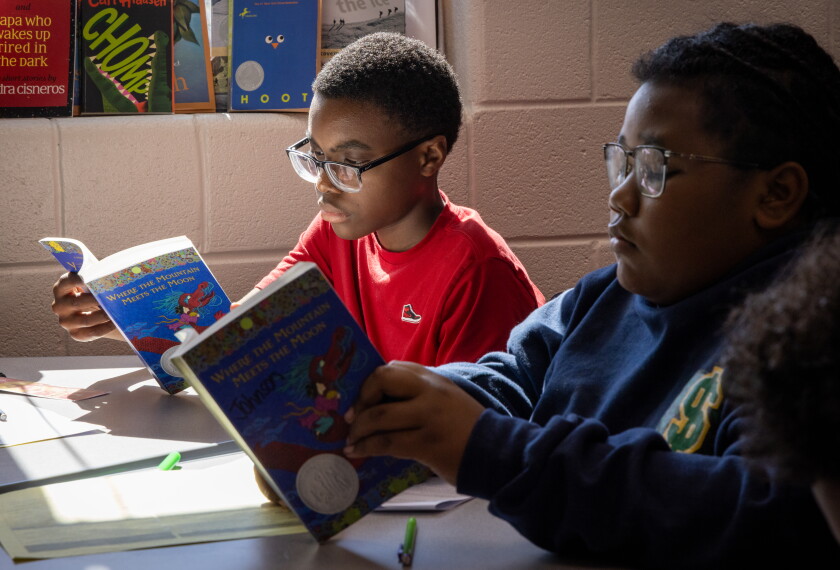
Students read Where the Mountain Meets the Moon in Jaime Johnson’s 6th grade language arts class at Murphy Middle School in Dacula, Georgia on September 22, 2026.
Students read <i>Where the Mountain Meets the Moon</i> in teacher Jaime Johnson’s 6th grade language arts class at Murphy Middle School in Dacula, Georgia on September 22, 2026. Johnson has students do most of the reading in class—to improve fluency, created a shared culture of engagement in books, and above all make sure every student completes the text.
Dustin Chambers for Education Week