
Teaching Profession

Three Tips to Help Mentors Work Better With Teachers

By Sarah D. Sparks — January 30, 2025 3 min read
Illustration of a diverse group of 7 professionals helping one another climb a succession of large bars with some using a ladder.
  • Save to favorites
  • Print

For a novice teacher, a great mentor can mean the difference between launching into a successful career and burning out in the first few years.

When teachers have effective mentors, they can improve student learning in their first year as much as those without mentors perform in their third year of teaching. But schools and districts often structure their mentoring programs in ways that can undermine these relationships, according to a new report by the nonprofit New Teacher Center, which works with school districts to develop and improve induction programs for novice teachers.

“A lot of people have moved away from this idea of a ‘buddy’ mentor to saying, we need someone who can really support our teachers with instructional focus, setting up optimal learning environments for students,” said Vera-Lisa Roberts, a program specialist with the center. “What we have found is having a full-time coach or mentor assigned to a teacher—able to meet with them on a regular basis to help them plan, observe instruction, provide feedback, analyze student learning, get to know their students—that has been the link that has helped a lot of teachers feel connected.”
See also

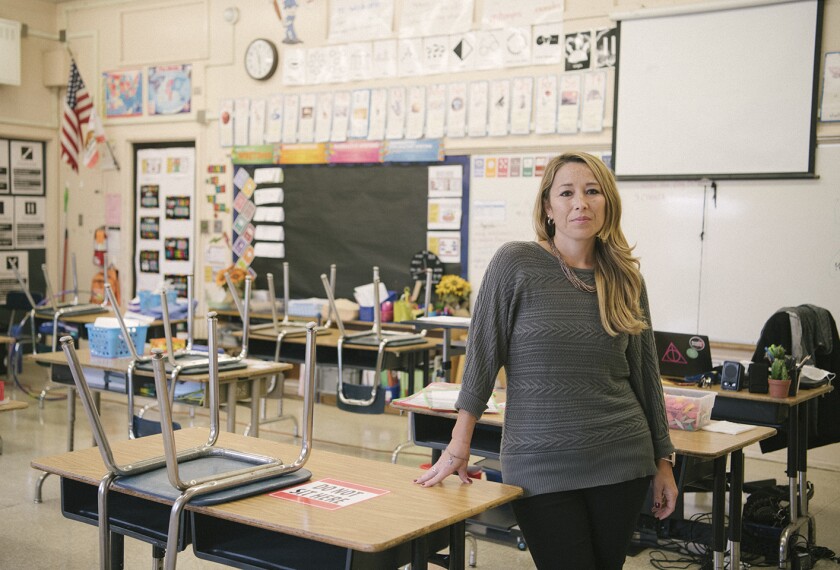
Misti Kemmer, a 4th grade teacher at Russell Elementary School in Los Angeles, had a negative experience being mentored as a new teacher, but is now a mentor herself.
Morgan Lieberman for Education Week

“Just like you want your students to feel emotionally, intellectually, and physically safe, how do we provide that same experience for our teachers?” Roberts said.

Roberts suggested three critical but often-overlooked practices for building effective teacher mentoring.

1. Pick the right people

Administrators should have a set process and clear criteria to choose mentors, the report said. Even those with content and classroom expertise also need relational skills: knowledge about how to collaborate, and the ability to address specific teacher needs.

For example, Hawaii offers specialized mentors for teachers hired under emergency credentials to fill special education shortages. These teachers often need help understanding how to manage paperwork associated with individualized education programs and working in co-teaching environments, a common arrangement in mainstream classrooms.

2. Define roles for mentoring

Mentors need clear roles, according to Tracy Laughlin, the New Teacher Center’s communications director. Without them, mentors often get tapped to revise curriculum, administer assessments, and other tasks.

“As mentors and coaches get assigned all these other duties as well, they spend less and less time doing that [mentoring] work,” Laughlin said.

One 2012 study suggested those teachers who mentored only part time, in addition to other instructional or administrative roles, had “less connection with the goals of the program, and may be likely to do their own thing with novices.”

It’s also important, Roberts said, for the teacher, mentor, and administrator to understand their separate responsibilities, “so that we’re all informed of those same goals and we’re working in support of everything, rather than [the teacher saying], ‘Here’s the principal giving a message. Now my mentor’s giving me this message, and I’m hearing two different things.’”

3. Dedicate the time

“One of the most common mistakes districts make is when they do not provide the sanctioned time for the mentor and the mentee teacher to have those one-on-one conversations,” Roberts said.

About three-quarters of the more than 1,000 districts nationwide which the New Teacher Center works with set and protect time for mentoring and teacher collaboration as part of the normal school schedule.

“New teachers need community. Whether it be through professional learning time, office hours, coffee time, but new teachers really need to come together with one another for that support,” Roberts said. “If not, you can feel a lot of isolation. You can feel that you’re the only one who is experiencing this, when we know that that’s not the case.”

Events

School & District Management Webinar EdMarketer Quick Hit: Build Campaigns That Engage K-12 Leaders
We’ll share what’s resonating with Education Week’s K-12 audience based on user behavior across platforms and other proprietary data.
This content is provided by our sponsor. It is not written by and does not necessarily reflect the views of Education Week's editorial staff.
Sponsor
Assessment Webinar
Measuring What Matters: How District Leaders Are Redefining Student Assessment
In this panel discussion, district leaders and systems experts will examine the gap between the outcomes we want and the systems in place.
Content provided by Otus
Early Childhood Webinar Selling Into Early Learning: New Survey Data and Strategies for Marketers
Selling into PreK? Get fresh EdWeek Research Center data and strategies to position your products and reach the right early learning buyers.

EdWeek Top School Jobs

Teacher Jobs
Search over ten thousand teaching jobs nationwide — elementary, middle, high school and more.
View Jobs
Principal Jobs
Find hundreds of jobs for principals, assistant principals, and other school leadership roles.
View Jobs
Administrator Jobs
Over a thousand district-level jobs: superintendents, directors, more.
View Jobs
Support Staff Jobs
Search thousands of jobs, from paraprofessionals to counselors and more.
View Jobs

Read Next

Teaching Profession Opinion ‘Can I Go to the Bathroom?’: How Even Teachers' Smallest Judgment Calls Add Up
Teaching is a constant exercise in emotional triage.
Heidi Wells
•
3 min read
A teacher is overwhelmed by the constant decision making of an educator's job. Educational triage. Burnout.
Vanessa Solis/Education Week + Getty
Teaching Profession Q&A What Teacher Shortages Really Say About the Profession
In the new book, Ending Teacher Shortages, researcher Tuan Nguyen highlights need to move from magic bullets to a more stable workforce.
4 min read
The definition of teacher sits on teacher Leon Smith's desk at Haverford High School, in Haverford, PA on March 20, 2024.
A definition of the word teacher sits on Leon Smith's desk at Haverford High School, in Haverford, PA on March 20, 2024. New data suggest a long-term trend of higher vacancies and more underprepared teachers.
Alejandro A Alvarez/The Philadelphia Inquirer via TNS
Teaching Profession What the Research Says How the U.S. Teaching Profession Compares to Global Peers
New data from OECD show global trends in teacher staffing and workloads.
4 min read
The Maryland governor's office reports that 4% of the state’s teacher positions are unfilled, meaning nearly 1,600 classrooms don’t have an experienced educator leading students.
New data from the Organization for Economic Cooperation and Development finds that teacher shortages are a global challenge.
Antonio Perez/Chicago Tribune/TNS
Teaching Profession What the Research Says States Roll Back Pay Incentives for Teachers in High-Need Areas
A new national study finds less differentiated pay for science fields, high-risk student groups.
3 min read
A classroom in Geneva Elementary School in Geneva County Schools, Geneva, Alabama on August04, 2026
A classroom in Geneva Elementary School in Geneva, Ala., is pictured in August 2026. Alabama still offers pay incentives for teachers in shortage areas, but many states do not, a new report finds.
Trisha Crain/Al.com via TNS
