Artificial Intelligence

6 Things Teachers Do That AI Just Can’t

By Lauraine Langreo — September 07, 2023 2 min read
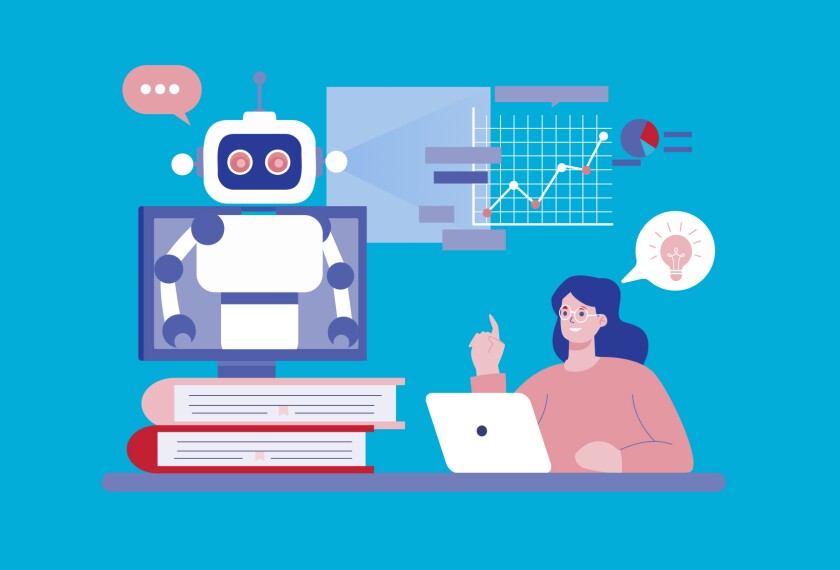
Illustration of woman using AI.
  • Save to favorites
  • Print

Tools powered by artificial intelligence have the potential to increase people’s productivity and make many tasks easier to do. In the K-12 world, educators are already using AI tools to plan lessons, create rubrics, provide feedback on student assignments, and respond to parent emails.

When asked what role AI-powered tools should play in teaching and learning, more than a quarter of educators (27 percent) said “creation of instructional materials,” 24 percent said “lesson planning for teachers,” 23 percent said “creation of assignments for students,” 12 percent said “grading students,” and 7 percent said “completing student paperwork,” according to an EdWeek Research Center survey of 1,301 district leaders, principals, and teachers conducted this summer.

Of course, there are downsides to this technology. For instance, AI tools can produce inaccurate or biased responses based on faulty data it draws from, and it has the potential to expose private and sensitive data. Many executives, researchers, and engineers have also raised red flags about AI’s potential to eliminate many jobs.

See Also

Illustration of stylized teacher student relationship with AI represented between them as layered screens.
Traci Daberko for Education Week

But teachers’ jobs are safe, experts say. While there are a handful of teacher tasks that generative AI tools can replicate, teachers also have so many other strengths and responsibilities that would be very unlikely to be replaced by those tools. In fact, even though AI “as a replacement for teachers” was one of the options in the EdWeek Research Center survey, no educator selected it as an answer.

Here are some teacher tasks that are unlikely to be taken over by AI tools, according to interviews and email responses from educators, AI researchers, and tech company CEOs:

Teaching critical thinking

   Problem solving often requires critical thinking, which involves the ability to analyze information, evaluate its relevance, and make informed decisions. Teachers guide students in developing these cognitive skills through thoughtful questioning, discussions, and activities. AI, while capable of processing vast amounts of data, lacks the depth of critical thinking and reasoning that humans possess.

— Dyane Smokorowski, digital literacy coordinator for the Wichita school district in Kansas

   A teacher is vital to the use of AI because they're going to be the gatekeepers. They're going to be the ones that validate the information and make sure that the AI isn't just sugarcoating things or putting things in the wrong category or whatever AI might do.

— Cherie Shields, high school English teacher in the Oregon Trail school district in Sandy, Ore.

Building relationships with students

   [AI is] not a human. It doesn't have relationships. It doesn't have history. It's not part of a culture. It doesn't have an understanding of students' individual needs. It can't be expected to inspire students, in terms of directions and future thinking. It doesn't understand social-emotional learning and mental health issues. It doesn't understand the family context of students. There's very many things that teachers remain critical for and always will remain critical for.

— Glenn Kleiman, senior adviser at the Stanford Graduate School of Education

   AI is unable to replicate the personal connections teachers build with their students. The emotional support and mentorship teachers provide are irreplaceable. Additionally, excellent teachers know their students well both as learners and as people. The teacher’s role to tap into student passions, talents, and curiosities to design dynamic learning experiences requires a human touch. Yes, a teacher can ask AI to help design a learning experience connected with a particular student’s passion such as soccer, anime, or computer science, but it takes the teacher to make that connection.

— Smokorowski

Motivating students

   The human touch is a huge part of motivation to learn, especially in K-12 students. Computers just can't match the kind of empathy that teachers have for their students.

— Tom Mitchell, professor and researcher in machine learning and artificial intelligence at Carnegie Mellon University

   Teachers play an extremely important role in supporting students' motivation to learn and, more generally, in helping them develop their own sense of identity as a learner, as citizen, as a future worker, and as a person. Teachers help students both through their direct interactions but also as role models. These elements of teaching and being a teacher will not be replaced by AI tools because the necessary skills and dispositions come from a lifetime of experience and involve interpersonal interactions.

— Ken Koedinger, professor of human-computer interaction and psychology at Carnegie Mellon University

Creating a positive learning environment

   AI will not replace the core work of teachers that supports positive learning experiences: inspiring and motivating students while helping them discover and explore their passions through: building of relationships with students and families; demonstrating empathy and compassion; helping students make meaning of complexities and develop meaningful questions (essential in a world where AI is prevalent); making certain students are valued, know and use their gifts and talents; ensuring physical and emotional safety and well-being; [and] building partnerships with community organizations, industry partners.

— Tara Nattrass, managing director of innovation strategy at ISTE/ASCD

   No amount of generated content or automated assessment will replace the value of teachers for students. Teachers are the ones who create a welcoming learning environment for a community of learners with diverse backgrounds and needs. Teachers are the ones who foster collaboration which prepares students to go onto a career or college. Teachers are the ones who inspire their students to become the person who they can't yet see in themselves. The purpose of school for students is broader than lessons and assessments.

— Adam Geller, founder and CEO of Edthena, which provides AI-powered professional development

   Teaching empathy, compassion, and emotional intelligence is a deeply human task that requires understanding and adaptation to each student's needs.

— Smokorowski

Providing high-quality feedback on student performance

   AI often faces challenges in delivering high-quality feedback on student work that demonstrates a deep understanding of the subject. These difficulties arise from AI's limited ability to grasp the broader context, assess subjective elements, and recognize creativity and originality. Furthermore, AI struggles with providing high quality, interdisciplinary projects, intricate problem-solving tasks, and the nuances of emotional and social interactions. Although it does an excellent job in assisting teachers as they develop products and performance ideas, it would be unable to provide high quality feedback on a choir, dance, or marching band performance, a piece of student artwork, even a student created Minecraft World.

— Smokorowski

Attending to students’ basic needs

   Teachers often have an acute awareness of their students' well-being. They can recognize signs of hunger, distress, or when a student is having a bad day. This empathetic connection allows teachers to provide not only academic support but also emotional and sometimes even physical support. AI lacks the ability to genuinely understand and address these fundamental human needs, making teachers irreplaceable in providing holistic care for their students.

— Smokorowski

Related Tags:

Events

This content is provided by our sponsor. It is not written by and does not necessarily reflect the views of Education Week's editorial staff.
Sponsor
School Climate & Safety Webinar
There But Not Present: Rethinking Student Engagement
Learn how to recognize the early signs of disengagement and what the behavioral science reveals about which interventions actually work.
Content provided by Frontline Education
Teacher Preparation Webinar What Teacher Education Should Look Like in the Age of AI
Explore the current trends around the use of AI in teacher preparation and continuing education with data from the EdWeek Research Center.
English Learners Webinar How Can School Districts Better Support English Learners With Disabilities?
Join this webinar to hear recent findings from the EdWeek Research Center and discover practical strategies for improvement.

EdWeek Top School Jobs

Teacher Jobs
Search over ten thousand teaching jobs nationwide — elementary, middle, high school and more.
View Jobs
Principal Jobs
Find hundreds of jobs for principals, assistant principals, and other school leadership roles.
View Jobs
Administrator Jobs
Over a thousand district-level jobs: superintendents, directors, more.
View Jobs
Support Staff Jobs
Search thousands of jobs, from paraprofessionals to counselors and more.
View Jobs

Read Next

Artificial Intelligence A Reckoning on Social Media Addiction Came Late for Kids. Will AI Safety Be Different?
Efforts to make social media safer offer lessons for those looking to protect children using AI.
5 min read
Kristin Bride, right, mother of 16-year-old Carson Bride, who died by suicide after being cyber-bullied on an anonymous app on Snapchat, is joined by Amy Neville, left, mother of 14-year-old Alexander Neville, who died from fentanyl poisoning after being deceived by a drug dealer operating on Snapchat, during a Social Media Victims Remembrance Day memorial on Capitol Hill, June 23, 2026, in Washington.
Rod Lamkey, Jr./AP
Artificial Intelligence Opinion Think Your Students Know More About AI Than You Do? Read This
Here are four things your students don’t understand about AI—and what you can do about it.
Sam Wineburg & Nadav Ziv
•
4 min read
102026 opinion Wineburg AI media literacy
Vanessa Solis/Education Week + Getty
Artificial Intelligence ChatGPT's 'Teen Mode' Is Unsafe for Students, Report Concludes
The chatbot failed to report unsafe interactions to parents in a timely manner, researchers found.
5 min read
Young man using a smartphone to ask an AI about exercise
Vanessa Solis/Education Week + Getty
Artificial Intelligence At OpenAI Forum, Discussion Focuses on Stronger Teen Safety Measures
Panelists put forward ideas on how to incentivize industry to develop responsible products.
4 min read
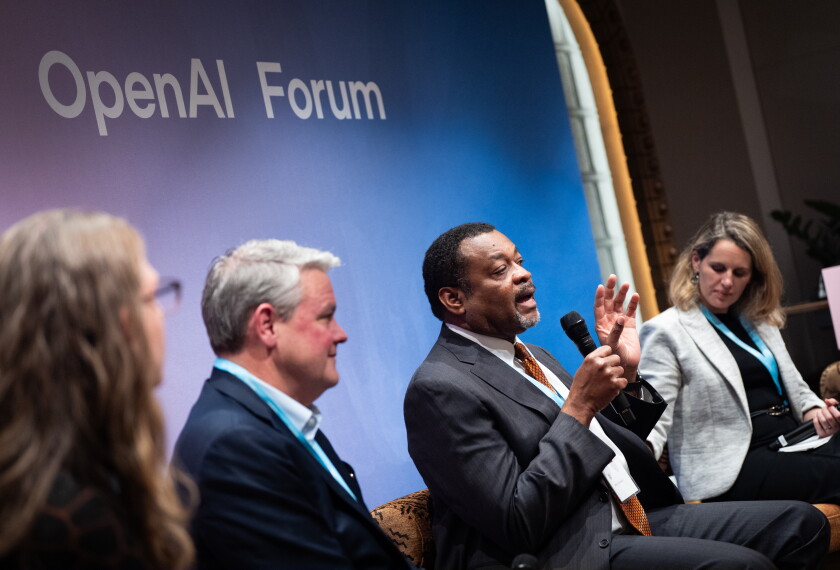
Washington, DC - October 5, 2026: Arthur C. Evans Jr., PhD, Chief Executive Officer of the American Psychological Association  speaks during the discussion. The OpenAI Forum hosted a panel on Responsible AI for Teens, how AI can support teens’ learning while promoting safe, healthy use. The program featured an OpenAI Forum panel with experts in learning, adolescent mental health, and family and online safety: Kate Ruane, Director of the Free Expression Project at the Center for Democracy & Technology, Chuck Melley, SVP of Policy, Advocacy and Communities at CodeAI, Arthur C. Evans Jr., PhD, Chief Executive Officer of the American Psychological Association and Mathilde Cerioli, Chief Scientist at everyoneAI. Chris Lehane, OpenAI’s Chief Global Affairs Officer, moderated the conversation and shared context on ChatGPT for Teens, a learning-first experience launched in August and designed to help teens think critically, deepen understanding, and use AI with confidence.
Arthur C. Evans, Jr., the CEO of the American Psychological Association, speaks on a panel at an Oct. 5, 2026, OpenAI forum on how to support responsible use of AI among teenagers.
Sarah Voisin for Education Week