Artificial Intelligence

Don’t Have Time to Try AI? 3 Simple Tips to Help Teachers Get Started

By Arianna Prothero — March 08, 2024 3 min read
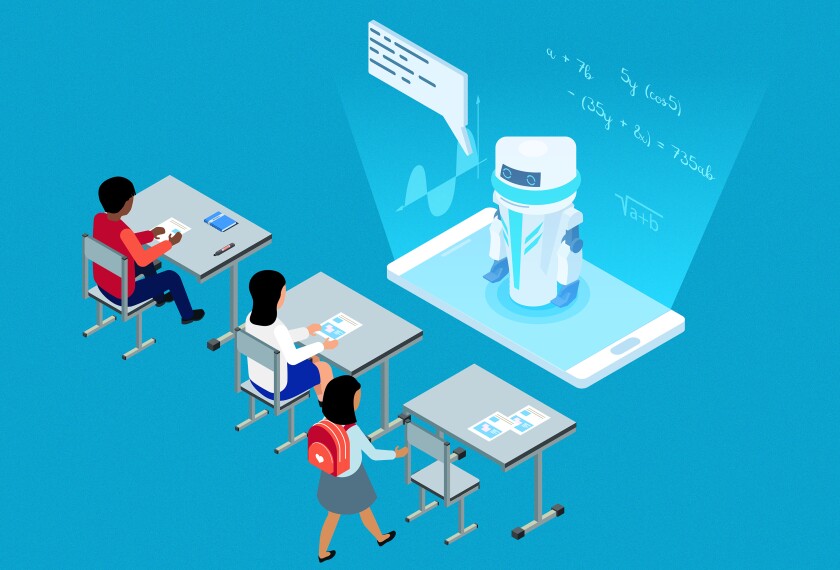
Vector illustration of a robot teacher and students. Robot teacher is standing on a cellphone with a chat bubble above its head a math equations and graphs projected in the air behind him.
  • Save to favorites
  • Print

While there’s lots of chatter that artificial intelligence is going to transform K-12 education, many teachers still haven’t jumped on board because they don’t know how to use AI-powered tools or don’t understand how the technology works.

That’s according to recent survey data of teachers by the EdWeek Research Center. But that survey also found that nearly a third of teachers say they plan to start using AI-powered tech in the classroom either this year or in the future.

But how should teachers get started? Getting over that initial hump can be hard, especially when there are so many demands on teachers’ time; limited—if any—formal professional development or guidance on the topic; and unclear payoff for any time teachers do invest in getting familiar with AI.

Whether feeling skeptical of the technology, overwhelmed, or just unsure of how to begin, here are three tips teachers shared at SXSWEDU on how to get started.

Start when school stops

Wait until you have a break from work—a long holiday or the summer break— to start trying to figure out how to use ChatGPT or the AI tools available in your district, recommends Kelly Gibson, a high school English language arts teacher in the Rogue River Schools in Oregon.

“Do not add it to your mental load right now,” she said. “It’s such a big thing to wrap your head around it. Wait until spring break, summer, and you’re rested.”

Gibson, who frequently shares her insights about education and AI on TikTok where she has a large following, said she first learned about ChatGPT over Thanksgiving break in 2022. After an initial panic over how she would ever assign essays again, she gave herself the time to start experimenting with the technology. That allowed her to familiarize herself with it and spark ideas about how she could use it in her classes, she said.

Play first, teach later

Instead of jumping in and using ChatGPT to create a grading rubric, try playing around with the technology and using it for non-education-related purposes first, suggests Erika Sandström, a middle school digital media teacher and digital learning coach at Peabody Public Schools in Massachusetts.

“To get a teacher to open their mind up, give them a small win, usually not related to school,” said Sandström, who is also known as the “Green Screen Gal” to her social media following.

For example, tell ChatGPT what food is in the refrigerator and ask it to craft recipes using that food, she said, or ask it to plan a weekend getaway.

See also

Elementary, Middle, and High-school age children interact with a giant artificial intelligence brain.
Kathleen Fu for Education Week

Gibson suggested using a generative AI image generator (like Midjourney or DALL-E) to create pictures of the characters in books, using details from the book in the prompts and tweaking them until the picture matches what the reader imagined from reading the text. (This is also an exercise she uses with her 12th grade English students.)

“Even that just takes a little edge off,” said Gibson. “Understand how to open it and put information into it.”

Try AI as a personal assistant

There are a lot of ways AI-powered tools can be used to teach students, and there are new AI-powered education tools entering the market every day.

For skeptical educators, it’s helpful to see how AI can make their lives easier—for instance, by releasing them from some of the heavy workloads they are experiencing, said Gibson.

(Forty-six percent of teachers said in the EdWeek Research Center survey they aren’t using AI in the classroom, yet, because they have other priorities.)

AI tools such as ChatGPT can help teachers with a lot of administrative tasks, whether it’s composing a diplomatic email to an angry parent to developing a list of topics students need some background knowledge about before tackling a new novel in their English class.

“I very much hope that as educators, as much as we are struggling to be everything to our students, I hope we allow ourselves [to use] this tool to feel a bit saner,” Gibson said.

Related Tags:

Events

This content is provided by our sponsor. It is not written by and does not necessarily reflect the views of Education Week's editorial staff.
Sponsor
Recruitment & Retention Webinar
Hiring, Retention, and Fill Rates: A Data-Driven Sub Strategy
Explore what keeps substitutes coming back and hear how one district rebuilt its substitute hiring process and improved its fill rate.
Content provided by Frontline Education
Early Childhood K-12 Essentials Forum Early Childhood Education: Building Essential Skills for Success
Join this free virtual event to examine the biggest challenges in supporting young children, from preschool through elementary school. 
This content is provided by our sponsor. It is not written by and does not necessarily reflect the views of Education Week's editorial staff.
Sponsor
Student Absenteeism Webinar
Attendance Isn't an Attendance Problem
Boost attendance by strengthening relationships, belonging, and support with practical strategies from Doug Fisher & Nancy Frey.
Content provided by Corwin

EdWeek Top School Jobs

Teacher Jobs
Search over ten thousand teaching jobs nationwide — elementary, middle, high school and more.
View Jobs
Principal Jobs
Find hundreds of jobs for principals, assistant principals, and other school leadership roles.
View Jobs
Administrator Jobs
Over a thousand district-level jobs: superintendents, directors, more.
View Jobs
Support Staff Jobs
Search thousands of jobs, from paraprofessionals to counselors and more.
View Jobs

Read Next

Artificial Intelligence Spotlight Spotlight on Using AI with Purpose: Building Responsible Practices for Schools
Learn how to implement AI responsibly with practical guidance for school leaders, teachers, and district decisionmakers.
Artificial Intelligence Schools Caught Flat-Footed After Google Makes Gemini Chatbot Available to All Students
Schools wrestle with the question of whether to permit or prohibit access to the AI chatbot.
5 min read
Social Studies teacher Simon Sharick supervises students at the Plymouth High School in Ohio on how to properly prompt the Gemini Ai App to get their desired information. Students were using the Gemini App for the first time on Friday, Aug. 28, 2026.
Students in a social studies class on Aug. 28, 2026, at Plymouth High School in Plymouth, Ohio, learn how to properly prompt Google's Gemini chatbot to generate useful and accurate information. In August, Google made Gemini available to K-12 students of all ages. <br/>
Ruddy Roye for Education Week
Artificial Intelligence Bill Gates' Stark Warning on AI in Education: It Could Result in 'People Learning Less'
The Microsoft co-founder is more worried about the technology than he was just a few years ago.
5 min read
SUN VALLEY, IDAHO - JULY 09: Bill Gates, co-founder of Microsoft and co-chair of the Bill & Melinda Gates Foundation, attends the Allen & Company Sun Valley Conference at the Sun Valley Lodge on July 9, 2026 in Sun Valley, Idaho. Every year, some of the world's wealthiest and most powerful figures from the media, finance, technology, and political spheres converge at the Sun Valley Resort for the exclusive week-long conference hosted by boutique investment bank Allen & Co.
Bill Gates attends a media, technology, and finance conference in Sun Valley, Idaho, July 9, 2026. The tech leader and philanthropist recently wrote an essay warning that AI could undermine employment and education.
Kevin Dietsch/Getty Images
Artificial Intelligence What the Research Says When Does AI Help Most With Tutoring? What Emerging Research Says
A brief from Stanford's SCALE initiative examines the existing evidence on using AI in tutoring.
4 min read
Student Caleb McDowell participates in an AI tutoring program at Nina Otero Community School in Santa Fe, N.M., on Jan. 23, 2025.
Student Caleb McDowell participates in an AI tutoring program at Nina Otero Community School in Santa Fe, N.M., on Jan. 23, 2025. Emerging research suggests that the level of involvement by a human tutor is a key factor in the effectiveness of AI-assisted tutoring.
Minesh Bacrania for Education Week
