Artificial Intelligence Data

How Teens and Young People Use AI Tools for Learning and Mental Health Support

By Jennifer Vilcarino — March 05, 2026 2 min read
Art teacher Lindsay Johnson, center, has students explore how to use generative AI features at Roosevelt Middle School, on June 25, 2025, in River Forest, Ill.
  • Save to favorites
  • Print

Two new research reports highlight growing concerns about the impact of AI use on teens and young adults’ mental health and how they use the technology to address those challenges.

The reports—both produced by Youth Futures, a nonprofit that is dedicated to improving the wellbeing of young people in the age of AI; Surgo Health, a public benefit corporation focused on healthcare access; and the JED Foundation, a nonprofit which supports emotional health and suicide prevention for teens and young adults—examine topics that are top of mind for K-12 educators as schools expand their use of artificial intelligence.

Both reports drew on survey data from 1,340 people ages 13 to 24.

See Also

Image of AI interacting with a student and the student looks unsure.
sabelskaya/iStock/Getty

One of the two reports—Youth Mental Health in the AI Era: Why Context Matters More Than Technology—outlines six different ways that teens and young adults are engaging with AI. While the majority are using it to learn and grow, 9% have been identified as “emotionally entangled superusers,” or those who are emotionally vulnerable and turn to AI for emotional connection.

The second report—Youth Mental Health in the AI Era: How GenAI Enters Help-Seeking Pathways—found that many teens and young adults who experienced mental health problems actively used GenAI to address those challenges. It’s worth noting that those who used GenAI to address mental health challenges were more likely to experience barriers to accessing quality professional care, according to the report.

“Young people aren’t a monolith and their relationship with AI reflects the broader context of their lives—their relationships, their stressors, and their access to support systems and caring adults,” said Kristine Gloria, chief operating officer and co-founder of Young Futures, in a press release that accompanied the reports.

AI engagement ranges from skeptics to daily users

The “Youth Mental Health in the AI Era: Why Context Matters More Than Technology” report includes different “personas” for teens and young adults who use GenAI and why, from overall skeptics to those who use GenAI daily and find it useful.

The following chart defines eight different personas of AI use and the percentage of young people who fall into them.

The following data points from the first report highlight how often teens and young adults are using GenAI.

46%   The percent of teens and young adults who use GenAI daily or weekly.

21%   The percent of teens and young adults who reported never having used GenAI. They cited ethical, autonomy, privacy, or environmental impact concerns for not using it.

10%   The percent of teens and young adults who use AI daily or weekly to talk through something emotional or for mental health support. Among this group, Black youths are three times more likely (18%) than white youths (6%) to use AI for this purpose.

12%   Among the respondents who reported experiencing financial difficulties, the percent who fall into the "emotionally entangled superusers category."

47%    Among the respondents who identified as LGBTQ+, the percent who "never used AI" or identify as "low-use anxious skeptics" of AI. This group's disengagement is shaped by concerns around safety, control, trust, and long-term impact, according to the report.

How teens and young adults use AI is just as important as how often

The second report—"Youth Mental Health in the AI Era: How GenAI Enters Help-Seeking Pathways"—focused on a smaller group of individuals who reported having mental health struggles and used AI to tackle them.

“Many young people are turning to general-purpose AI tools to address mental health concerns, especially when they face barriers to care,” said Dr. Laura Erickson-Schroth, the JED Foundation’s chief medical officer, in the press release. “These systems were not designed for this purpose and often serve as endpoints rather than pathways to support.”

The following chart breaks down—by gender, race, economic status, and other factors—how teens and young adults are using GenAI for mental health support.

The data points below highlight, among those using GenAI and experiencing mental health problems, how they are interacting with the technology and why. For example, teens and young adults who lack parental support have turned to GenAI more than those who have parental support.

69%   The percent of teens and young adults who are using general purpose GenAI tools for mental health support even though those tools are not designed for mental health support.

59%   The percent of teens and young adults who use GenAI for mental health and reported the technology encouraged them to seek professional help or crisis services.

69%   The percent of teens and young adults who have used GenAI to address mental health concerns and said it was helpful.

46%   The percent of teens and young adults whose parents/caregivers did not support them when they shared they needed help and as a result used GenAI for mental health support.

37%   The percent of teens and young adults who use GenAI exclusively for mental health support rather than seeking professional help.

Related Tags:

Events

This content is provided by our sponsor. It is not written by and does not necessarily reflect the views of Education Week's editorial staff.
Sponsor
School Climate & Safety Webinar
There But Not Present: Rethinking Student Engagement
Learn how to recognize the early signs of disengagement and what the behavioral science reveals about which interventions actually work.
Content provided by Frontline Education
Teacher Preparation Webinar What Teacher Education Should Look Like in the Age of AI
Explore the current trends around the use of AI in teacher preparation and continuing education with data from the EdWeek Research Center.
English Learners Webinar How Can School Districts Better Support English Learners With Disabilities?
Join this webinar to hear recent findings from the EdWeek Research Center and discover practical strategies for improvement.

EdWeek Top School Jobs

Teacher Jobs
Search over ten thousand teaching jobs nationwide — elementary, middle, high school and more.
View Jobs
Principal Jobs
Find hundreds of jobs for principals, assistant principals, and other school leadership roles.
View Jobs
Administrator Jobs
Over a thousand district-level jobs: superintendents, directors, more.
View Jobs
Support Staff Jobs
Search thousands of jobs, from paraprofessionals to counselors and more.
View Jobs

Read Next

Artificial Intelligence A Reckoning on Social Media Addiction Came Late for Kids. Will AI Safety Be Different?
Efforts to make social media safer offer lessons for those looking to protect children using AI.
5 min read
Kristin Bride, right, mother of 16-year-old Carson Bride, who died by suicide after being cyber-bullied on an anonymous app on Snapchat, is joined by Amy Neville, left, mother of 14-year-old Alexander Neville, who died from fentanyl poisoning after being deceived by a drug dealer operating on Snapchat, during a Social Media Victims Remembrance Day memorial on Capitol Hill, June 23, 2026, in Washington.
Rod Lamkey, Jr./AP
Artificial Intelligence Opinion Think Your Students Know More About AI Than You Do? Read This
Here are four things your students don’t understand about AI—and what you can do about it.
Sam Wineburg & Nadav Ziv
•
4 min read
102026 opinion Wineburg AI media literacy
Vanessa Solis/Education Week + Getty
Artificial Intelligence ChatGPT's 'Teen Mode' Is Unsafe for Students, Report Concludes
The chatbot failed to report unsafe interactions to parents in a timely manner, researchers found.
5 min read
Young man using a smartphone to ask an AI about exercise
Vanessa Solis/Education Week + Getty
Artificial Intelligence At OpenAI Forum, Discussion Focuses on Stronger Teen Safety Measures
Panelists put forward ideas on how to incentivize industry to develop responsible products.
4 min read
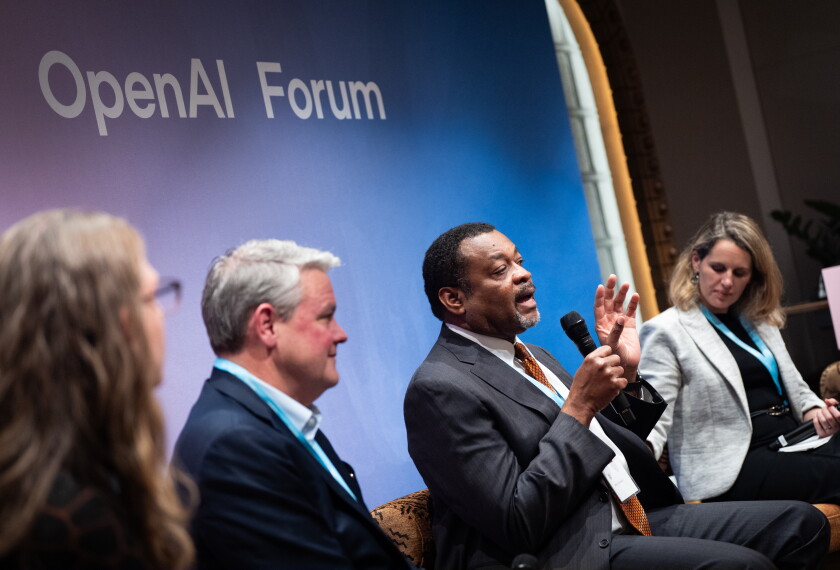
Washington, DC - October 5, 2026: Arthur C. Evans Jr., PhD, Chief Executive Officer of the American Psychological Association  speaks during the discussion. The OpenAI Forum hosted a panel on Responsible AI for Teens, how AI can support teens’ learning while promoting safe, healthy use. The program featured an OpenAI Forum panel with experts in learning, adolescent mental health, and family and online safety: Kate Ruane, Director of the Free Expression Project at the Center for Democracy & Technology, Chuck Melley, SVP of Policy, Advocacy and Communities at CodeAI, Arthur C. Evans Jr., PhD, Chief Executive Officer of the American Psychological Association and Mathilde Cerioli, Chief Scientist at everyoneAI. Chris Lehane, OpenAI’s Chief Global Affairs Officer, moderated the conversation and shared context on ChatGPT for Teens, a learning-first experience launched in August and designed to help teens think critically, deepen understanding, and use AI with confidence.
Arthur C. Evans, Jr., the CEO of the American Psychological Association, speaks on a panel at an Oct. 5, 2026, OpenAI forum on how to support responsible use of AI among teenagers.
Sarah Voisin for Education Week