Classroom Technology

Software That Monitors Students May Hurt Some It’s Meant to Help

By Alyson Klein — August 08, 2022 2 min read
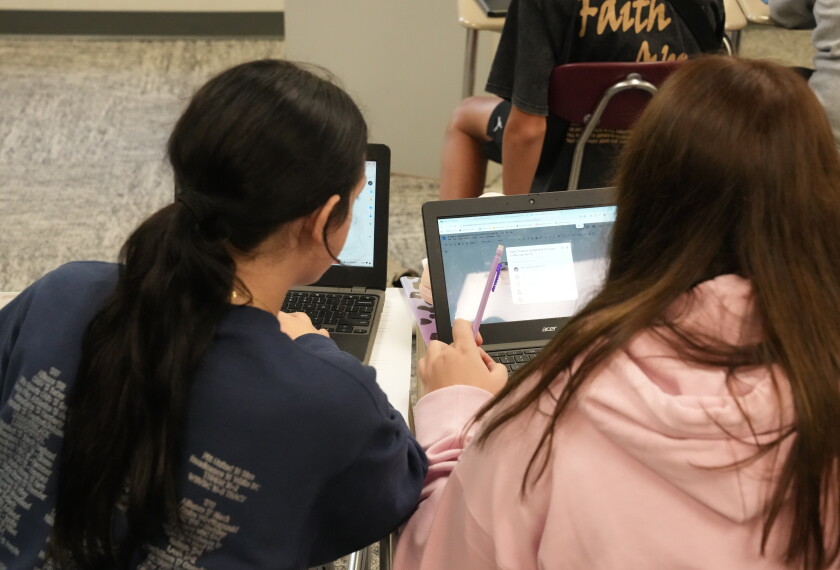
Students using computers.
  • Save to favorites
  • Print

Districts increasingly rely on monitoring software to keep students safe and on-task when they use school-issued digital devices, but the practice may do more harm than good, according to a report out this month by the Center for Democracy & Technology, a nonprofit that focuses on technology policy.

Monitoring programs can allow educators to keep an eye on students’ emails, messages, documents, and search queries, in part to scan for mental health problems or violent threats. The software can also pinpoint when students have logged into their device and for how long, and even give teachers a real-time glimpse at what’s on their students’ computer screens. Eighty-nine percent of teachers surveyed by the CDT say their districts use some sort of monitoring software, a 5 percent hike over last year.

But in addition to referring kids who may be troubled to counseling services, the software is often used for discipline purposes, the CDT found. In fact, 78 percent of teachers whose school uses monitoring software say it has helped identify students for disciplinary purposes. Just 54 percent of those teachers say the programs have been used to connect students to a counselor, therapist, or social worker for help.

Districts have also used the software to identify students as part of the LGBTQ community without their consent. Thirteen percent of all students at schools that use student activity monitoring say they or another student they know who is LGBTQ has been outed because of the software.

All of this is having a chilling effect on students’ online behavior, the survey found. About half of students said they agreed with the statement, “I do not share my true thoughts or ideas because I know what I do online may be monitored.” And about 80 percent said they were more careful about their searches because they know their school is keeping tabs on their online activities.

“We’ve found that nearly every school in the country is giving devices to students—and monitoring is hurting them,” said Alexandra Reeve Givens, the president and CEO of the CDT, in a statement. “When you combine the resurgence of violence in schools with the mental health crisis among kids, schools are surveilling students’ activities more than ever. But these efforts to make students safer more often result in disciplining students instead.”

What’s more, teachers often play a significant role in figuring out how to handle potential problems surfaced by the software, with 65 percent saying they are responsible for following up on the alerts it generates. Those alerts can flag everything from whether a student is off task, to whether they are at risk of hurting themselves or others. Despite that, just 31 percent of teachers say they have gotten guidance on how to use the monitoring systems securely.

In response to the findings, the CDT and other non-profit organizations sent a letter earlier this month to Catherine E. Lhamon, the assistant secretary for civil rights at the U.S. Department of Education urging her to “curb [the] harms” to student privacy and mental health as a result of the monitoring software through guidance and, if necessary, enforcement.

The report was informed by a survey of 1,606 6th- to 12th-grade parents and 1,008 6th- to 10th-grade teachers, as well as two surveys of 9th- to 12th-grade students conducted in late spring.

Events

This content is provided by our sponsor. It is not written by and does not necessarily reflect the views of Education Week's editorial staff.
Sponsor
Personalized Learning Webinar
Differentiation That Delivers: Proven Practices From High-Growth Districts
Make every minute count. Proven strategies from educators and leaders driving real student growth. Save your seat!
Content provided by i-Ready, Curriculum Associates
This content is provided by our sponsor. It is not written by and does not necessarily reflect the views of Education Week's editorial staff.
Sponsor
College & Workforce Readiness Webinar
From Exposure to Experience: Designing Accessible Work-Based Learning
Learn how schools can create meaningful experiences that help every student build skills, connections, and a clearer path to their future.
Content provided by Project Lead The Way
This content is provided by our sponsor. It is not written by and does not necessarily reflect the views of Education Week's editorial staff.
Sponsor
School & District Management Webinar
A Tale of Two School Districts: Forecasting Enrollment
Forecasting enrollment is hard. Here’s how two different districts are navigating times of change with data that considers the whole picture.
Content provided by Zonda Education

EdWeek Top School Jobs

Teacher Jobs
Search over ten thousand teaching jobs nationwide — elementary, middle, high school and more.
View Jobs
Principal Jobs
Find hundreds of jobs for principals, assistant principals, and other school leadership roles.
View Jobs
Administrator Jobs
Over a thousand district-level jobs: superintendents, directors, more.
View Jobs
Support Staff Jobs
Search thousands of jobs, from paraprofessionals to counselors and more.
View Jobs

Read Next

Classroom Technology 3 Ways to Build Elementary Students' Digital Literacy Skills
Teachers suggest age-appropriate ways to talk about computers, the internet, and artificial intelligence.
3 min read
A screen displays guidelines for using artificial intelligence above a portrait of Ernest Hemingway in Casey Cuny's English class at Valencia High School in Santa Clarita, Calif., Wednesday, Aug. 27, 2025.
A screen displays guidelines for using artificial intelligence in Casey Cuny's English class at Valencia High School in Santa Clarita, Calif., Wednesday, Aug. 27, 2025. Tip for educators teaching digital literacy to young learners.
Jae C. Hong/AP
Classroom Technology Are Teens Starting to Accept Cellphone Bans? A New Survey Has Answers
Researchers surveyed teens and adults on how well school cellphone policies were enforced over the course of a school year.
5 min read
Students use their cellphones as they leave for the day the Ramon C. Cortines School of Visual and Performing Arts High School in downtown Los Angeles, Aug. 13, 2024.
Students use their cellphones as they leave the Ramon C. Cortines School of Visual and Performing Arts High School in downtown Los Angeles on Aug. 13, 2024. A new set of surveys of teen attitudes toward school cellphone restrictions shows growing acceptance of the policies by those most directly affected.
Damian Dovarganes/AP
Classroom Technology Opinion The Big Flaw With Ed-Tech Tutoring Isn't Technological
Before focusing on the technology, we need to redesign the learning model, Michael Horn argues.
•
4 min read
The United States Capitol building as a bookcase filled with red, white, and blue policy books in a Washington DC landscape.
Luca D'Urbino for Education Week
Classroom Technology Q&A Students’ Tech Engagement Doesn’t Equal Learning, Psychologists Warn
A panel of psychologists shares recommendations for ensuring technology promotes meaningful learning.
6 min read
DSC03088
Students at a high school in Plymouth, Ohio work on how to properly prompt the Gemini AI app on Aug. 28, 2026. A new report of the American Psychological Association warns that student engagement with tech apps should not be conflated with benefits for learning.
Ruddy Roye for Education Week